


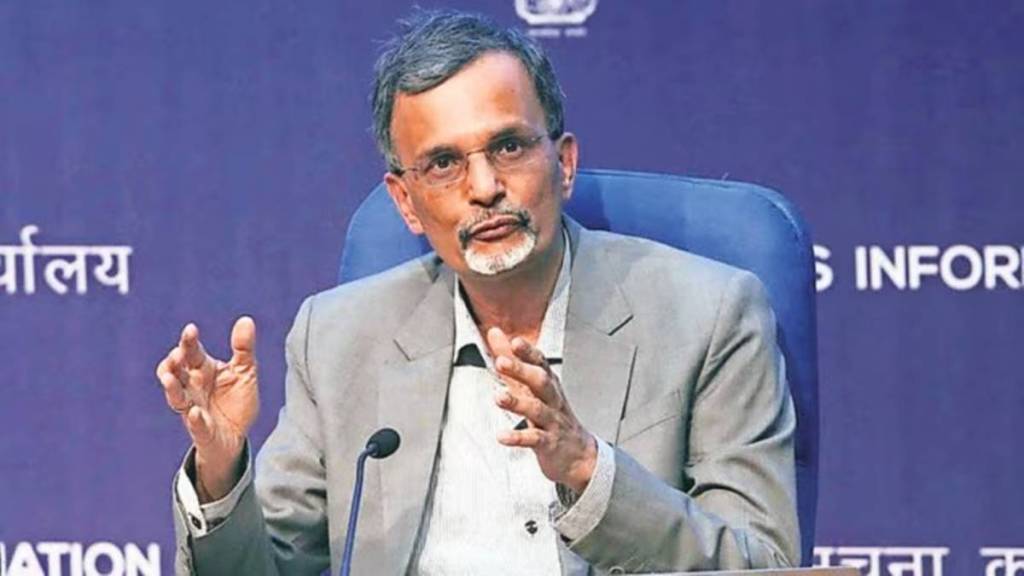

A quarter of India’s workforce is now employed in occupations exposed to artificial intelligence (AI), up from about a fifth in 2012, Chief Economic Adviser V Anantha Nageswaran said on Sunday.
He was delivering a special address at the launch of a white paper, AI, Automation and India’s Workforce, by the Great Lakes Centre for Finance & Economic Research, Chennai. The report was authored by Vidya Mahambare, Vivek Jadhav and Vishnu Venugopalan.
Citing from the report, Nageswaran said that in urban India, the share of jobs exposed to AI is close to half. “Exposure is not the same as job loss. In some jobs, of course, AI is likely to raise what a worker can do,” he said, adding that 46 million Indians, including doctors, teachers, engineers and managers, are in occupations where AI complements their work for the first time.
According to the report, the share of workers in highly routine jobs rose from under 28% in 2012 to over 32% in 2025, impacting nearly 200 million people. Many of these jobs, including machine operation, garment and food processing, cleaning and construction labour, are also susceptible to conventional automation.
“Whatever happens happens with AI, regardless of AI. Part of this rise reflects a welcome movement out of low-productivity farm work, which is good,” Nageswaran said.
However, he cautioned that the shift also meant that many workers had moved into occupations involving tasks that machines could most easily learn to perform. “Our relative wages still protects these jobs, but they may not protect them forever,” he said, stressing the need to build the capacity to retrain workers before the disruption begins to show up in employment statistics.
The risk is particularly high among entry-level workers, with 39.4% of those under 25 employed in high-routine jobs, the highest share among all age groups. Nageswaran said that, for India, a large part of the answer lay in extending the reach of scarce expertise, including in natural medicine, frontline healthcare, and among self-employed workers such as small contractors, electricians, and kirana shop owners.
He also added that the challenge of AI is greater on new recruits compared to experienced engineers, who can derive considerable value from AI because of their experience and judgement to check its output. “With AI agents able to perform routine tasks cheaply, training a junior employee increasingly becomes a cost for the firm.”
Nageswaran said the exposure to how experienced employees work, allocate responsibilities, and manage their time is an important part of the learning process. “If junior employees are denied these opportunities, they may never develop the capabilities required to become senior professionals, he said, warning of a vicious cycle created by AI adoption.”
Nageswaran also cautioned that countries would face growing competition for natural resources in the coming decades, including for energy, base metals, rare earth, and critical minerals. “If we treat workers as a cost to be cut, we waste that one resource which we hold in abundance. If we train them well, it becomes a source of strength that others will see.”