


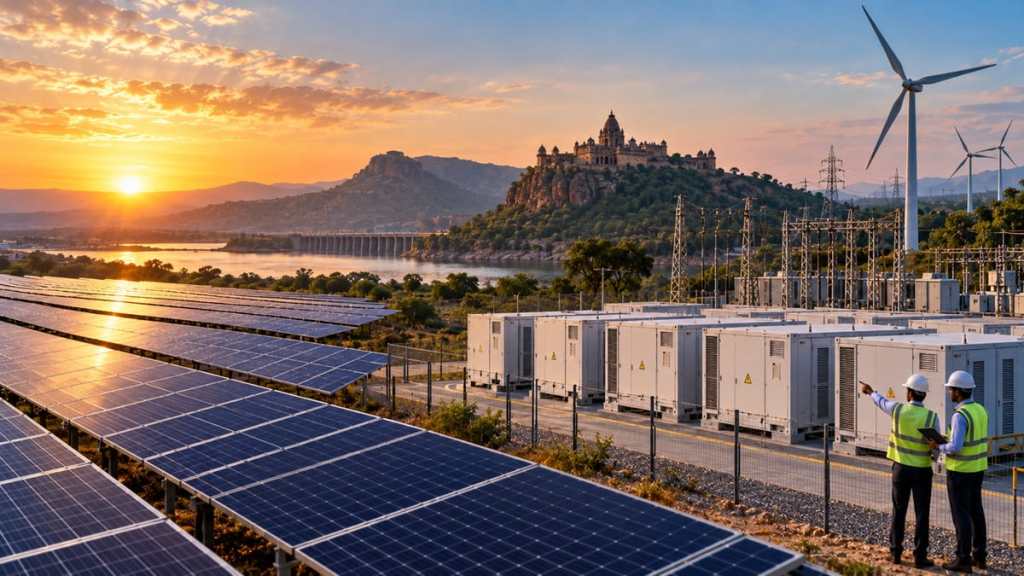

India is on track to achieve 500 GW of non-fossil-fuel-based power generation capacity by 2030 — with solar leading the renewables charge. The country has approximately 170 GW of installed capacity following a record year of deployments. But the world’s second-largest solar market now faces a looming complication in the form of solar waste.
According to a 2024 study, India could see solar waste reaching a staggering 600 kilotons by 2030. The quantity is equivalent to filling up 720 Olympic-size swimming pools — with around 67% of this waste coming from five states. Multiple industry assessments put the average expected operational lifespan of solar infrastructure at a maximum of 35 years. The figure can vary widely with data from the U.S. Department of Energy’s NREL fleet performance recording a median degradation rate of 0.5% to 0.7% per year. At the same time, studies highlight a stark improvement over time due to technological progression.
The rate is much higher for India — with IIT Bombay researchers finding in 2018 that photovoltaic modules degraded faster in hot places, on rooftops, and in installations of smaller size. Researchers found that a hot climate could cause yellowing and failure in solder joints and improper handling of modules may cause microcracks in solar cells.
Solar waste in India projected to hit 600 kt by 2030: Study
A government-led study predicted in 2024 that India would see solar waste reach 600 kilotons by 2030 — the same deadline set by the government to achieve 500 GW of renewable energy capacity. Independent think tank Council on Energy, Environment and Water added that installed capacity of 66.7 GW (as of FY23) had already generated about 100 kilotons of waste. This figure was projected to reach 340 kilotons by 2030, while the remaining 260 kilotons of waste would likely come from new capacity deployed between 2024 and 2030.
It is pertinent to note that the study — titled ‘Single Court Open, Enabling a Circular Economy in India’s Solar Industry: Assessing the Solar Waste Quantum’ — was published in March 2024. According to PIB data, the country added 37 GW of solar capacity in 2025 and crossed 170 GW by the end of September 2026.
“Most of this waste will come from five states: Rajasthan, Gujarat, Karnataka, Andhra Pradesh, and Tamil Nadu. Rajasthan is expected to account for 24%, followed by Gujarat at 16% and Karnataka accounting for 12% of the waste generated by 2030,” the CEEW report added.
According to the report India will generate around 600 kt of cumulative waste by 2030 from existing and new capacities. This volume will increase 32x by 2050 and result in about 19,000 kt of cumulative waste. It predicted that India would need about 292 GW of installed solar capacity by 2030, 1,700 GW of solar capacity by 2050, and 5,600 GW by 2070 to achieve its net zero target. The report accounted for a design life of 25 years — while noting that some witness an early end of life due to factors such as damage during transportation, module handling, and project operations.
Shorter lifespan and geographical issues
Researchers from IIT Bombay found in 2018 that locations that enjoy good sunlight for many days of the year were ideal for setting up solar plants. But at the same time installations in hot and dry locations showed a larger number of solder joint failures and yellowing of encapsulant materials. Another issue was that rooftop installations appeared to degrade faster than those in larger power plants.
“Ideally locations with a cold climate and a lot of sunlight are best suited for installation of solar modules. In India this happens only in Ladakh, where we do not have connectivity to the rest of the Indian grid, with not-good local connectivity,” Professor Juzer Vasi of IIT Bombay had noted.
This has left India with a significant concentration of solar installations in locations such as Rajasthan, Gujarat, Madhya Pradesh, and Andhra Pradesh. According to data released by the Ministry of New and Renewable Energy at the end of August 2026, Rajasthan leads the list with total solar capacity of 44,370.37 MW. Gujarat follows with 34,879.88 MW while Tamil Nadu stands third at 14,353.58 MW. Karnataka, Andhra Pradesh, Madhya Pradesh and Uttar Pradesh round out the top seven.
How much of India’s silicon and silver demand can solar waste recycling meet?
A separate report published by CEEW in November 2025 estimates that India will generate approximately 11,021 kilotons of cumulative solar PV module waste by 2047. But the high volumes of waste also pose a significant recycling opportunity to address the growing demand for silicon and other key materials. The study showed that recycling solar module waste can address approximately 60% of the demand for silicon, 50% for aluminum, 44% for copper, 40% for glass, 38% for silver, 15% for tellurium, and 13% for cadmium by 2047. This can significantly reduce dependence on material imports and support domestic production of raw materials required for solar PV manufacturing.
The CEEW reported that recycling of solar modules presently cost between ₹883 and ₹1,079 each — approximately Rs. 4.11 to Rs. 5.02 per watt. But mechanical recycling in a formal setup remains financially unviable with a loss of about Rs 10,230 per ton. The report cited high procurement cost of base solar modules, the loss of valuable materials such as silver, and the inability to recover high-purity silicon as key reasons. The recurring cost of chemical recycling (involving the recovery of high-grade materials) is even higher at Rs 49,607 per ton. The current procurement cost of approximately Rs. 600 per panel is the heaviest operational expenditure.
The E-waste (Management) Rules of 2022 exempt solar photovoltaic components from the standard numeric EPR recycling targets. The rules mandate storage until 2034-2035, giving manufacturers time to develop collection systems.
“If EPR certificate trading is extended to solar waste, mechanical recycling and chemical recycling could yield a net financial benefit of ₹11,770 per ton (₹259 per module) and ₹9,659 per ton (₹213 per module), respectively, at 30% of the environment compensation as per the e-waste management rules,” CEEW estimated last year.
Rs. 3,700 crore recovery market
According to an analysis by U.S.-based Incwood Research, the solar panel recycling market reached $16.5 million in 2026, with projected growth to $77.98 million by 2034. This represents a compound annual growth rate of 21.43% during the forecast period — the highest among major markets globally.
CEEW added that 656 kt of materials can be recovered from solar waste in 2047. This is projected to create a market opportunity of ₹3,709 crore and includes critical minerals such as silicon, copper, cadmium, and tellurium. The think tank added that solar module recycling could meet 38% of the overall material demand (with silicon being the highest at 60%) from 2026 to 2047. It added that reduced reliance on new materials could help India avoid 37 million tons of CO2 emissions by 2047.
Need for 3,600-ton processing capacity
“To manage this waste India will require 299 solar PV recycling facilities by 2047, each with a processing capacity of 3,600 tons per annum. Of these 270 facilities will be needed to manage waste from C-Si modules and the remaining 29 facilities will be needed to manage thin film module waste. To meet this infrastructure requirement India will require an estimated capital investment of ₹4,274 crore,” the report added.
Union Minister Shripat Nayak told Parliament in August that the government had already taken several measures to promote manufacturing, recycling, and circular economy practices for end-of-life solar panels. He cited the CEEW report to reiterate the need for an annual processing capacity of 3,600 tons by 2047 for the environmentally sound management of end-of-life solar PV waste.
The government has constituted committees to prepare relevant action plans and also launched an innovation challenge to support research. The Ministry of Mines has also launched a recycling incentive scheme with an outlay of ₹1,500 crore under the National Critical Mineral Mission to develop domestic capabilities for recovering critical minerals from e-waste, lithium-ion battery waste, and components of end-of-life vehicles.
The Union Minister of State, however, added that no specific locations have been identified for the establishment of recycling facilities for solar panels and related renewable energy equipment at this time.