


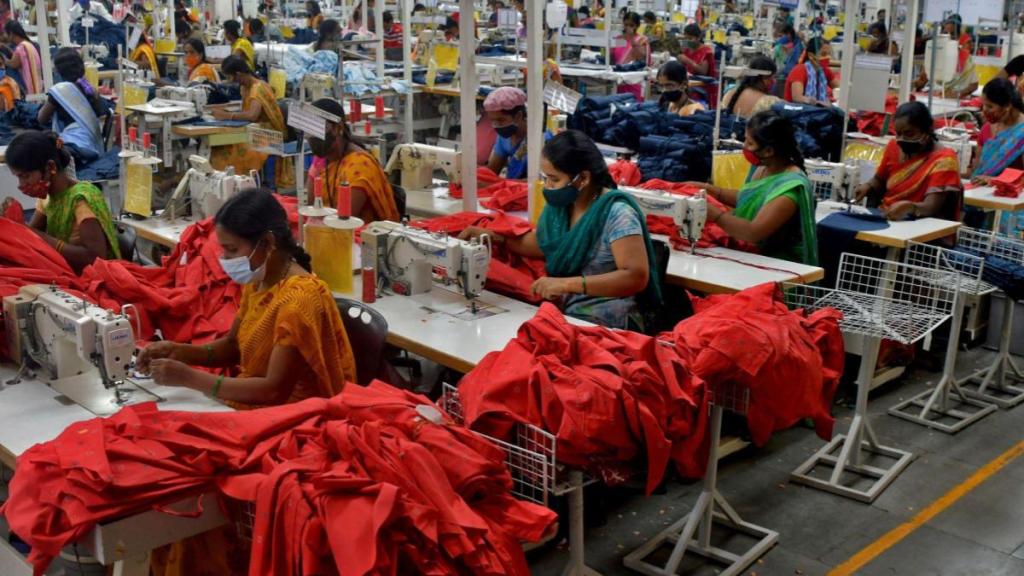

As US President Donald Trump’s tariff threats rattled global trade over the past year, Indian textile and apparel exporters found a cushion in a strategy they had spent years building: a wider spread of markets. By reducing dependence on the US, their single largest market, exporters are seeking not just to weather the uncertainty but also to sustain growth in the $38-billion industry.
Take Pearl Global Industries, one of India’s largest listed garment exporters. The maker of apparel for brands such as GAP and Zara reported record revenue of ₹1,528 crore in the first quarter, alongside its highest-ever shipments of 20.8 million pieces, as it expanded its presence beyond the US.
“We derisk the geographic exposure by lowering dependence on any single market. Revenue flows are being balanced across regions,” said Pallab Banerjee, managing director of Pearl Global. The US accounted for 85% of the company’s $200-million revenue in FY22. By FY26, revenue had grown to $550 million, while the US share went below 50%. The company has expanded its presence in Canada, Japan and the European Union, as well as the UK and Australia.
Similarly, home textile major Welspun Living drew 41% of its ₹9,399-crore revenue from non-US markets, including Europe, the UK and the Gulf Cooperation Council. Indo Count Industries, which typically has 70% of its export business in the US, adjusted its product mix and entered into tariff-sharing arrangements with customers to protect volumes and market share. However, tariff volatility weighed on profitability, contributing to an almost 100-basis-point contraction in EBITDA margins.
The push to diversify has gained urgency as US tariffs on Indian goods swung between 10%, 25% and 50% over the past year, complicating sourcing decisions for American buyers. The impact was visible in export performance. Shipments declined to $35.7 billion in FY26 from $36.6 billion in the previous fiscal year. Exports subsequently grew a marginal 2% year-on-year to $18.16 billion in April-September 2026.
“For a sector dominated by MSMEs and operating on razor-thin margins, this performance demonstrated remarkable resilience. Despite the challenges, Indian exporters largely held their ground in the US markets,” said Chandrima Chatterjee, secretary general of the Confederation of Indian Textile Industry (CITI).
But the damage has still been done. Ashish Gujarati, president of the Pandesara Weavers’ Association, pointed out that suppliers and buyers shared the tariff burden when the levies were at their peak. Industry sources in Surat said textile export order volumes from the city to the US, a major destination for clothing items made of man-made fibres (MMF), plunged by 50% between August 2025 and February 2026, as the tariffs created barriers to business.
Karan Mittal, director of Kottex Industries, which exports linen fabric to the US and Latin American markets, said shipments to the US fell by 60-70% during the peak tariff period. The company plans to expand exports to Latin American countries to offset the decline.
However, Prabhu D, convenor of the Indian Texpreneurs Federation (ITF), said diversification had yet to translate into a decisive shift away from the US market. “We need a more focused strategy to penetrate markets such as Japan and Russia, while exploring substantial untapped opportunities within many EU countries.” Prabhu said. MMF apparel, according to him, offers scope for growth as India still accounts for just 2% of the $3.5-billion US market here.
Market access remains a key challenge. India has historically faced a tariff disadvantage in the UK, where its exports attracted duties of 10-12%, while competitors such as Bangladesh, Cambodia and Vietnam enjoyed duty-free access. The India-UK free trade agreement, signed last year, is expected to improve market access and reduce trade barriers.
Exporters nevertheless remain cautious about how quickly new markets can compensate for lost US orders. “It takes six months to a year to build a new buyer relationship in new markets. Also, a single US order can be for half a million pieces — other markets cannot match that scale,” said Siva Subramaniam, founder and chairman of Tiruppur-based innerwear exporter Raft Garments. The company’s US orders for the Christmas season were 25-30% lower than a year earlier amid renewed uncertainty over 100% tariffs
Last month, Trump signed an executive order imposing 100% tariffs under the Lindsey O. Graham Sanctioning Russia and Iran Act on countries importing Russian oil and gas. The tariffs were waived on national-interest grounds last week. Subramaniam said orders could pick up in the coming weeks once US buyers assessed the implications of the latest policy changes.
Further trade action is another concern. CITI’s Chatterjee flagged the US’s 10% tariff on Indian goods over alleged forced-labour concerns, following Section 301 investigations. With no expiry date, the tariff also poses reputational risks. While rivals face similar rates, exemptions allowing some countries’ textile and apparel exports to enter the US without Section 301 tariffs could divert orders from India, she said.
Exporters see opportunities in the second half of FY27 and beyond, supported by a possible India-US trade deal, an early resolution to the conflict in West Asia and improved market access through free trade agreements, particularly the proposed pact with the European Union. “We are quite optimistic about the second half of FY27. Inquiries and buyer engagement from the UK are increasing, while easing Russia-related tariff concerns could trigger renewed US inquiries and help recover earlier export volumes,” Prabhu said.