


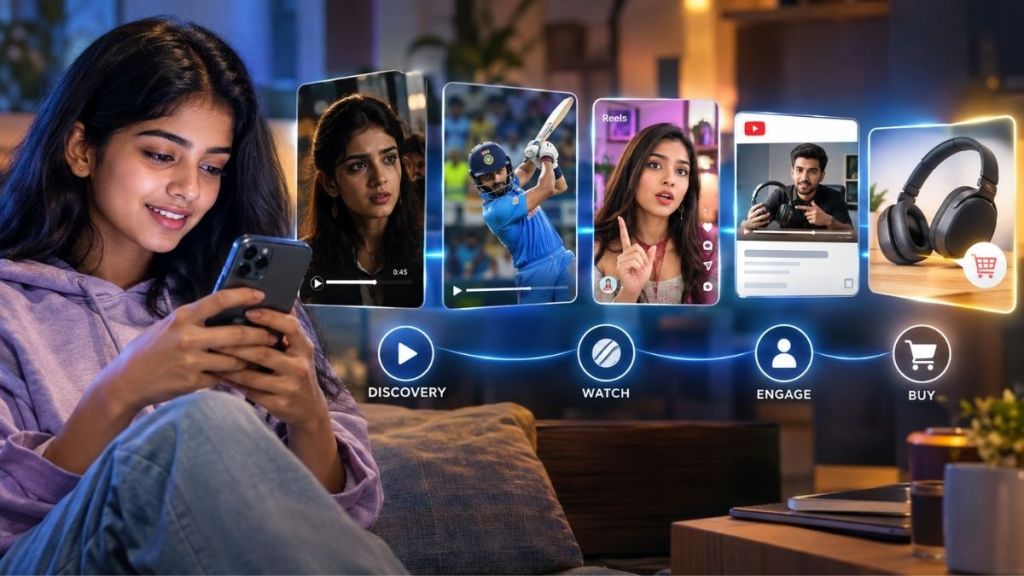

It starts with a 45-second revenge drama. Then come cricket highlights, then an Instagram Reel that tips off a new series, and finally a YouTube video about a gadget worth buying. For a young Indian, that’s an ordinary evening of scrolling. For the companies behind those screens, it’s a single commercial journey, and every stop on it is up for grabs.
The prize is enormous. India’s Gen Z cohort accounts for more than 40% of the country’s total consumption spend. So entertainment and technology companies are redesigning products and content with one goal: to walk this audience from discovery to fandom to purchase, without losing them to a rival along the way.
JioStar is building for this movement across screens. “We don’t create for a screen, we’re creating for a consumer,” a company spokesperson told FE.
The numbers suggest it’s working. The company says TADKA, the vertical-video product it launched within JioHotstar earlier this year, crossed 100 million users within two months. More than 42% of its viewers were under 24, and daily watch time per viewer rose fivefold. Its MaxView vertical cricket experience reached close to 70 million IPL viewers.
Yet JioStar rejects the popular idea that Gen Z can’t focus. “If a story earns their interest, they will stay with it,” the spokesperson said. TADKA is meant to be a doorway into long-form programming, not a replacement for it.
Sony Pictures Networks India (SPNI) agrees, warning against treating Gen Z as one uniform audience. Young viewers will happily spend hours with a series, film or match if it holds them. “The length must come from the idea, not the other way around,” its spokesperson said, a principle that matters more now that microdramas are emerging as a significant category.
Primetime, pocket-sized
Microdramas are where the behaviour gets striking. Users of Story TV, Eloelo Group’s microdrama platform, spend more than 95 minutes a day on the service, with peaks in the morning, early evening and late night. GSN Aditya, COO of Eloelo Group, calls it “real primetime behaviour, just on a mobile screen.”
Story TV has more than 2,000 original titles and adds more than five a day across Hindi, Tamil, Telugu, Kannada and Malayalam. It is targeting more than 1,000 South Indian originals by March 2027, and more than 1,000 AI-powered shows this fiscal.
The sharper innovation lies in how shows get made. Its Prism AI engine studies completion and drop-off patterns to predict where a story might lose viewers, before a single scene is shot. Aditya says conversion has improved 400% since Prism was integrated.
Kuku TV runs on a similar playbook. Sachin Singh, head of Kuku TV, said its proprietary AI Storytelling Stack draws on billions of consumption signals to guide concept selection, creative development and recommendations. “Every new show generates more consumption data, which informs what we create and recommend next,” Singh said.
Kuku casts a wider net than Gen Z, targeting the 18–34 bracket, and pitches microdramas as content for the “micro-moments” of the day: commutes, breaks and other short windows. It is expanding into Tamil, Telugu, Malayalam and Kannada, and experimenting with sports, horror, mythology, reality and biographical drama.
Big platforms bet on breadth
The larger OTT players are using short-form as bait and long-form as the hook for retention and monetisation.
Gen Z “is not looking for one kind of entertainment,” said Tejkarran Singh Bajaj, Business Head, Zee5 India and AI & Innovation. This audience moves freely across languages, genres, formats and screens, so Zee5 is expanding originals across seven languages, sports and international content, and using AI and personalisation to speed up discovery.
Prime Video sees the same restlessness. Gen Z “doesn’t watch within boundaries,” said Nikhil Madhok, Director and Head of Originals, Prime Video (SVOD) and Amazon MGM Studios India. These viewers hop between languages, genres and geographies, and find shows through social chatter and word of mouth. Hence a slate that runs from Indian titles such as Call Me Bae and The Traitors to Korean dramas, anime and global franchises. Access is just as varied: Prime Video subscriptions, rentals, add-on subscriptions, and free, ad-supported content on Amazon MX Player.
That flexibility points to an uncomfortable truth for the industry: there may be no single Gen Z business model. The same person can be a free viewer on one app, a paying subscriber on another and a creator-influenced shopper somewhere else. SPNI puts it bluntly. Gen Z will pay, but not by default. “Every platform has to keep earning its place on their phone or television,” its spokesperson said.
Scroll to checkout
Tech giants are pushing further down the funnel, toward the cash register. Google says 79% of Gen Z consumers in India use Google and/or YouTube daily, and YouTube’s shopping affiliate programme lets eligible creators tag products and earn commissions.
Meta has gone a step further and started making entertainment itself. Instagram launched Party of Two, a seven-episode microdrama series and its first in India, built around Gen Z and Reels.
The next frontier lies beyond the metros. JioStar says regional and cultural relevance matters increasingly to young viewers in Tier 2 and Tier 3 cities, while Kuku TV and Story TV are expanding aggressively in Indian languages.
Put together, a new entertainment funnel is taking shape. A short video acquires the user. A creator deepens discovery. A full-length show builds the habit. Commerce monetises the relationship.
So the real contest is not OTT versus social media, or short-form versus long-form. It’s for the consumer relationship that sits beneath all of them.
As JioStar puts it, “attention is rented, fandom is earned.” The harder task, for every company chasing India’s Gen Z, is turning that fandom into a business that pays every month.
Tomorrow: Lenders