


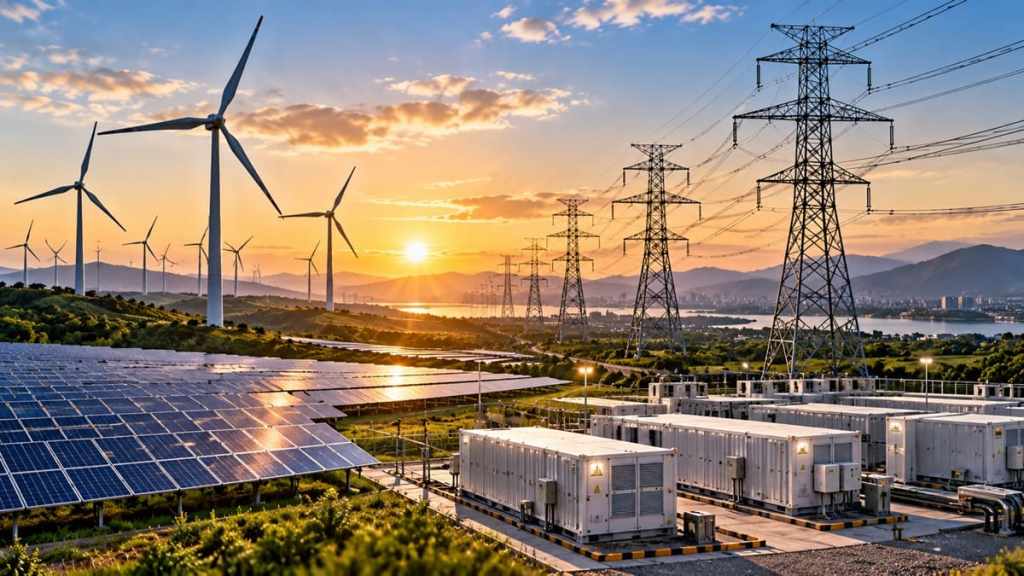

India’s renewable-energy capacity is expanding faster than the power network needed to carry and use the electricity, leaving around Rs 84,000 crore of investment dependent on temporary grid access and potentially costing solar developers about Rs 8,000 crore a year in lost revenue.
The concern is no longer simply whether India can build enough renewable capacity, but whether electricity from new solar and wind projects can reach consumers once the projects are ready.
“Capacity is being built faster than the system can absorb, connect, or consume it, and the cost of that mismatch is now large enough to measure in tens of thousands of crores a year,” according to the white paper “Firming the Transition,” authored by Sushil Jiwarajka, Chairman, Essjay Group, and Amitabh Prasad, Founder, A4P4 Ventures.
India crossed 50% non-fossil installed capacity in June 2025, five years ahead of its Paris commitment. Total installed power capacity stood at around 533 GW at the end of March 2026, including 283.46 GW of non-fossil capacity. The paper, however, argues that the next challenge is making sure this capacity can actually deliver electricity.
Between April and June 2026, around 8,133 GWh of solar power could not be used because transmission infrastructure was delayed. At an indicative realised tariff of Rs 2.50 per unit, the paper estimates developers lost around Rs 2,033 crore in revenue in just those 90 days.
If electricity continues to be lost at the same rate, the annual revenue foregone could be around Rs 8,000 crore, even before accounting for financing costs and the possibility that developers may build the risk of such losses into future tariffs.
Simply put, solar projects were capable of generating electricity, but part of the power could not be moved from the plants to consumers because the required transmission network was not ready.
The scale of the connectivity problem is also reflected in existing projects. Around 21 GW, or close to 9% of installed renewable capacity, is operating with only temporary permission to use the transmission network rather than firm grid access.
At an indicative project cost of Rs 4 crore per MW, the paper estimates this amounts to around Rs 84,000 crore of deployed investment sitting on temporary grid connectivity.
Rajasthan illustrates the mismatch. The state has around 23 GW of commissioned renewable capacity but only 18.9 GW of capacity to carry that electricity, leaving more than 4,000 MW unable to be fully moved during peak solar hours.
One reason for the problem is the difference in construction timelines. Solar and wind projects can typically be completed in 12-18 months, while transmission lines required to carry their electricity can take 36-60 months. Around one in four transmission projects is delayed, the paper said.
“Every failure documented in this paper is a variant of a single mistake: the commercial signal was strengthened ahead of the physical enablement,” the authors said. The paper points to renewable projects being tendered before transmission lines were sanctioned, capacity targets being set before land was available and round-the-clock renewable supply requirements being introduced before sufficient storage systems were in place.
The white paper proposes six steps that can be taken within 12 months without a new law. These include ensuring transmission arrangements are identified before renewable projects are auctioned, compensating developers when electricity cannot be supplied because of transmission constraints, publishing information on where the grid has room for new projects and creating a common contract for renewable power that can be supplied more reliably.
It also recommends locating large electricity users such as data centres and green-hydrogen plants closer to renewable-energy centres, so that more electricity can be consumed where it is generated. Four of the six proposed measures involve no direct fiscal cost, the paper said.