


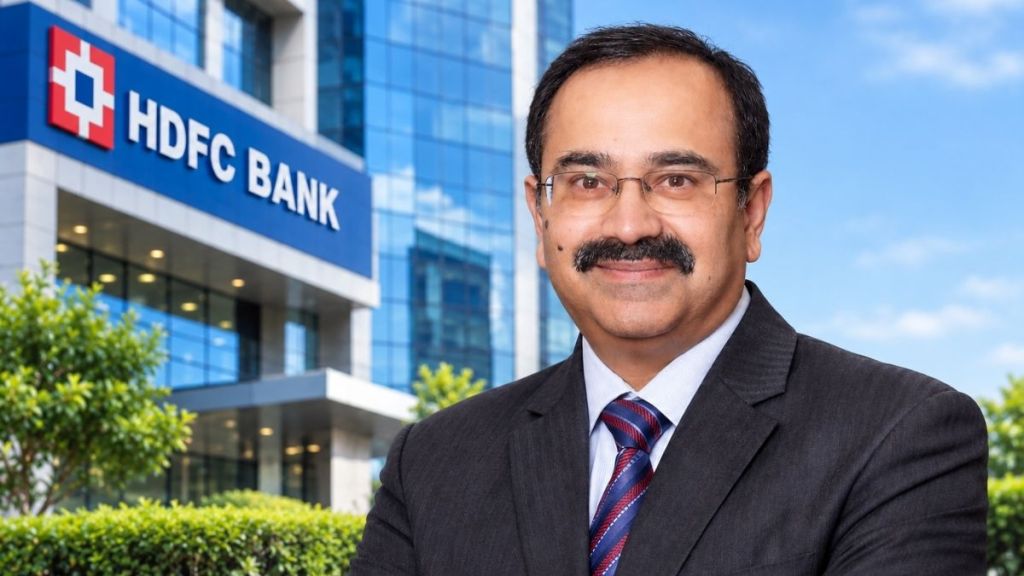

Anup Bagchi has worked in almost every major segment of financial services over a career spanning more than three decades: retail and corporate banking, treasury, capital markets, technology, wealth management and, most recently, life insurance. That breadth of experience will now be tested at HDFC Bank, where he takes charge amid one of the most consequential leadership transitions in the lender’s history.
The 55-year-old Bagchi will also be the first outsider to helm HDFC Bank. Aditya Puri was its founding chief executive, while his successor Sashidhar Jagdishan spent decades at the bank before taking over the top job in October 2020. Bagchi, by contrast, is an ICICI veteran — an engineer-turned-banker who spent most of his career building businesses for the institution HDFC Bank regarded as its biggest private-sector rival.
He succeeds Jagdishan, whose second term as managing director and chief executive ends on October 26. Jagdishan decided not to seek another term.
After graduating in chemical engineering from IIT Kanpur, Bagchi joined ICICI in 1992 and subsequently obtained a management degree from IIM Bangalore. Over the years, he worked across retail banking, corporate and investment banking, treasury and markets.
Technology has been a recurring thread through his career. Bagchi was closely associated with the development of ICICI Bank’s internet banking platform and ICICIdirect, the group’s online broking platform. He also helped build the bank’s retail liabilities and third-party product distribution businesses.
His first substantial CEO assignment came at ICICI Securities. Appointed managing director and CEO in May 2011, Bagchi oversaw retail and institutional broking, wealth management, financial-product distribution and corporate finance. The role gave him exposure to capital markets at a time when technology was rapidly changing how retail investors accessed financial products.
He returned to ICICI Bank in a larger role in 2016, initially heading retail banking, and joined its board as executive director in February 2017. His responsibilities subsequently spanned retail and wholesale banking, transaction banking, markets and proprietary trading. His career has also covered MSME banking, credit policy, payment and settlement systems and data analytics.
In 2023, Bagchi moved to ICICI Prudential Life Insurance, becoming executive director and chief operating officer in May before taking over as managing director and CEO on June 19. The move took him out of mainstream banking for a little over three years — an issue the RBI reportedly examined while considering his candidature for HDFC Bank. According to reports, the central bank sought feedback from the insurance regulator as well as ICICI Bank CEO Sandeep Bakhshi.
Bagchi’s regulatory exposure extends beyond the institutions he has managed. He has served on committees associated with the RBI and Sebi, including the RBI’s expert committee on MSMEs and Sebi committees dealing with financial and regulatory technology, market conduct and risk management. He has also been associated with committees of NSDL and BSE and co-chaired FICCI’s capital markets committee.
At HDFC Bank, however, the scale and complexity of the assignment will be considerably greater.
The lender is still working through the consequences of its July 2023 merger with parent HDFC Ltd. The enlarged balance sheet has required it to rebuild deposits, improve its liability mix and restore margins while sustaining credit growth. The change at the top also comes after a period in which governance and succession have received heightened attention.
Bagchi inherits India’s largest private-sector bank at an important inflection point. Among the immediate tasks on his plate will be accelerating deposit growth, improving CASA and margins, extracting greater benefits from the HDFC merger and restoring the growth premium historically associated with the franchise.
There is also an intriguing competitive dimension to his appointment. Bagchi comes from the ICICI stable at a time when ICICI Bank has emerged as an increasingly formidable competitor to HDFC Bank, particularly on profitability and return ratios. That divergence was evident in the June-quarter results. HDFC Bank reported a net profit of Rs 19,060 crore, up 5% year-on-year, against ICICI Bank’s Rs 14,804.5 crore, which represented a sharper 15.9% increase.
ICICI Bank also reported stronger return ratios, with return on assets (RoA) at 2.5% and return on equity (RoE) at around 17%, compared with HDFC Bank’s RoA of about 1.9% and RoE of around 14%.
The stock market has taken note. Over the past six months, ICICI Bank’s share is up 7.67% in the past six months, HDFC Bank is down 3.07%.
With this appointment, HDFC Bank is effectively entrusting its next phase to a banker steeped in the culture, technology and operating model of its biggest rival.
For Bagchi, who began his career at ICICI in 1992, the move represents his first major professional break from the group in more than three decades.
It could also prove the most consequential one.