



Big businesses do not always begin with big investments. Sometimes, all it takes is a small opportunity and the determination to make something of it. For Satyanarayan Nuwal, that opportunity came in the form of an explosives storage facility rented for Rs 1,000 a month in 1979. Five decades on, the venture has grown into Solar Industries India, a multinational enterprise with manufacturing facilities across 10 countries, products reaching more than 90 nations and a workforce exceeding 15,000.
The first-generation entrepreneur has travelled a remarkable distance. With an expanding defence portfolio and a growing international presence, Nuwal’s challenge is now to manage a business substantially larger and more complex than the one he founded. Sustaining growth will require continued investment in technology, timely execution of defence orders and the successful integration of overseas operations.
His earliest lessons in business came from helping his grandfather run a small grocery shop, where he learnt the importance of treating customers with respect. And what distinguishes Nuwal’s journey is the way he has reinvented his enterprise over and over again. He began as a trader, became a manufacturer and subsequently ventured into defence, developing products that were traditionally imported. The latest phase of his company’s expansion, including its proposed acquisition of South Africa’s Omnia Holdings, reflects an ambition to build an even larger international enterprise.
Born in Bhilwara, Rajasthan, in 1952, Nuwal completed his matriculation in 1967 and spent a year at the Vedamata Gayatri Ashram in Mathura. His early entrepreneurial ambitions met with disappointment when his first business venture failed to take off. Married at 19 and facing financial difficulties, he moved to Maharashtra in search of a livelihood. There were times when he could not afford accommodation and spent nights on railway platforms.
His fortunes turned following a chance encounter with an explosives dealer, Sattar Bhai, in Chandrapur. Nuwal secured an explosives storage facility and in five years later, Imperial Chemical Industries (ICI), then a major global explosives manufacturer, appointed him a consignment agent. He went on to become one of India’s largest explosives dealers.
Trading, however, was only the first step. Nuwal recognised that manufacturing offered greater opportunities for expansion. In 1995, he established Solar Industries’ first explosives manufacturing unit in Nagpur, supported, reportedly, by a Rs 60-lakh bank loan. The company went public in 2006, when it had a turnover of Rs 78 crore and a net profit of around Rs 11 crore. The listing helped fund its manufacturing expansion, laying the groundwork for a much larger enterprise.
Over the next three decades, Solar expanded its footprint across international markets, emerging as India’s largest manufacturer and exporter of industrial explosives. Yet Nuwal was already looking beyond the business that had established his fortunes.
The next major turning point came in 2010, when Nuwal steered Solar Industries into defence manufacturing. Building on its expertise in explosives and energetic materials, the company began developing indigenous capabilities in an industry where India had long depended on imports.
A significant achievement was the establishment of an HMX manufacturing facility in Nagpur, creating domestic capacity for a critical high-energy material used in military applications. Solar Industries subsequently expanded into rockets, warheads, artillery ammunition and loitering munitions. Its defence portfolio now includes Pinaka rockets and Nagastra loitering munitions, while investments in unmanned aerial systems have added another dimension to the business.
The transformation is increasingly evident in the company’s financial performance. Its consolidated revenue rose 30.5% to Rs 9,838 crore in FY26, while net profit increased 34.8% to Rs 1,737 crore. Defence contributed around 27% of revenue, compared with just 9% two years earlier. Its defence order book stood at Rs 17,794 crore at the end of March 2026.
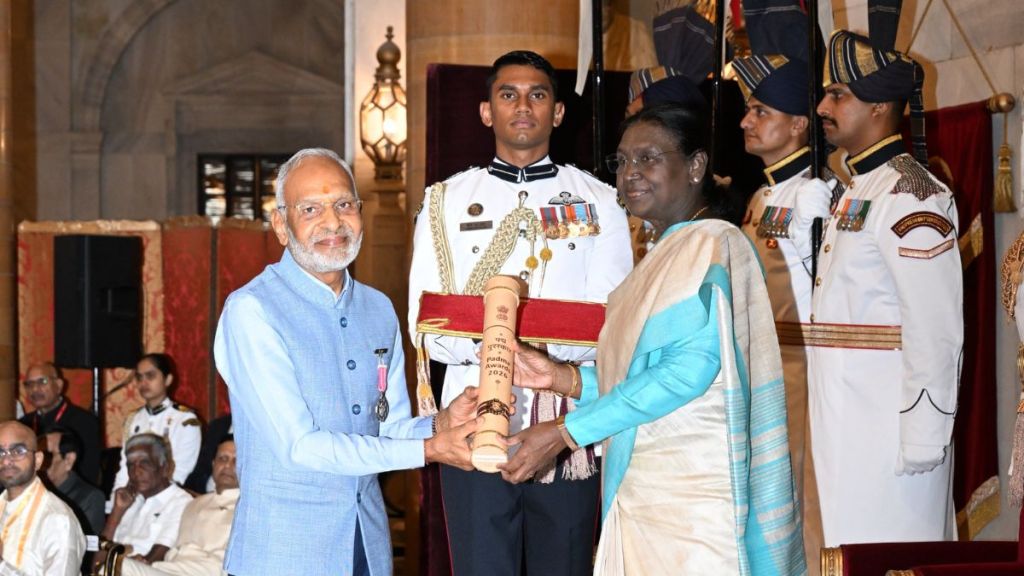
The expansion has brought recognition beyond the world of business. Nuwal, who features on Forbes’ billionaire list, received the Padma Shri in 2026 for his contribution to trade and industry. His interests also extend to education and healthcare. He serves as chairman of Ramdeobaba University and Madhav Netralaya in Nagpur, besides being involved in social initiatives.
Notwithstanding his considerable business success, he described himself as “an ordinary man” in a 2026 interview to The Hitavada, underscoring the simplicity that characterises his approach to leadership.
For the entrepreneur who entered the explosives trade with a rented storage facility, the scale of the enterprise has changed beyond recognition. The progression from trading to manufacturing, and from industrial products to advanced defence systems, illustrates how each stage of Solar Industries’ growth has created opportunities for the next.
Nearly five decades after his first venture, Nuwal is no longer merely building a business. He is building a global manufacturing enterprise, with his biggest ambitions extending beyond the geography where it all began.