


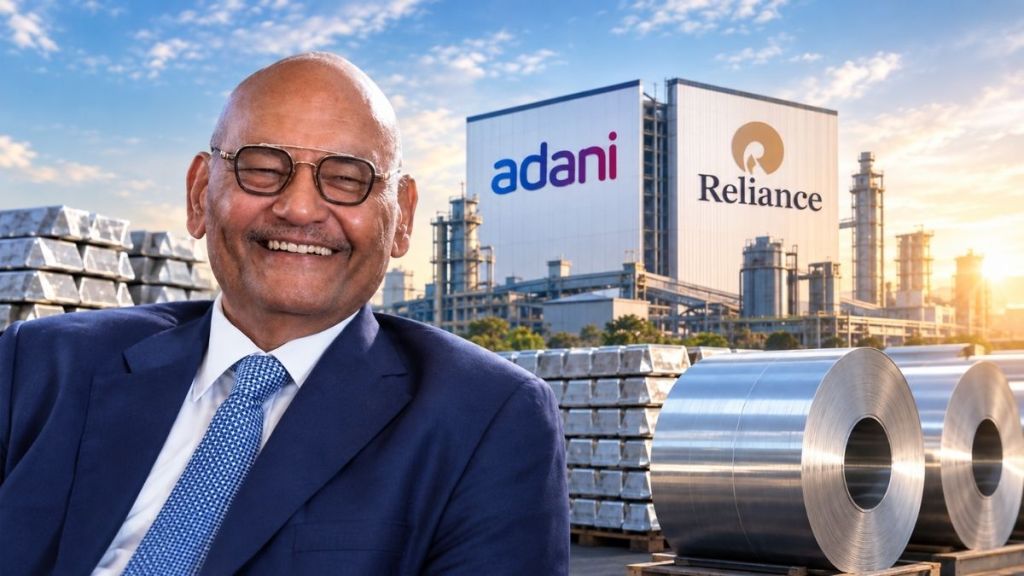

The entry of the Adani Group and Reliance Industries into the aluminium sector will intensify competition and improve efficiency in the industry, Vedanta Chairman Anil Agarwal said, adding that the emergence of more players could eventually create room for mergers and acquisitions.
Agarwal said the domestic aluminium industry currently has three major primary producers, Vedanta, Hindalco Industries and National Aluminium Company (Nalco). “We have Hindalco, we have Nalco,” he said, referring to the established players in the sector, before pointing to the entry of newer competitors.
“We welcome competition. Competition makes you more efficient,” Agarwal said in an interview with Fe. He said the entry of large business groups would bring greater competition into the sector, while over the longer term could lead to consolidation.
The statement assumes significance because the primary aluminium sector has so far largely operated as a duopoly with around 90% production capacity dominated by Vedanta and Hindalco Industries.
Adani Enterprises, along with UAE-based International Resources Holding, has announced an $11.5 billion integrated aluminium project in Odisha, comprising a 4 million tonne alumina refinery, a 2 million tonne aluminium smelter and a 1 million tonne downstream manufacturing park. Reliance Industries, meanwhile, has purchased tender documents for the Karlapat bauxite block in Odisha, which has attracted interest from several large industrial groups.
Agarwal said Vedanta would continue to expand its aluminium business despite the entry of new players. “We have our plan. We are increasing our capacity,” he said. Vedanta is targeting aluminium capacity of around 6 million tonnes in the next three years and 10 million tonnes over the longer term.
“Whoever is efficient will survive,” Agarwal said, adding that competition would force companies to improve productivity and costs. He said the emergence of more players could eventually lead to mergers as the industry evolves.
The aluminium expansion is part of a broader $25 billion investment programme that Vedanta plans to undertake over the next three to five years across its businesses. The spending will cover aluminium, oil and gas, zinc, steel, power and other businesses.
“We are investing $25 billion in the next three to five years,” Agarwal said. The group plans to fund the expansion through internal accruals, debt and asset recycling. At the same time, he said, the parent company would be brought to zero net debt within three years.
On oil and gas, Agarwal said production could rise to around 500,000 barrels per day over the next three years, with about $4 billion of investment planned. Zinc production is targeted at around 2 million tonnes in two years, while silver output is expected to rise to 1,500 tonnes. The group is also expanding its fertiliser, steel and power businesses.
Power generation capacity, he said, could rise from around 4,000 MW currently to 12,000 MW, while the group is also looking at nuclear power. “We are looking at all the critical metals,” Agarwal said, as Vedanta expands into critical minerals through exploration, mining and recycling.
He said the timelines for critical-mineral projects would vary significantly. “Some projects can happen in one year, some will take three to five years,” he said, adding that exploration was fundamental to building the country’s domestic resource base.
Agarwal also said the group currently has no plan to pursue semiconductor activity. “For now we are not pursuing any semiconductor ambition,” he said, indicating that Vedanta was focused on scaling its existing businesses. The group had earlier pursued a semiconductor foray in partnership with Foxconn.
He said India needed to accelerate mineral exploration and production to reduce its dependence on imports. A stronger ecosystem of smaller exploration companies and startups, he said, would help identify deposits that could subsequently be developed by larger mining companies.