


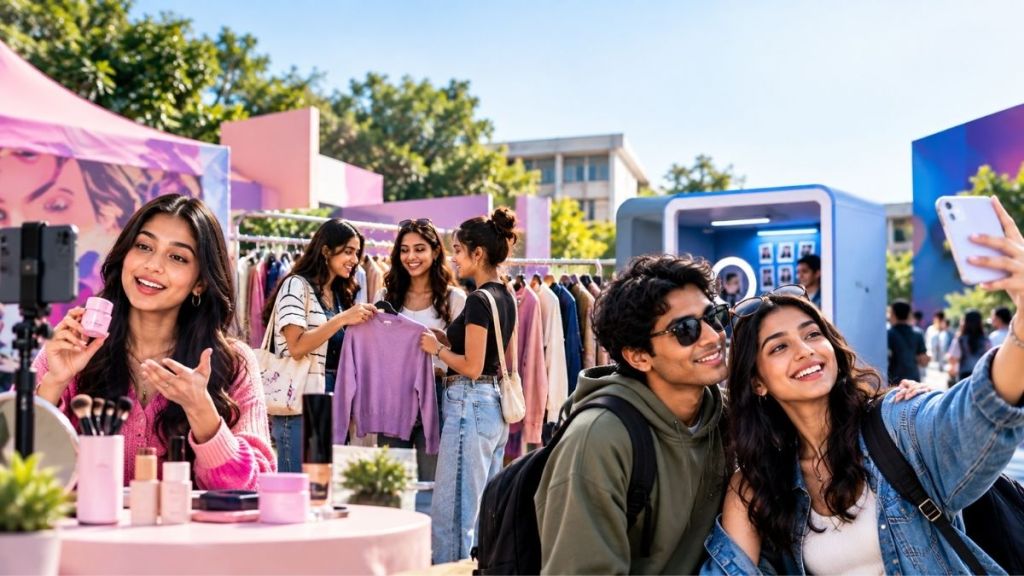

At a college festival in Bengaluru, the product launch is no longer the main event. A creator runs a live tutorial for a beauty brand. A fashion label sets up a pop-up where students try on new clothes. A smartphone maker offers a camera booth built for Instagram-ready portraits. The sale, if it comes, happens later: on an app, through a quick-commerce order, or after a few more scrolls.
This is how brands now court India’s Gen Z. Close to 400 million strong, the cohort shapes what goes into a product, how it is marketed and where it is sold. It influences 43% of India’s consumer spending. That makes it an enormous opportunity, and also an easy one to misread. These consumers experiment readily, discover products online and switch brands quickly.
The traditional buying funnel of awareness, consideration, intent and purchase has all but disappeared, and manufacturers‘ timelines have shrunk with it. Quick-commerce platforms are reshaping how people shop, and brands now need logistics that can serve hyper-local micro-markets.
The product is just the beginning
Hindustan Unilever (HUL) MD & CEO Priya Nair has spoken about how Gen Z is changing the way brands must look and communicate. “It is not just good enough to have higher brand equity. You need to have brands that are truly desired by consumers,” she said. HUL, she added, is reimagining its brands to make them “more modern and youthful”.
That thinking feeds into HUL’s “Winning in New India” strategy, which combines premiumisation, new categories and market expansion. Beauty brands such as Dove and Minimalist sit alongside bets on skincare, haircare and wellness. The company is also using creators and digital media to draw younger buyers into categories once marketed to households rather than individuals.
The shift matters. Someone who discovers a serum, shampoo or fragrance through a creator may start using the category well before settling on a brand.
Nykaa has built its strategy around this kind of social discovery. In its FY26 commentary, the company said two in five new e-retail shoppers were Gen Z, and that their spending per shopper was growing 2.5 times faster than that of other shoppers. Its campus ambassador programme, launched in mid-2025, has produced more than 7,000 pieces of content. A partnership with Snapchat, launched in October 2025, set up an incubator for Gen Z beauty creators.
Anchit Nayar, executive director and CEO of beauty at Nykaa, calls Gen Z “the next frontier for growth in beauty”. So the company is going where young consumers are: campuses, events and social platforms.
The lesson extends beyond beauty. Companies are trying to reach Gen Z not just where they shop, but where they decide what to shop for.
Chasing trends
Fashion shows what happens when discovery cycles speed up. Reliance Retail is reworking in-house brands such as Azorte and Zivame around faster product cycles, trend-led collections and tech-enabled stores. Its youth line, AZ, targets teenagers and first-time fashion buyers with accessible prices, personalisation by cohort and digital tools.
The real test is speed. That means fast manufacturing, but also spotting what consumers are responding to and turning it into products and experiences before the conversation moves on.
Other categories are following suit. Samsung designed its Galaxy F70e 5G, launched earlier this year, for young users who “create, share, and express themselves daily.” The phone’s camera, 120Hz display and design are all pitched at content creation and social use. PepsiCo India launched Adrenaline Rush, a Rs 60 energy drink aimed at Gen Z, in June, with marketing built around ambition, individuality and performance. Mondelez India is running culture-driven digital campaigns for Cadbury Silk and Biscoff to stay relevant with younger buyers.
The playbook is much the same everywhere. Brands read cultural signals, turn them into products or experiences, and make the path from discovery to purchase as smooth as possible.
Speed is the new edge
There is a catch. Gen Z may drive spending on fashion, beauty, food and lifestyle, but its bond with trends can be stronger than its bond with brands, says Ankur Bisen, senior partner at The Knowledge Company.
“Gen Z consumers are not linear in their thinking. What they consume are trends, not brands. If companies can be at the cutting edge of trends that is half the battle,” Bisen says. The other half, he adds, is a relentless focus on execution.
That makes speed, data and flexible supply chains the new competitive advantages. Brands can no longer build awareness and wait for consumers to work their way down a funnel. A trend can surface on social media, get amplified by creators, spread across campuses, show up in product searches and turn into purchases, sometimes within a very short span.
So companies must manage the whole journey: product development, content, creators, retail, technology and fulfilment. The common thread, as Bisen puts it, is not Gen Z’s smartphone. It is the vanishing line between attention and commerce.
Tomorrow: Entertainers