


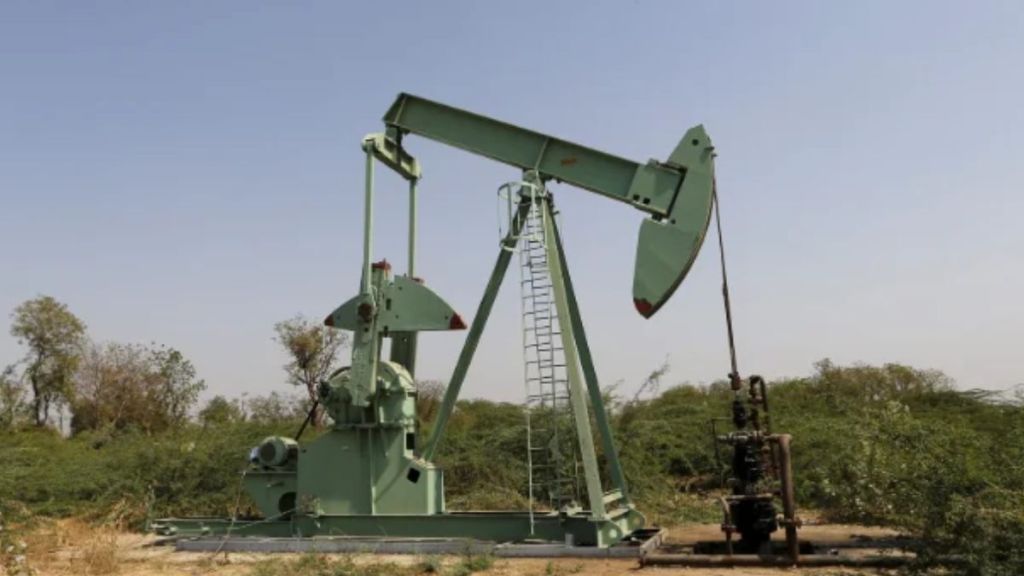

India’s strategic petroleum reserve programme is under scrutiny after the West Asia crisis exposed vulnerabilities with imports meeting nearly 88% of its crude requirement. Saurav Anand explains how India is expanding storage capacity through public funding, PSUs, private participation, and overseas arrangements
What is the total capacity of India’s strategic oil reserves?
India’s Strategic Petroleum Reserves (SPRs) are underground rock caverns managed by Indian Strategic Petroleum Reserves Ltd (ISPRL). Phase I comprises Visakhapatnam with 1.33 million tonne (MMT), Mangaluru with 1.5 MMT and Padur with 2.5 MMT — a combined capacity of 5.33 MMT. These were commissioned between 2015 and 2018.
In a reply to Rajya Sabha on March 23, 2026, the government gave the then official stock position: ISPRL held 3.372 MMT of crude, around 64% of total capacity. The amount available at any point can vary as crude is sold, replenished or retained for strategic purposes.
The often-cited 9.5-day cover also needs context. It is based on the full 5.33-MMT capacity and the 2019-20 consumption pattern. The Comptroller and Auditor General (CAG), using March 2024 import levels, calculated that the full Phase-I capacity represented 7.88 days of import cover, while the 2.91 MMT of government/ISPRL crude actually held at that time provided 4.56 days.
Why does the government also talk about 74 days of cover?
The 74-day figure refers to overall national oil-storage capacity, not 74 days of government-owned crude stored in strategic caverns. It combines dedicated strategic petroleum reserves with commercial crude and petroleum-product storage available with oil companies. The government has said oil companies have storage capacity equivalent to around 64.5 days of consumption, which, along with the dedicated SPR capacity, takes the overall storage capacity to about 74 days.
During the 2026 West Asia crisis, the Centre said actual stocks across crude, petroleum products and strategic reserves provided around 60 days of cover. It also said Indian oil companies had tied up crude supplies for the following 60 days. The distinction is important. Strategic reserves are the emergency core of a wider oil-security system.
Who owns the oil in the caverns?
Under a 2017 agreement, the UAE’s Abu Dhabi National Oil Company (ADNOC) agreed to store 5.86 million barrels of crude at Mangaluru at its own cost. Part of the crude can be used com-mercially, while a major portion is main-tained for strategic purposes. A March 2026 reply in Parliament said ADNOC is permitted to use Cavern-A at Manga-luru, which has a nominal capacity of 750,000 tonne. In 2021, India allowed up to 30% of Phase I capacity to be leased or rented, while up to 20% can be used by ISPRL for the sale and purchase of crude. The remaining 50% is to be maintained as strategic capacity. Emergency-access provisions allow the government to draw on crude in leased capacity during a supply disruption. In May 2026, ISPRL and ADNOC agreed to explore storing up to 30 million barrels of ADNOC crude in India, including at Visakhapatnam and the proposed Chandikhol facility. The two sides are also exploring the possibility of storing strategic crude at Fujairah in the UAE.
What are the new facilities being built?
The approved phase II programme will add 6.5 MMT of storage — 4 MMT at Chandikhol in Odisha and another 2.5 MMT at Padur in Karnataka — as commercial-cum-strategic facilities under the public-private partnership model. The concession agreement was signed on October 1, 2025. August 2030 is the target completion date for Padur II. At Chandikhol, around 400 acres have been acquired, while the request for proposal is under review. A separate 1.75-MMT Mangaluru expansion is also progressing. ONGC gave in-principle approval to the project in July 2026 and, on October 7, invited expressions of interest for engineering and project-management consultancy. While 50% of the proposed capacity will be reserved for strategic use, the balance is for com-mercial operations. Sites at Bikaner in Rajasthan and Bina in Madhya Pradesh are also being considered. The feasibility study for Bikaner has been completed, while pre-feasibility work for Bina has been completed.
How much money has been spent on this?
Construction of phase I was originally estimated to cost Rs 2,396.83 crore, later revised to Rs 4,098.35 crore, while the eventual construction cost was Rs 4,026.86 crore, as per the CAG 2025 report. Separately, the original estimate for buying crude to fill the caverns was Rs 8,870 crore. The government approved Rs 4,948 crore in 2015 and another Rs 3,184 crore in 2020 for crude purchases. Construction of the three Phase-I facilities took around nine to 12 years, against the six years envisaged.
India did, however, use the 2020 collapse in oil prices to strengthen its reserves. It bought 16.71 million barrels of crude at an average price of about $19 a barrel, with the government estimating savings of Rs 5,069 crore. In 2021, India also agreed to release 5 million barrels from its strategic reserves in coordination with other major oil-consuming countries.
For FY27, Rs 200 crore has been allocated under the strategic-oil-reserve head. According to reports, 90% is earmarked for filling caverns and operations and maintenance, while 10% is for construction of new caverns.