


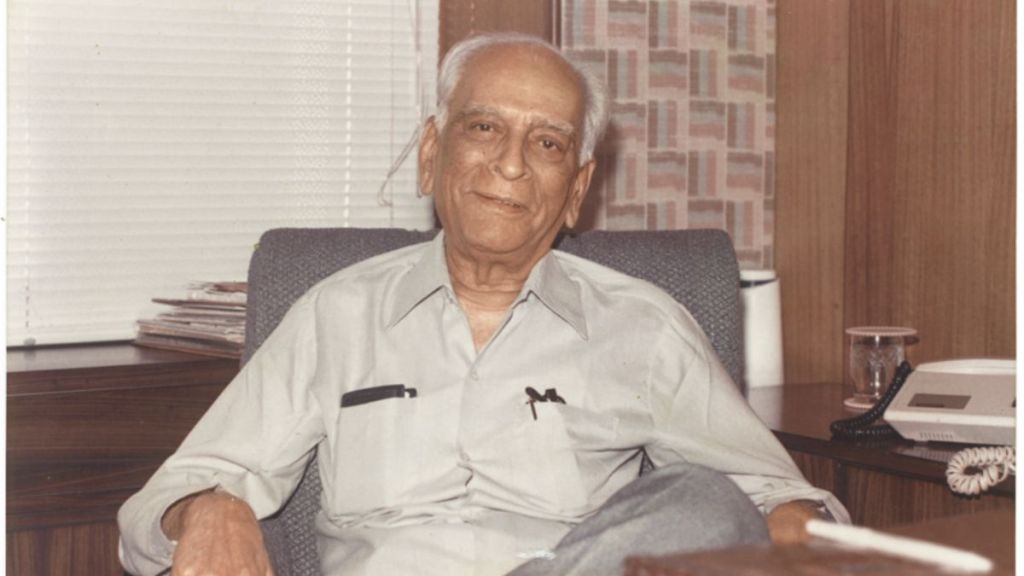

In 1951, a young Bombay stockbroker sat down and drafted a business proposal. He wanted his firm to start a housing finance company. The kind he’d seen thriving in Britain as a student at LSE, building societies that lent people money against a home and trusted them to pay it back over time.
His firm turned it down.
Most people would have let the idea die then and there. But he didn’t. For twenty-six years, the idea kept resurfacing. Meanwhile, he built an entirely different career, running one of India’s earliest development finance institutions and becoming a respected voice in Indian banking without ever being a banker.
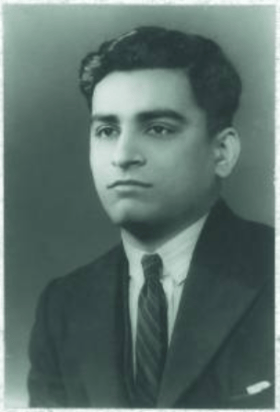
He pitched the same housing finance idea again in 1973, this time to a different bank. That went nowhere, either.
Then, in 1977, at an age when most of his peers were already retired, he stopped pitching the idea to other people and built it himself.
His name was Hasmukhlal Thakordas Parekh. Most of India knows him simply as H.T. Parekh, and the company he founded at 66, Housing Development Finance Corporation, or HDFC, would go on to decide that an ordinary Indian no longer had to wait until the end of a working life to own a home.
Early Career: From LSE to Stockbroking and ICICI
Parekh was born on 10 March 1911 in Surat, into a family where banking was practically the family trade. His father had joined the Central Bank of India in its earliest days and stayed until retirement, and his elder brother and two others eventually followed the same path. Yet it was his mother’s quiet, self-effacing nature, more than his father’s professional world, that seemed to leave the deeper imprint on him. She instilled in him a sense of humility and integrity that people who knew him later would describe again and again.
He came of age during the Gandhian era, and something of that austere, service-minded philosophy stayed with him for life. After graduating in Economics from Wilson College, he went on to pursue his B.Sc. in Economics at the London School of Economics in 1936.
When he returned to Bombay, friends nudged him toward stockbroking, and his LSE senior A.D. Shroff, who would go on to become both a mentor and a lasting influence, encouraged the same. He joined the firm Harkisondass Lukhmidass, and for two decades he built something unusual there.
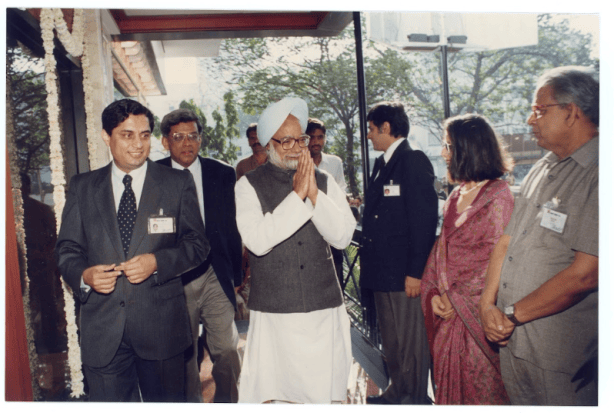
He was never quite seen as a stockbroker in the conventional sense. Colleagues and clients regarded him instead as a marketman and an economist, someone whose research and thinking on money, banking and economic policy carried more weight than his trades. He even taught Economics part-time at St Xavier’s College during this period, and built a personal rapport with the Reserve Bank’s then Governor that brought the firm its first RBI business.
It was also during these years, while reading about British building societies during his time in London, that a very specific idea took root in his mind. In 1951, he drafted a proposal for his own firm to set up a housing finance company modelled on those British institutions. The proposal went nowhere. But the idea did not leave him. It would sit quietly for more than two decades, waiting for the right moment.
H.T. Parekh and the rise of development banking
That moment did not arrive immediately. In 1956, Parekh joined the newly formed Industrial Credit and Investment Corporation of India, ICICI, as Deputy General Manager, stepping into a sector of Indian finance that barely existed yet.
ICICI had been set up with the backing from the World Bank and the governments of India and the United States, and Parekh’s years there sharpened his conviction that financial institutions could be deliberately engineered to drive national development, not merely to protect capital.
He carried a nationalist’s instincts alongside a genuine belief in international cooperation, and he often credited the World Bank with shaping his interest in development banking.
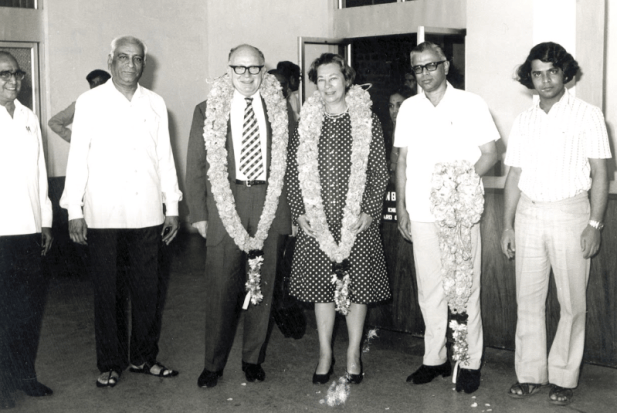
As early as 1962, long before the idea had any institutional shape, he was advocating for a common Asian market bringing together India and its neighbours, a vision that would eventually take form two decades later as SAARC.
Under his stewardship, ICICI earned the trust of Indian business and recognition from both the government and the World Bank as a genuine showcase institution. In 1972, he was named Executive Chairman of ICICI, a position he held until 1975, after which he continued for a few more years as Honorary Chairman of the board.
All the while, the housing finance idea he had shelved in 1951 kept resurfacing. In 1973, he drafted another proposal, this time for Bank of Baroda to set up a housing finance subsidiary, and sent it directly to the Finance Ministry. It went nowhere either. But by now, the pattern was becoming clear. Parekh was not a man who let an idea die simply because the timing was wrong.
The Paradigm Shift: Lending Against Future Income
What troubled Parekh was a simple observation about how Indians bought homes, or rather, how they mostly didn’t. In the India of the 1970s, a middle-class family typically could not dream of owning a house until the very end of a working life, once decades of savings, provident fund payouts and gratuity had finally accumulated enough.
Cash transactions further muddied property deals, while steep wealth and income taxes made the arithmetic even harder for ordinary earners.
Parekh’s question was almost embarrassingly direct. Why should an Indian have to wait well past their prime to buy a house.
His answer ran against the entire logic of how Indian finance operated at the time. Rather than lending against existing capital, which is how virtually all credit worked in a capital-scarce economy, he proposed lending against a borrower’s future income, an approach that came to be known as income-gearing. It sounds almost obvious in hindsight. In the India of that era, it was close to heretical.
Founding HDFC at 66: The Rs 10,000 Vision
Parekh left ICICI and, at the age of 66, finally turned decades of thinking into an actual institution. Housing Development Finance Corporation was registered on 17 October 1977, at a point in his life when most of his contemporaries were easing into retirement rather than founding companies.
The initial public issue of shares closed on 25 July 1978, raising Rs 10 crore through ten lakh shares priced at Rs 100 each, making HDFC the country’s first retail housing institution of its kind. Parekh himself put in a modest Rs 10,000, buying 100 shares as a signatory to the Memorandum of Association, a stake he would hold, unchanged, for the rest of his life.
The idea did not receive an easy welcome everywhere. H.M. Patel, the then Union finance minister, however, gave him precisely the encouragement he needed. When Parekh sought his blessing before launching the venture, Patel is said to have responded, “If you do not want finance from the government, what are you waiting for, go ahead, it is a good idea!”
Parekh’s reputation for integrity did the rest of the work. HDFC disbursed its first home loan, worth Rs 30,000, in 1978, to Mr D.B. Remedios for a home in Malad, Bombay.
That same year, his nephew Deepak Parekh, then working at Chase Manhattan Bank in the United States, agreed to return to India to help his uncle build the venture, joining as Deputy General Manager. Deepak would later describe HDFC as a startup unlike any other, precisely because its founder had launched it at an age when most careers were winding down rather than beginning.
How HDFC built its home loan model
HDFC’s model was simple: borrow long-term wholesale funds, lend to retail customers at fixed rates, earn a spread of around 2%, at a time when variable rates didn’t exist in India. The harder part was sourcing that funding, and Parekh leaned on relationships from his ICICI years to secure it from the World Bank, the Commonwealth Development Finance Corporation, KfW and USAID.
Since much of the property market ran on undisclosed cash, HDFC sent its own staff to appraise homes independently rather than lend against declared values alone. Parekh’s attention to detail ran deep, down to the loan application form and the company’s initial logo. He wanted the customer experience to feel first-world at a time when Indians queued for basic services. For nearly two decades, HDFC had the space to itself, until insurance companies, public banks and private players moved in, some of them, tellingly, promoted by HDFC itself alongside SBI and Canara Bank.
How HDFC changed home loan access
Deepak Parekh liked to recount one story that captured what HDFC meant to its customers. N.R. Narayana Murthy, long before Infosys made him a household name, walked into HDFC’s office with his wife Sudha Murthy, an appointment letter in hand but nowhere to live. HDFC sanctioned him a home loan within a week.
H.T. Parekh passed away on 18 November 1994. By then, the institution he had built almost as an afterthought to a long and unconventional career had already begun reshaping how India thought about home ownership.
Corporate Evolution: From Housing Finance to Banking Giant
As India opened its banking sector to private players in the early 1990s, HDFC applied for one of the new bank licences on offer. HDFC Bank was incorporated in August 1994, built as an independent institution under Aditya Puri, and grew over the next two decades into one of India’s largest private lenders, with over 6.8 crore customers and assets exceeding Rs 19 lakh crore by 2021.
HDFC Ltd and HDFC Bank merger
In April 2022, HDFC Ltd and HDFC Bank announced a merger, folding the housing finance company into the bank it had itself spawned decades earlier. By the time the merger wasannounced in 2022ment, the bank had grown to 6.8 crore customers across 3,000 cities and towns with more than 6,300 branches, according to Forbes India.
HDFC Bank capped the financial year 2025‑26 with net revenue of Rs 1.9 lakh crore, up from Rs 1.6 lakh crore a year earlier, while profit after tax rose 10.9% to Rs 74,671.3 crore. Net interest income grew a slower 4.9% to Rs 1,28,686 crore. As of today, HDFC Bank commands a market cap of Rs 11.27 lakh crore
Deepak Parekh called it a friendly merger, like a son growing older and taking over his father’s business. Quietly, it also closed a chapter: nearly five decades after H.T. Parekh had started HDFC with a modest personal investment and a stubborn idea about income and homeownership, Parekh family leadership at the institution came to an end.
Philanthropy and Enduring Legacy
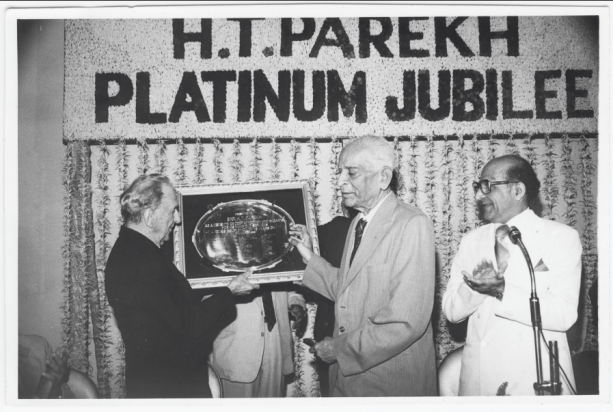
Those who worked with HT Parekh described him with a fairly consistent set of words: humble, ethical, patient, perseverant, visionary, a man of few words who believed strong convictions rarely needed loud language.
His interests reached well beyond finance. He helped establish the Centre for Advancement of Philanthropy in 1986 alongside Darius Forbes, Russi M. Lala and R.R. Chari, and chaired it until 1993, contributing his own money to its corpus and helping raise more besides. In 1991, he co-founded the Bombay Community Public Trust with Lala, modelled on community giving structures like the New York Community Chest, and he served as trustee to institutions ranging from the Sameeksha Trust, publisher of the Economic and Political Weekly, to the Kasturba Gandhi National Memorial Trust.
He also founded GRUH Finance in 1986 to extend housing finance into rural Gujarat, and one account credits him with financing Bombay’s first corporately-supported public toilet in Dadar in 1989, built and managed by the social organisation Sulabh.
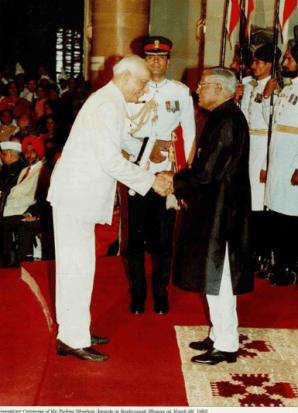
Despite building an institution that gave millions of Indians the means to buy homes, Parekh himself never owned one. He was awarded the Padma Bhushan in 1992, and HDFC would later describe him as the man who saw tomorrow.
His old office at Ramon House in Churchgate now shares its address with a street bearing his name, H.T. Parekh Marg, and the same floor houses the H.T. Parekh Legacy Centre, a private museum built jointly by HDFC Ltd and the H.T. Parekh Foundation, on the very spot where HDFC began nearly fifty years ago and where his original cabin still stands.
As Parekh himself put it, not long before his death: “I am never tired of dreaming about growth and progress, and about the betterment of living, about human welfare.”
Editorial Note: This profile is based on original reporting, including direct communication with HDFC and H T Parekh Foundation. To ensure a comprehensive perspective, FinancialExpress.com corroborated this information with public records and third-party sources. FinancialExpress.com retains full editorial independence and final authority over all editorial decisions.