


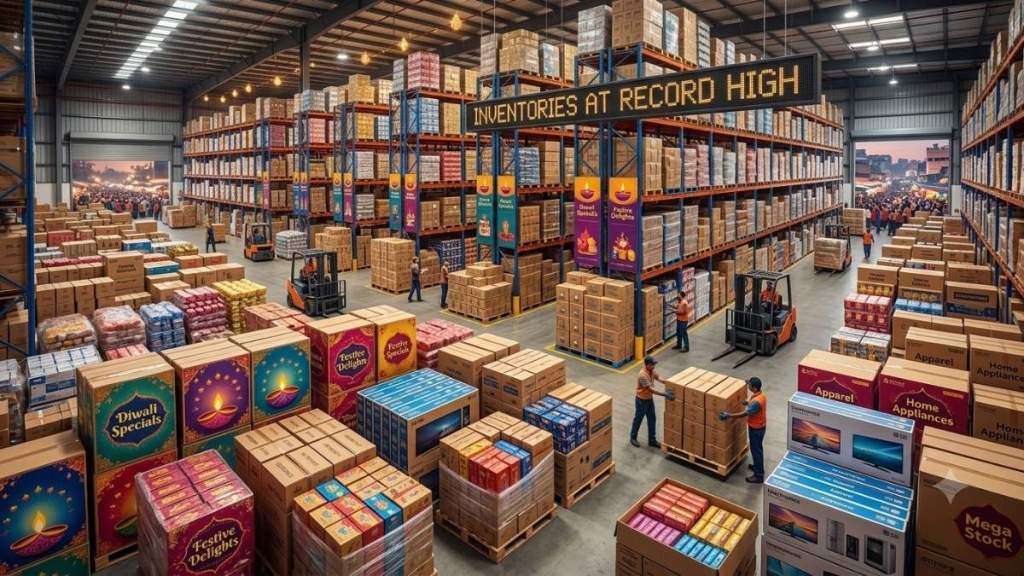

The boost to private consumption from last year’s deep Goods and Services Tax (GST) cuts shows little sign of fading and could extend into the upcoming festive season. Expecting demand to stay strong in the weeks ahead, companies across sectors have stepped up inventory building, with finished-goods stocks rising at the fastest rate in more than a decade.
The latest manufacturing Purchasing Managers’ Index (PMI) data show the finished-goods inventories index hit an 11-and-a-half-year high in July and remained elevated in the following two months. The July and September readings were among the highest recorded in nearly 12 years, pointing to growing confidence among companies that festive-season demand will remain robust.
Companies ramped up inventories betting on future sales, while consumer demand is already strong in most segments. The PMI data also suggest that optimism about strong demand continues, with the Future Output Index within manufacturing PMI rising to a four-month high in September. Macro data also supports that consumption demand has been strong since last September’s GST reductions. Private final consumption expenditure (PFCE) growth has been above 7% in the last three quarters.
“Most companies expect a bumper festive period this year given that demand trends remain strong. Second, buying behaviour has also undergone a transformation, people are looking for upgrades as lifestyles improve,” said NS Satish, chief executive officer at Haier Appliances India.
However, economists have sounded a note of caution. Madan Sabnavis, chief economist at Bank of Baroda, said the elevated inventory levels could reflect two contrasting trends. While companies may be building stocks in anticipation of stronger festival demand from this month, high inventories in some cases could also indicate that unsold stocks are being carried forward amid weak demand. “Hence, the reason will vary from company to company as well as across sectors. This will hold especially for consumer goods industries,” he said.
While sentiment has improved across markets, the mass segment is seeing challenges due to inflationary pressures, said Kamal Nandi, business head (appliances), Godrej Enterprises Group. “But the premium segment is doing well. A trend that is expected to continue into the festive season,” Nandi said.
According to Haier’s Satish, the inflationary impact could also be cushioned by finance schemes during the festive season, which gives an incentive for consumers to upgrade. “This could explain the record build up in buffer stocks this year,” Satish said.
Passenger vehicle stocks are also high. According to Federation of Automobile Dealers Associations (FADA) data, dealer inventory was around 43-45 days in September 2026, well above FADA’s recommended 21-day benchmark, with 60% of passenger vehicle (PV) dealers holding more stock due to upcoming festivals. In August, dealer PV inventory was around 38-40 days.
Inventory across the automobile supply chain has also shifted upstream to component manufacturers. A source at a major carmaker said Original Equipment Manufacturers (OEMs) have asked component suppliers to hold higher inventory, with some being asked to double their raw-material stocks. This is aimed at preventing production disruptions and assembly-line stoppages amid supply-chain uncertainties.
“Following disruptions after the West Asia crisis, OEMs have also sought higher buffer stocks from suppliers to ensure uninterrupted production,” the source said. As a result, while inventory at OEMs and dealers remains controlled, Tier-1, Tier-2 and Tier-3 suppliers are carrying higher levels of raw materials and finished goods, effectively absorbing the additional inventory burden to provide greater supply-chain resilience.
The rise in inventory levels is “not a big surprise,” said Rahul Bajoria, head of India and ASEAN economic research at BofA Global Research. “The question really is how the festive season goes and whether that results in some inventory reduction over a 3-month period, which would obviously mean that production would be a bit weaker than sales. But if the demand cycle is strong and you see high income growth visibility, then production momentum might also be maintained. So we are not reading too much into the fact that there is some upstocking,” Bajoria said.