


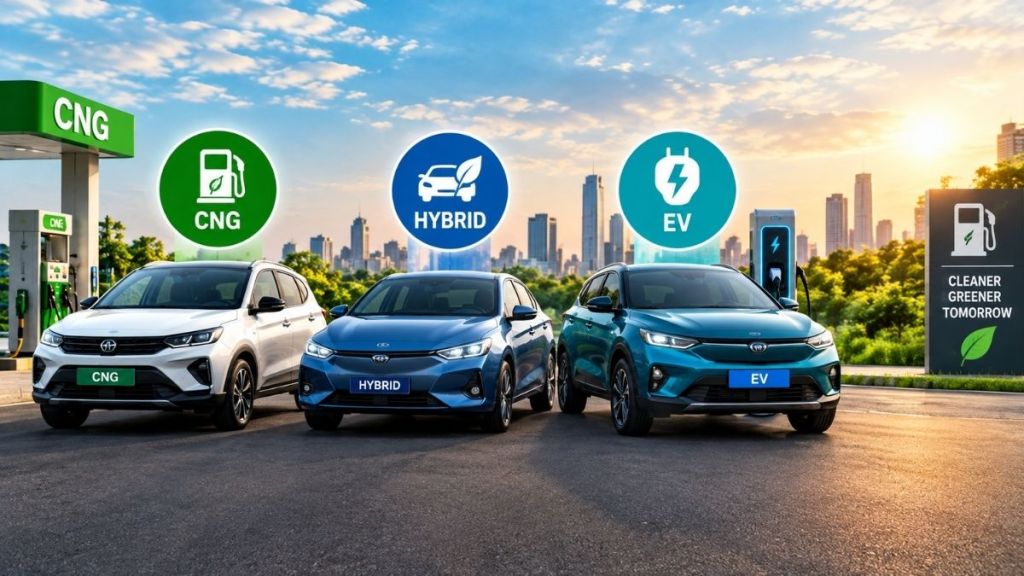

Customers preferring an EV, a hybrid SUV, or a factory-fitted CNG hatchback are no longer outliers, latest sales data of passenger vehicles show. Alternative fuel vehicles are now giving petrol cars a run for their money, as a niche segment confined to big cities becomes a pan-India trend, writes Banasree Purkayastha
l What’s changed in the car market?
Compressed natural gas (CNG), hybrid, and electric vehicles (EVs) have collectively overtaken petrol cars in India for the first time. According to data released by the Federation of Automobile Dealers Associations, CNG/liquefied petroleum gas (LPG), hybrid, and EVs together accounted for 41.95% of passenger vehicle (PV) retail sales in August, against 40.85% for petrol/ethanol-run ones. CNG/LPG was the largest contributor to the alternative-fuel mix at 25.28%, followed by hybrids at 9.04%, and EVs at 7.63%. Diesel accounted for 17.21%. Petrol/ethanol, however, remained the largest individual fuel category at 40.85%.
The demand for alternative fuel vehicles isn’t confined to the traditional strongholds — states such as Tamil Nadu, Delhi, and Andhra Pradesh are at the forefront of this shift. Tamil Nadu’s share of all alternative fuel PVs sold in India grew from 4.8% in August 2025 to 6.5% in August 2026, a gain of 1.6 percentage points, the sharpest increase among all states. Delhi’s share grew from 5.2% to 6.5% while Andhra Pradesh saw a jump from 1.4% to 2.1%.
l Does this mean petrol has lost its dominance?
The August crossover should be viewed as the culmination of a trend that has been building over the past few months rather than a standalone event. The share of alternative fuels in PV retail sales has increased from 36-37% in April to 38.0% in May, 40.6% in July, and 41.95% in August, while petrol’s share has moderated over this period. It reflects a broader shift in purchase behaviour, with buyers increasingly evaluating vehicles based on total cost of ownership rather than upfront acquisition cost alone. While alternative fuels accounted for a greater percentage of PV retail sales than petrol, the latter remains the single largest fuel category. “It signals a gradual rebalancing of the PV fuel mix, with alternative fuels likely to account for a larger share of incremental industry growth going ahead,” says Arti Roy, associate director, CareEdge Ratings.
l Reasons for shift to alternative fuels
The shift reflects improving ownership economics, greater availability of factory-fitted CNG, hybrid, and EV models, expanding infrastructure, and increasing consumer preference for fuel diversification. Rising petrol prices have also played a big role in persuading customers to look at alternative fuels. Since the West Asia crisis in February, petrol and diesel prices have been on an upward trajectory. The growing concerns about the effect of E20 on vehicles are also nudging buyers towards EVs and CNG cars.
A study by market research company GfK in 2023 found that nearly 40% of urban Indian consumers harboured a strong desire to purchase alternative fuel cars. EVs were the most coveted alternative mobility option. For more than 55% of respondents, the advanced technology of EVs was the primary motivator among those considering the fuel type for their next purchase.
l Why is CNG leading the shift?
The shift is being aided by favourable total cost of ownership, particularly for high-usage customers, along with the significant expansion of factory-fitted CNG offerings by OEMs and continued development of refuelling infrastructure. These factors have improved accessibility and consumer confidence, especially in mass-market segments. While EV adoption is also rising, CNG offers a more practical transition path for a huge section of mainstream consumers. It delivers lower running costs than petrol while leveraging an established refuelling ecosystem and familiar vehicle usage patterns. As a result, CNG adoption has scaled faster than EVs, mainly in entry-level and mid-segment vehicles, says CareEdge’s Roy. While fuel-price volatility and concerns around the E20 transition may have influenced consumer behaviour at the margin, ownership costs and fuel diversification seems to be driving the broader trend. “Acceptability of CNG will continue to grow and push the mix. OEMs are also pushing for more CNG models,” Amar Jatin Seth, vice-president, FADA, told FE earlier.
l Is it a structural change or a blip?
Automotive experts expect this trend to gain strength. Consumers now have reliable alternative fuel choices across hatchback, sedan, and major SUV segments rather than being limited to a few experimental models. Leading carmakers like Maruti Suzuki (dominating CNG), Tata Motors (leading EVs), Toyota, Hyundai, and Mahindra are scaling up multi-powertrain strategies. Strong overall volume growth adds buoyancy to the shift. About 1.7 lakh units of alternative fuel PVs were sold last month, a 38% rise against August 2025. This is more than double the rise in overall PV sales, which grew by 16% in the same month. The government’s aim for EVs to constitute 30% of sales by 2030, along with proposed tax incentives for hybrid models, ensure policy backing. For manufacturers, the trend reinforces the importance of a multi-powertrain strategy. OEMs with diversified portfolios are likely to be better positioned to capture consumer demand. For consumers, the growing availability of alternative-fuel vehicles expands choice and shifts purchase decisions increasingly.