


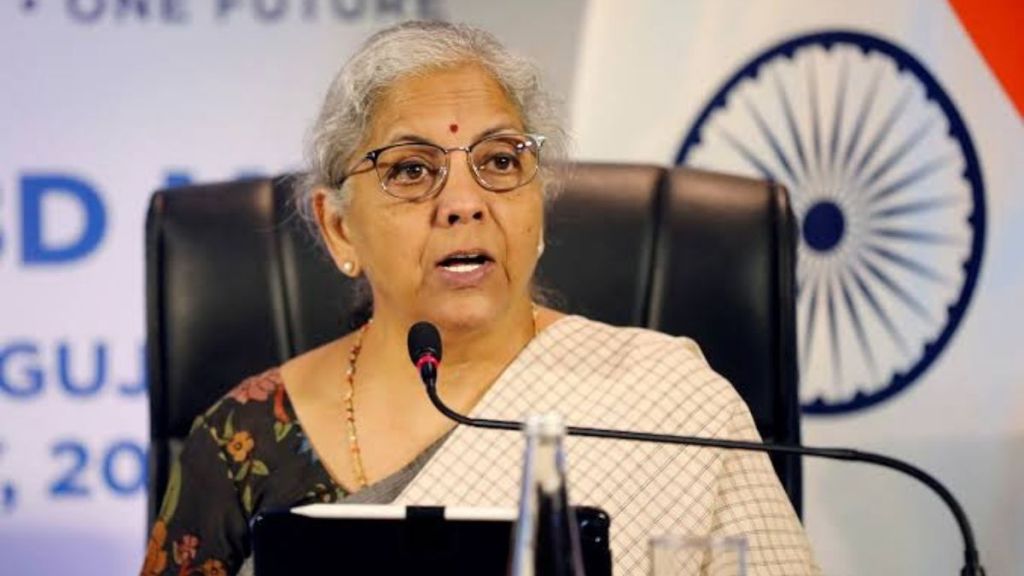

India stands at a structural inflection point, with the next phase of consumption to be driven by upward mobility into income brackets where discretionary spending accelerates, Finance Minister Nirmala Sitharaman said on Tuesday. She also asked corporates to avoid designing products only for the formal urban elite.
Rising incomes and upward mobility are expected to push more households towards discretionary spending, while an ageing population could increase demand for healthcare, wellness, consumer durables and quality services. “India’s consumption base rests on working families across agriculture, rural construction, transport, and informal enterprise,” she said at an All India Management Association event here. “If corporate India pursues premiumisation for the urban tier alone, growth will lose its structural durability.”
Sitharaman said quality and innovation must become central to the next phase of growth, with higher standards across factories, services, management and research.
She said India’s gross expenditure on R&D stands at 0.83% of GDP, far below the OECD average (2.7%), China (2.6%), and the US (3.5%), reflecting a persistent shortfall in private-sector R&D depth, where the domestic private sector contributes just 36% compared to over 70% in leading advanced economies. Sitharaman urged companies to increase R&D spending, either internally or through partnerships with academia.
The larger ambition, she said, should be to move from “Made in India” to “Imagined in India”—creating intellectual property, designs, engineering capabilities, patents, software and technologies domestically and taking them to global markets.
Talking about the economy, she said India’s growth story is increasingly about combining public investment and reforms with private capital, manufacturing scale and stronger domestic resilience.
While trade, supply chains and geopolitical assumptions are becoming less predictablem she said India’s answer is not isolation, but stronger domestic capacity, fiscal strength and industrial scale.
Global growth is slowing below 3%, but India is growing near 8%, strengthening international confidence. Japan Credit Rating Agency upgraded India to A- in September 2026, a first in over 35 years, she said
She said the centre is now borrowing essentially to invest rather than to consume — a transformation very few emerging economies can claim. Public capital expenditure was deployed deliberately to crowd in private investment, and that crowding-in is now visible.
Gross fixed capital formation rose to more than 34% of GDP in Q1 of 2026-27, growing about 12% in real terms, while Manufacturing capacity utilisation has climbed to 75%,” she said.
The old “twin balance-sheet problem” has shifted toward a twin balance-sheet advantage—banks can lend, and companies are financially better positioned to invest.
The minister also highlighted the geographical spread of investment, with states competing to attract businesses to tier-2 and tier-3 cities such as Coimbatore, Vadodara, Visakhapatnam, Indore, Bhubaneswar and Jaipur. This trend, she said, should extend beyond manufacturing into electronics components, biotechnology, advanced materials and green energy.