


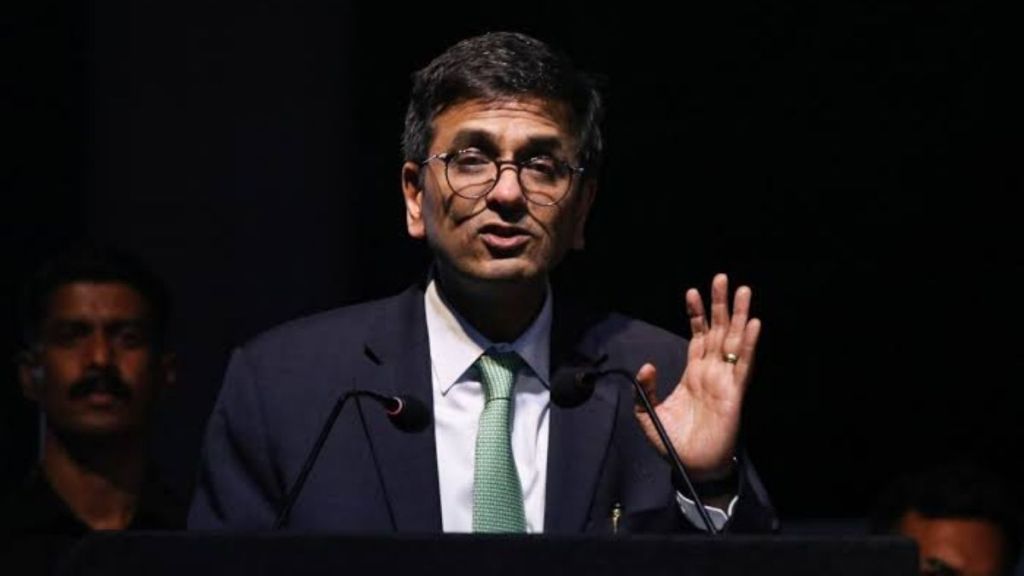

The legal opinion that Noel Tata placed before the Tata Sons board on Thursday — and which, Tata Trusts says, the board did not take note of — strikes directly at the legal foundation on which N Chandrasekaran’s reappointment appears to rest: the chairman’s casting vote.
The opinion, authored by former Chief Justice of India D Y Chandrachud at the Trusts’ request, concludes that no casting vote can substitute for the affirmative support of the Trusts’ nominee directors, and that a chairman’s reappointment without that support would be invalid. FE has reviewed excerpts.
Chandrachud’s starting point is that affirmative voting rights written into a company’s Articles of Association are “central to establishing control and safeguarding interests” of those they favour. The affirmative vote of the Trusts’ nominee directors, he holds, is “an independent and standalone requirement” that operates “on a wholly different plane” from the chairperson’s casting vote — the latter exists to break a tie across the board as a whole, not between two specific directors.
From this follows the opinion’s central conclusion. Where one of the two nominee directors declines to support a resolution, the requirement that a majority of nominee directors back it “has not been satisfied” — and the resolution is invalid, “irrespective of the Chairperson’s casting vote resolving the deadlock between the nominee directors”.
The Articles, Chandrachud writes, cannot be read to mean that both nominees’ presence is necessary but one nominee’s affirmative rights “can be superseded by the casting vote of the Chairperson”.
A casting vote “cannot supply that missing affirmative vote”, he observes, invoking the settled principle that such a vote cannot “create a majority where none exists” or “defeat a veto right held by a particular constituency of directors”. Nor can the chairman’s voting power be enlarged “to permit a circumvention of substantive governance protections”.
The opinion then addresses the argument that a reappointment differs from a fresh appointment. It does not, Chandrachud holds: even when an incumbent is reappointed, the new term “would be a fresh Chairmanship, not a continuation” — meaning the selection process prescribed under Article 118 applies in full.
To hold otherwise, he warns, “would open the possibility that the Board of Directors would repeatedly reappoint the incumbent Chairperson”, effectively circumventing the Trusts’ right to influence the selection of the chairman — an outcome “contrary to the scheme of the Articles of Association as a whole”, which is designed to protect the majority shareholder.
The Trusts, as “the key parties who drafted the contract, could never have had such an intention”, the opinion notes.
The document’s significance lies in what it targets. Tata Sons is understood to have taken legal advice before Thursday’s meeting on how the nominee directors’ affirmative rights operate when the two disagree, with the board proceeding on the view that the chairman’s casting vote could resolve such a deadlock.
Chandrachud’s opinion rejects precisely that construction — framing the dispute that now heads towards the AGM, and possibly the tribunals, as a contest between two irreconcilable readings of the same Articles.