


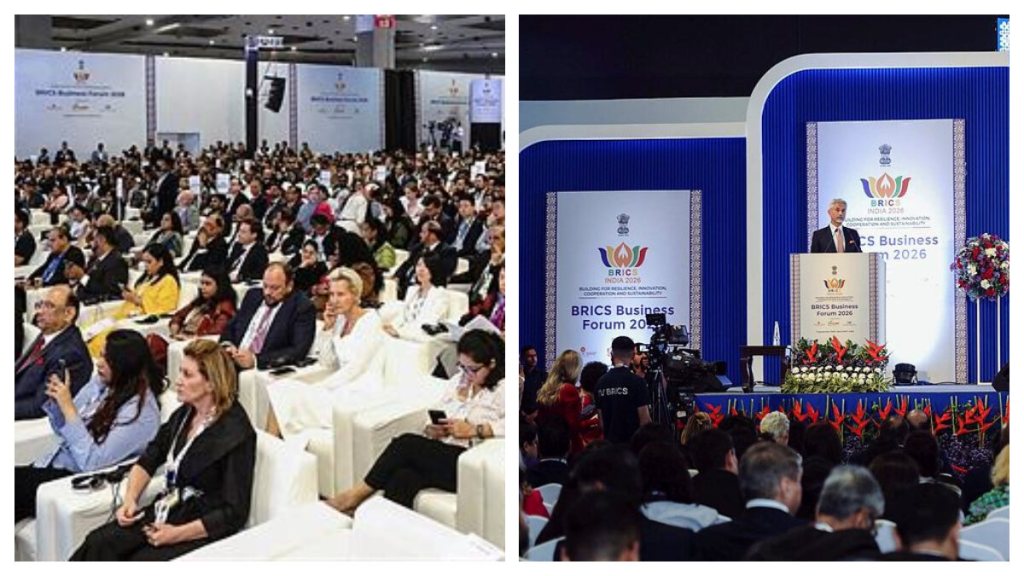

The BRICS Business Forum kicked off in Delhi on Friday, setting the stage for the 18th BRICS Summit on September 12–13, 2026. Business leaders, ministers and heads of state from Brazil, Russia, India, China, South Africa and partner countries are gathering to shape the grouping’s economic agenda under India’s chairship, themed “Building for Resilience, Innovation, Cooperation and Sustainability.”
Jai Shroff, Chair of the BRICS Business Council, opened the forum by framing BRICS as more than a club of big economies. “We should not look at BRICS as a group of large markets but as an economic network where our strengths can reinforce one another,” Shroff said.
He explained how the interactions among the dignitaries could be turned into commercial opportunities. “A resource in one BRICS economy can support manufacturing in another. A technology developed in one market can find scale in another. Capital can find projects and business can find new partners and customers across our economy.”
Shroff tied this directly to India’s four priorities as chair: “India’s BRICS chairmanship under the leadership of Prime Minister Narendra Modi has been built around four priorities: Resilience, Innovation, Cooperation and Sustainability. These are important priorities for the government, but equally relevant for business.”
The BRICS Business Forum is the grouping’s main private-sector platform, held each year in the host country just before the leaders’ summit. Its recommendations feed directly into summit declarations and work programmes on intra-BRICS trade, investment, digital economy, MSMEs, standards cooperation and value-chain integration.
‘Global political, economic order under churn’: Jaishankar
External Affairs Minister (EAM) Dr S Jaishankar, addressing the forum, said the world is navigating a period of deep uncertainty. “We meet at a time when the global political and economic order is under churn. Volatility, uncertainty, and complexity have become defining features of the world around us,” Jaishankar said.
He pointed to geopolitical conflicts, pandemics and climate disruptions as major economic shocks, even as technology opens new avenues for growth, “At the same time, rapid digitisation and technological advances are opening new possibilities for growth, productivity and development.”
The result, he said, is an economic landscape where risks and opportunities are more widely distributed: “The ability to anticipate, adapt and respond is acquiring greater importance.”
Speaking at the opening ceremony of BRICS Business Forum 2026.
https://t.co/0crl3kUZwb— Dr. S. Jaishankar (@DrSJaishankar) September 11, 2026
Jaishankar outlined what this means for BRICS businesses. “The common thread is how to make it easier for businesses in our countries to find more partners, access more markets, connect supply networks and convert complementarities into viable commercial partnerships.”
For BRICS, he linked higher economic activity to greater self-reliance. “For BRICS particularly, higher economic activity and higher economic security mean greater self-reliance. The objective is to strengthen our ability to absorb shocks while remaining connected and competitive.”
He called for “genuine market practices, dependable logistics, a predictable business environment, diversified commercial relationships, and transparent trade and investment,” as well as energy systems that can cope with disruption and transition pathways suited to different national circumstances.
#WATCH | BRICS Summit 2026 | Speaking at BRICS Business Forum, External Affairs Minister Dr S Jaishankar says, "The common thread is how to make it easier for businesses in our countries to find more partners, access more markets, connect supply networks and convert… pic.twitter.com/PnCDV7zWPL
— ANI (@ANI) September 11, 2026
Russia–India: Significant increase in trade numbers expected
Russian President Vladimir Putin arrived in Delhi for bilateral talks with Prime Minister Narendra Modi. The discussions are expected to focus on trade resilience, cross-border payments, energy security and pathways to manage ongoing geopolitical tensions in Eastern Europe and West Asia.
Olga Kulikova, Business Ambassador of Russia to India, said Moscow sees large untapped potential in bilateral commerce. “We do really look into the increase of the bilateral trade because we see very big potential for the Indian companies to come to the Russian market because now there is a gap in mutual trading,” Kulikova said.
She urged Indian firms to be more visible in Russia. “We think that Indian companies should come more to the Russian market and promote themselves because by promoting themselves Russian companies would know the potential and the capabilities of what Indian companies can offer. We expect that there will be a significant increase in trade numbers.”
A key outcome of the Modi–Putin meeting is an MoU to connect India’s and Russia’s domestic payment networks. This will allow users in both countries to make cross-border payments using their national systems, feeding into the broader BRICS Pay initiative.
“We’re really looking forward to the BRICS currency because it will definitely ease the trade and would also allow an increase in travel between the countries and we think that this is one of the biggest opportunities for our countries,” Kulikova said.
Both leaders are also visiting the INNOPROM exhibition organised by the two countries’ industry and trade ministries. Kulikova expressed hope that step-by-step measures would remove remaining barriers. “We expect that some of the barriers that are still there will be erased. We think that this step-by-step process that is being taken will bring us very positive results and really increase trade.”
China–India: The whole world is looking at cooperation
All attention is now fixed on Chinese President Xi Jinping’s visit to New Delhi for the BRICS Summit—his first trip to India in seven years—widely seen as a meaningful thaw in Sino-Indian ties after the Galwan standoff.
On Saturday, PM Modi is set to hold a bilateral meeting with President Xi, with talks expected to cover border management, trade, technology and climate cooperation. The outcomes of this engagement, together with the Modi–Putin discussions and the recommendations emerging from the BRICS Business Forum, are likely to play a decisive role in shaping the summit’s final declaration and the bloc’s work agenda for the year ahead.
Li Jingjing, a Chinese journalist with CGTN, told ANI that the summit is crucial because the world is watching how India and China work together in a shifting global order. “This is a very important visit, and also an important BRICS meeting. I think this is what people from both China and India want to see, and also what people from the world want to see,” Li said.
She highlighted the scale of opportunity if the two neighbours coordinate. “China and India are neighbours and we are also the two largest developing countries with large populations. If we work together, there’s so much potential, we can work on trade, green development, energy technology—there’s so much that we can work on, and that will benefit people from both our countries and the world. I’m sure the whole world is looking at the cooperation between China and India.”
Li underlined China’s positioning with the Global South: “President Xi made it very clear, no matter what stage China is reaching in development, China will always be a member of the global south. And China always supports the development of the global south, stands with global south countries, to make sure our interests will be heard, to make sure the world order is fairer to all of us.”
She said BRICS members share a common concern about being under-represented in existing institutions. “Sometimes they have to sacrifice their own interests, national interests, or sovereignty, in order to follow Western institutions’ orders. So now, through regional corporations like BRICS, like SCO, developing countries are raising their concerns and working together to enhance corporations like trade and green development.”
Referring to rising tariff tensions with the United States, Li described BRICS as a platform for dialogue rather than confrontation. “BRICS Summit is about cooperation. I think the world has been seeing the trade war and the tariff war being launched, not just on China, but also on India or all the global south countries. And now leaders from both countries are willing to seek a solution through dialogue, through cooperation. That’s great for everybody, because no one wants to see conflict.”
What the BRICS Summit will tackle: From payments to AI
The main BRICS Summit programme begins on September 12 (Saturday), with leaders expected to discuss initiatives under India’s presidency and ways to deepen the BRICS strategic partnership.
India’s chairship has focused on:
- Trade and resilient global supply chains
- Cross-border payment integration and greater use of national currencies
- MSME development and digital trade
- Artificial intelligence and the digital economy
- Energy security, climate resilience and development finance
- Expansion of the New Development Bank
- Reforms of multilateral financial and political institutions