


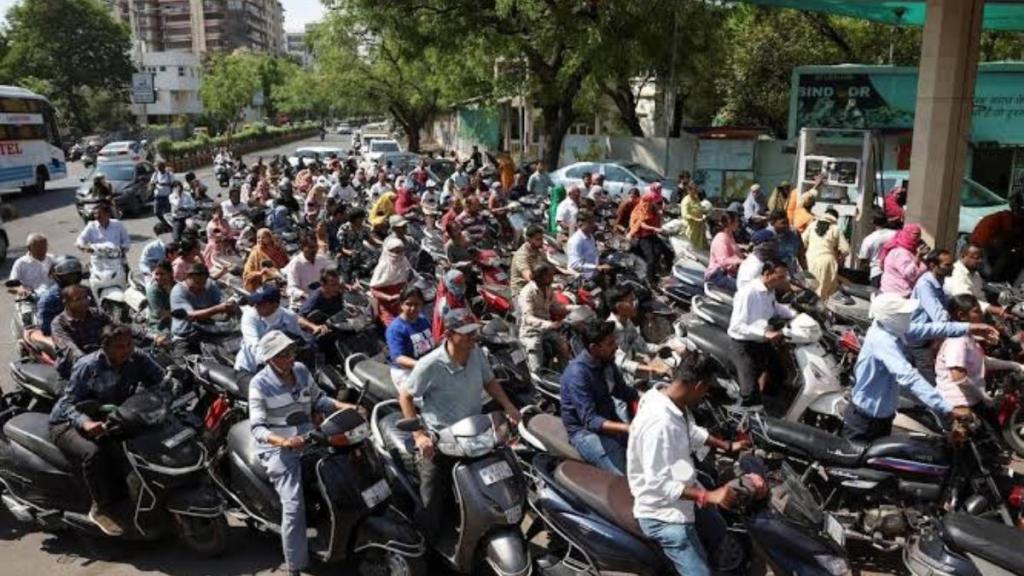

Most workers in India aged 15 years and above travel to work using two-wheelers and by walking, with less than 10% using public transport for their daily commute, according to a new survey by the Ministry of Statistics and Programme Implementation (MoSPI).
The average monthly expenditure on commuting to a fixed workplace was Rs 785 per worker, with commuters in urban India spending 70% more than their rural counterparts.
As per the survey, 42.6% of workers in India used two-wheelers to commute to fixed workplaces. Walking was the second most favored mode of commute at 28.3%.
Urban workers spent Rs 1,044 on average every month to commute to and from work, much higher than Rs 612 spent by workers in rural India, results of the first ever National Household Travel Survey (NHTS), conducted during July 2025 and June 2026, showed.
There was gender disparity in worker travel spending. Male workers on average spent Rs 835 per month on fixed-workplace commutes compared to Rs 533 per month for female workers.
Survey results showed a gender gap in workforce travel as well with 61.9% of male workers commuting more than 1 km daily for work compared to 41.9% of female workers.
Just 3% of workers used cars for their commute, while 6.7% used buses and 2.3% traveled by train, monorail, tram, etc. Usage of monorail, metro, suburban rail, and trams accounted for 5.0% of urban worker commutes nationally, but usage was sharply higher in Maharashtra (20.7%), West Bengal (16.5%), and Delhi (14.4%).
About 21.7% of female workers in urban areas used bus as their primary mode to travel to and from their workplace, while 57% of their male counterparts used two-wheelers for this purpose.
Over 64% of urban workers travelled 1 km or more to their workplace compared to 54.5% of their rural counterparts. Nearly 53% of female workers aged 15 years and above in urban areas travel 1 km or more to their workplace, compared to 37.7% of their rural counterparts.
Overnight trips undertaken by households were primarily for social and religious purposes, with buses being the predominant mode of transport, according to the survey results.
Nearly 74% of overnight trips rely on bus and rail, with buses’ share at 55.8% and inter-city railways at 17.7%. Cars were the third most used modes for household overnight travel at 15.1%.
The survey found that over 66.4% of students commute more than 1 km daily. Walking, buses, and bicycles accounted for the vast majority of student commutes in India.
Students aged 15-29 years recorded the highest regular trip participation at 79.1% in rural India and 73.3% in urban India for daily commute to attend educational Institutes.
The average student commute cost was Rs 443 per month, with urban students spending an average of Rs 617 every month on trips to and from educational institutions, compared to Rs 361 per month in rural India.
The average travel time from origin is 23 minutes for students and 25 minutes for workers travelling to a fixed workplace. Around 87.6% of students reached their educational institutions within 30 minutes, while 83.4% of workers commute to their fixed workplaces in less than 30 minutes.
States such as Rajasthan, Gujarat and Madhya Pradesh showed average commute times of around 20–23 minutes, with higher travel times in parts of southern India.
For within-day trips other than education and employment, people primarily used two-wheelers, walking, and auto-rickshaws.