


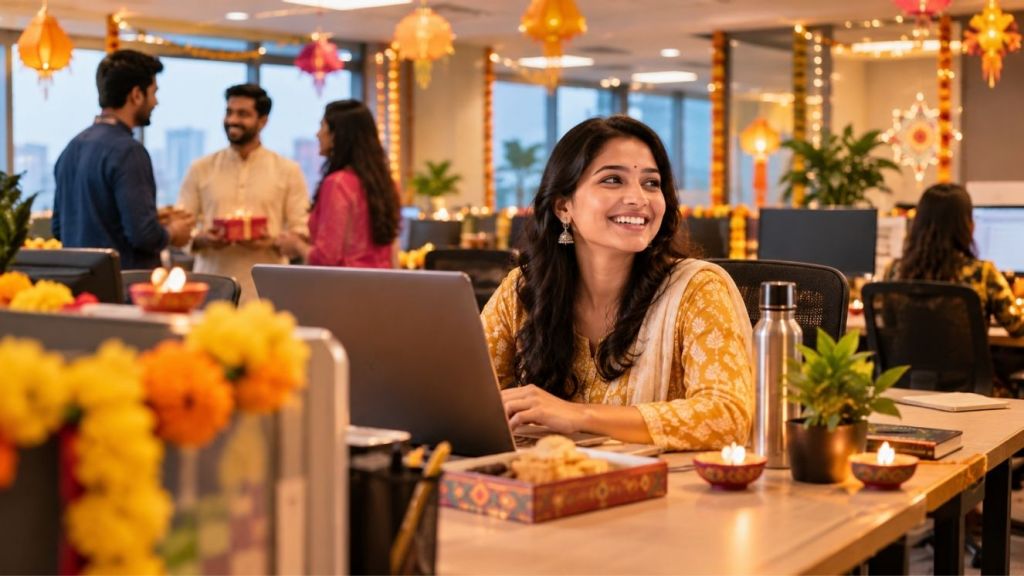

When it comes to being generous to employees on Diwali, it seems Indian companies feel the festive spirit more than their global counterparts.
For many employees in global organisations, a Diwali bonus is far from guaranteed. A mid-level employee at a foreign bank said the company offers neither a Diwali gift nor a bonus. A tax consultant at a multinational tech company, who has spent nearly 15 years with the organisation, echoed the sentiment: “MNCs don’t give Diwali bonuses. All these years we have not got any bonus or mithai.”
At several technology companies, festive gifting rather than a cash bonus appears to be the norm. “There is a trend of giving end-of-the-year gifts such as trolley bags or bluetooth speakers, but nothing on Diwali,” an employee shared.
Moreover, employees of these companies usually even miss the statutory bonus under the Payment of Bonus Act, 1965, which has since been subsumed into the Code on Wages, 2019, which seeks to consolidate and simplify India’s wage-related laws. Under this, factories or specified establishments are required to pay bonus to eligible employees. The minimum bonus prescribed is 8.33% of the salary, or Rs 100, whichever is higher, for employees with at least 30 working days in an accounting year and salary up to Rs 21,000.
Most companies time this bonus around Diwali, but as most MNC employees earn well above the Rs 21,000 limit, they are not eligible for this bonus.
But for businesses rooted in India, the cultural connect is higher. For instance, proptech startup NoBroker, whose annual revenue reportedly crossed Rs 1,000 crore in FY26, places particular emphasis on celebrating the people who often work behind the scenes. “Diwali begins with the people who are usually the first to arrive and the last to leave: our housekeeping, security, office support, electrical and maintenance teams, almost 250 outsourced staff. We hold a grand celebration in their honour and felicitate them with a gift chosen for its usefulness to them and their families. A festive dinner is organised and everyone is included,” said Amit Kumar Agarwal, CEO of NoBroker.
Last year, the company distributed silver coins, while this year, it has planned gifts worth Rs 4,000 each for over 250 outsourced staff, which comes to around 20% of their monthly salary (average salary around Rs 20,000).
Shaily Mehrotra, CEO and co-founder of skincare brand Fixderma and FCL (Fixderma Cosmetic Laboratories), said her company is stepping up its festive gifting this year for its workforce of around 700 employees. “We are giving our employees a Rs 5,000 Diwali bonus along with a trolley bag. Last year, we shared sweets and dry fruits with the team. We see this as a gesture of appreciation for the hard work and commitment our team brings throughout the year.” The company has a reported revenue of approximately Rs 275 crore.
At Gurugram-based FMCG company LT Foods, which has more than 2,700 employees and reported consolidated revenue of Rs 11,023 crore for FY26, Diwali celebrations include cultural activities, a traditional puja and festive gatherings. “Employees receive a box of sweets alongside a special hamper of LT Foods products, besides a Diwali bonus,” said Palash Aggarwal, chief human resources officer at LT Foods.
Experts say MNCs usually follow global practices when it comes to incentives, which are usually linked with performance instead of any particular festival. “The timing and amount of the bonus depend on the company’s internal policies. However, given the cultural significance of some festivals and based on local customs and practices, companies may offer festive gifts or vouchers instead of a cash bonus or align disbursement of bonuses with the festive month,” said Neeraj Agarwala, senior partner, Nangia & Co, a tax advisory firm. However, any bonus is subject to tax, but if the aggregate value of these gifts remains below Rs 15,000 for the entire financial year, they are tax-exempt, said Agarwala.
Based on market experience, Aditya Mishra, MD & CEO, CIEL HR, an HR solutions company, estimates that corporate gifting is growing at an estimated 15-20% annually. “Gifting is becoming a year-round activity, with companies planning budgets in advance. But many traditional Indian companies, especially smaller businesses, continue to offer employees a Diwali bonus alongside festive gifts. For these organisations, the practice is rooted in established traditions and the importance of celebrating festivals with employees. MNCs, on the other hand, generally follow structured compensation cycles, with bonuses linked to individual performance, organisational results, or both. These payments are typically aligned with the calendar year or financial year rather than a particular festival. This does not necessarily mean that MNCs offer fewer rewards; their approach to employee compensation is organised differently,” said Mishra.