



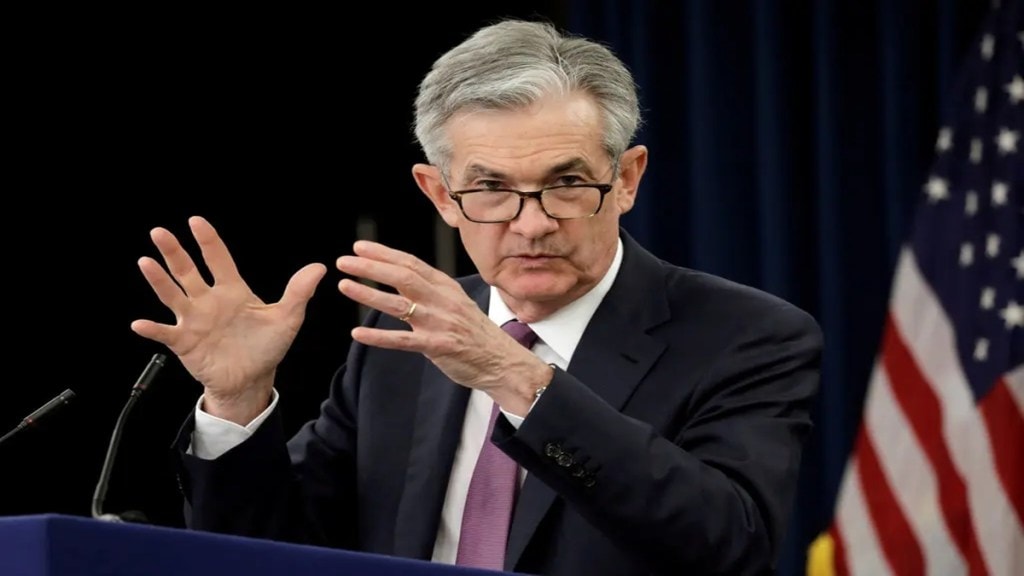
US Federal Reserve Chair Jerome Powell kept things simple on Monday when he spoke at the Hoover Institution at Stanford University. Before anything else, he told the audience exactly what he would not be talking about.
“Just to be clear, I will not address current economic conditions or monetary policy,” Powell said as he began his opening remarks. His decision comes just weeks before the Fed announces its next policy move, and any remark from him could have easily shaped expectations. Powell made sure that didn’t happen.
Jerome Powell steers clear of economy talk
Instead of discussing rates or inflation, Powell chose to focus entirely on George Shultz, the former US Secretary of State, calling it an honour to speak about his life and work.
“I am deeply honoured to have been asked to speak here today about the remarkable legacy of George Shultz,” Powell said, as he spoke at a panel held as part of the George P. Shultz Memorial Lecture Series. Powell shared that his admiration and respect for Shultz began when he was still in college. At the time, he saw Shultz as the kind of public figure he hoped to emulate, someone who worked in the private sector but also served the country.
FOMC meeting in December
The next Federal Open Market Committee (FOMC) meeting is scheduled for December 9–10, with Fed Chair Jerome Powell set to announce the monetary policy decision on December 10. Markets are expecting a 25-basis-point rate cut, which would mark the third drop this year.
The Federal Reserve’s mandate remains unchanged — support the job market and keep inflation at a moderate, stable level. In September, US inflation came in lower than expected, and the core CPI also rose less than anticipated. The White House had earlier said the October US CPI might not be released due to the government shutdown.
Who was George Shultz
George P. Shultz was one of America’s most respected public servants. He served as the 60th US Secretary of State from 1982 to 1989, and played a major role in improving relations with the Soviet Union during the final years of the Cold War.
Shultz served in four Cabinet positions. He stayed active on major issues, including health care reform, climate change, and nuclear disarmament, even after leaving office. Over his long career, he served as Secretary of Labor, Secretary of the Treasury, and Director of the Office of Management and Budget.
He worked in both the Nixon and Reagan administrations, and his influence reached nearly every part of the US government. The Foreign Service Institute (FSI) later renamed its main campus the George P. Shultz National Foreign Affairs Training Center in his honour.
“George may also have caught my attention because my dad was a labour lawyer who represented one of the major steel companies in collective bargaining. Like George, my father had both a belief in the collective bargaining process and a deep respect for workers,” Powell said during the speech. “He was a man who combined strong principles and unshakeable integrity with common sense and a practical, problem-solving approach to policy. He had a deep belief in the wisdom of markets and a desire to let them work whenever possible without government direction,” he added.