


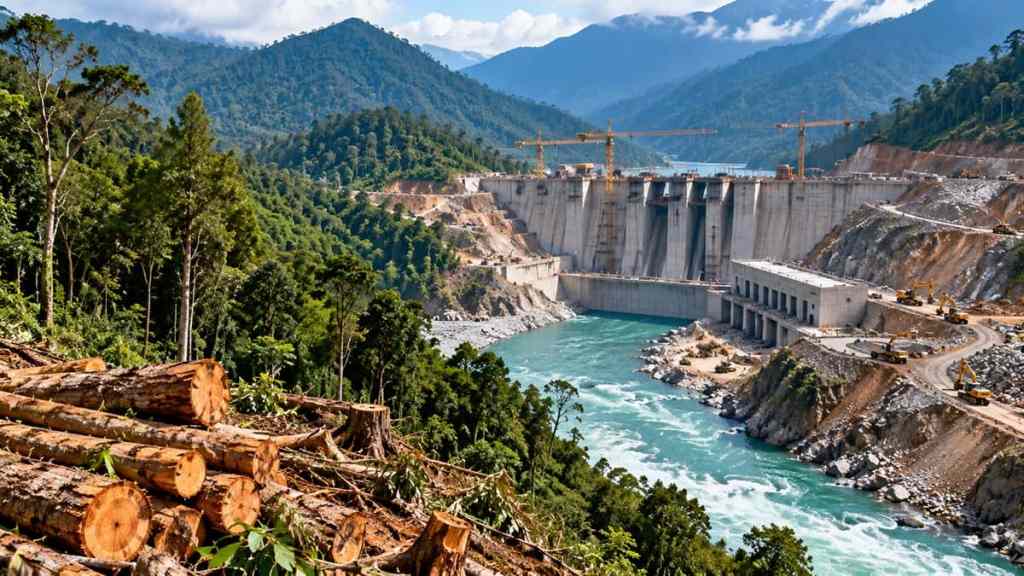

State-run NHPC has sought forest clearance to divert 3,278 hectares of forest land in Arunachal Pradesh for its proposed Rs 24,000-crore, 1,720 MW Kamala hydroelectric project. The proposal could involve the felling of more than 23.4 lakh trees across three districts in the lower Himalayas.
According to The Indian Express, the proposal will be considered by the Forest Advisory Committee (FAC) of the Union Environment Ministry on October 23. The committee reportedly examines proposals seeking approval to use forest land for non-forest purposes.
The project, planned on the Kamala River, a right-bank tributary of the Subansiri River, is among a series of hydropower projects proposed in the Subansiri river basin.
The proposed diversion covers forest areas in Kra Daadi, Kurung Kumey and Kamle districts. Official documents cited by The Indian Express show that 23,40,213 trees have been identified for felling, including around 15.08 lakh in the Hapoli forest division and 8.31 lakh in the Kra Daadi division.
Compensatory afforestation proposed in Madhya Pradesh
NHPC has proposed compensatory afforestation over 7,018 hectares across several districts of Madhya Pradesh to offset the diversion of forest land in Arunachal Pradesh.
Under the Forest Conservation Act framework, compensatory afforestation generally requires an equivalent area of non-forest land to be made available for plantations. Where equivalent non-forest land is unavailable, plantations covering twice the diverted forest area may be undertaken on degraded forest land.
The arrangement shows provisions that allow compensatory afforestation obligations to be met in another state when suitable non-forest land is not available locally. The proposed plantations in Madhya Pradesh would cover more than twice the 3,278 hectares of forest land sought for diversion.
Wildlife impact flagged in site inspection
In January, the Kamala project received a recommendation for environmental clearance from the Environment Ministry’s sectoral expert panel on river valley and hydroelectric projects. The recommendation was conditional on obtaining in-principle forest clearance before the final environmental clearance could be granted.
A site inspection report by officials from the ministry’s regional office in Shillong noted that the project site does not fall within a national park, wildlife sanctuary, biosphere reserve or elephant corridor.
However, the report also flagged potential impacts on wildlife habitats. It noted that the expanded submerged area could hinder the movement of wild animals between riverbanks and called for a wildlife mitigation plan or biodiversity conservation plan, The Indian Express reported.
The concern comes amid the proposed diversion of forest areas that include dense vegetation and wildlife habitats in the Kamala River valley.
Nearly 3,300 hectares of forest proposed for diversion
The forest land proposed for diversion includes 439 hectares classified as very dense forest and 1,119 hectares categorised as moderately dense forest.
Field surveys conducted across seasons recorded 155 plant species belonging to 69 families in the study area, according to the project documents cited by The Indian Express.
The Kamala River valley is predominantly hilly and largely covered by dense forests. The project’s reservoir and dam-top areas are expected to account for nearly 2,960.49 hectares of forest land.
Conceived as a run-of-the-river project with storage, the scheme envisages a 216-metre-high concrete gravity dam with flood moderation features.
5,440 families across 126 villages could be affected
Beyond the ecological impact, the project is expected to affect 5,440 families across 126 villages, according to its Social Impact Assessment report.
With a proposed capacity of 1,720 MW and an estimated investment of nearly Rs 24,000 crore, the Kamala project is a massive hydropower development planned in the region. However, the proposed forest diversion, tree felling and potential effects on wildlife habitats remain key considerations as the clearance process proceeds.
The FAC’s appraisal of the forest diversion proposal on October 23 will be an important step in determining whether the project can move forward with the proposed use of forest land.