


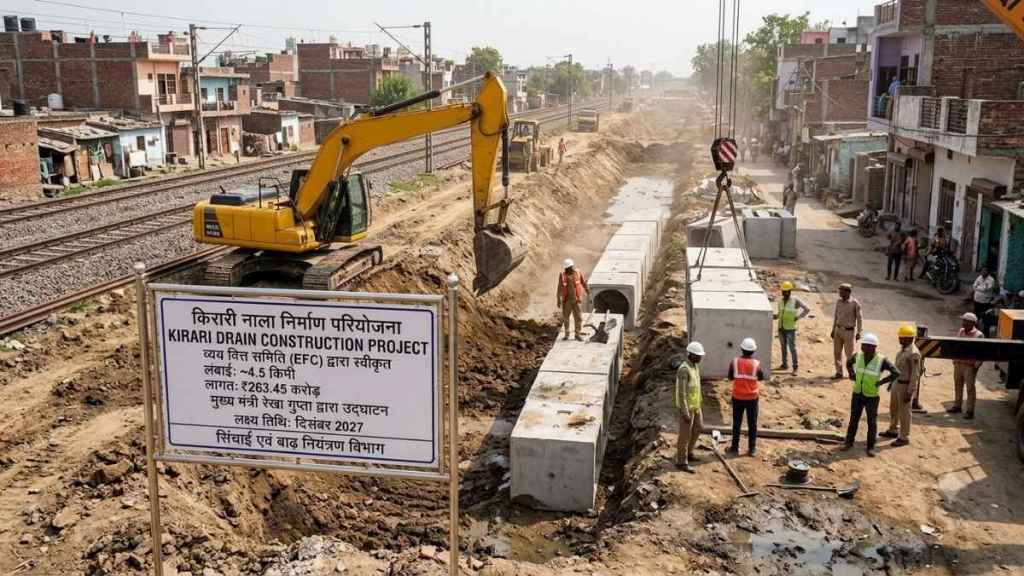

Delhi’s Expenditure Finance Committee, headed by Chief Minister Rekha Gupta, on Tuesday cleared a Rs 263.45-crore plan to construct an approximately 4.5-kilometre drain alongside the railway tracks in Kirari, news agency ANI reported. The Irrigation and Flood Control Department expects the work to finish by December 2027. The new drain is intended to provide a lasting solution to the locality’s repeated monsoon flooding.
Once the work is completed, the new drainage network will benefit residents across four assembly constituencies — Kirari, Mundka, Bawana, and Nangloi Jat— as well as 70 unauthorised colonies in Kirari.
Why is Kirai drain project significant?
The CM has said that waterlogging remains a serious hardship for Kirari residents, especially in the monsoon months, when inundated streets interfere with everyday movement and damage homes as well as local commerce. She stressed that the administration is prioritising a lasting fix instead of relying solely on short-term seasonal interventions.
Irrigation and Flood Control Minister Parvesh Sahib Singh described the scheme as one element of a broader push to upgrade Delhi’s drainage infrastructure. According to him, the new drain will channel excess rainwater out of chronically flooded pockets and ease conditions across Kirari and the adjoining constituencies.
How does the project resolve the waterlogging problem?
The new drain is planned to start close to Mundka Halt railway station and link up with the Supplementary Drain. Designed to handle 760 cusecs, it will serve as a primary channel for rainwater that now pools along the railway corridor. Neighbourhoods set to gain relief include Rani Khera Industrial Area, Venu Enclave, Ratan Park, Rajdhani Park, the JJ Cluster Colony, Rajendra Park Extension, Ram Nagar, Kunwar Singh Nagar and Nilothi village.