


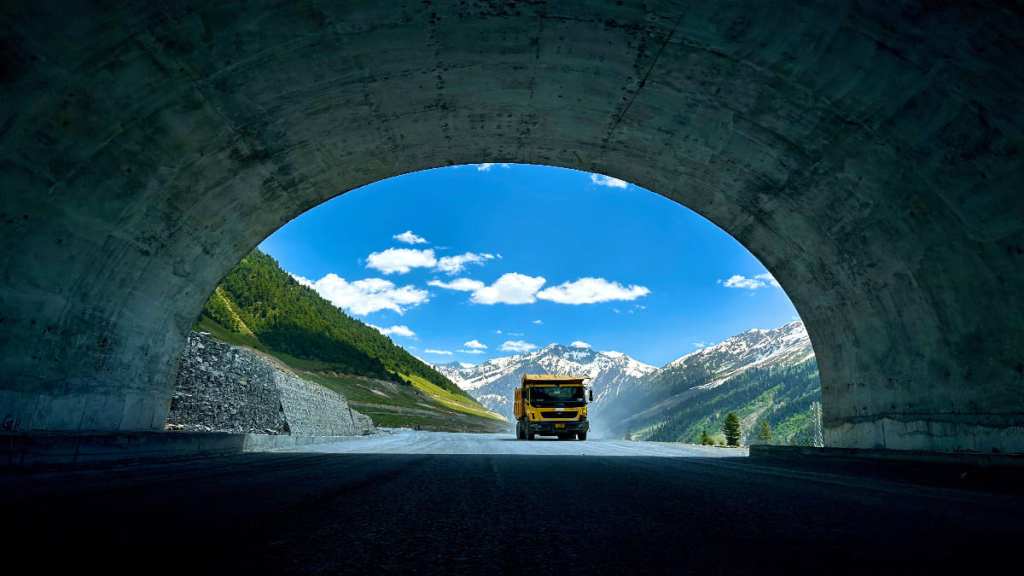

India is witnessing a major expansion of tunnel infrastructure across roads and railways, with projects coming up in the Himalayas, the Northeast and major urban centres.
From high-altitude road tunnels to underwater rail tunnels, these projects are being built to improve connectivity across difficult terrain and reduce travel distances.
Several major projects have also recorded construction milestones in 2026, including breakthroughs, tunnel boring machine launches, and new project approvals. Here are some of the major tunnel projects currently under construction or in the development stage across India.
1. Zojila Tunnel: A major project connecting Kashmir and Ladakh
The Zojila Tunnel is being built between Baltal in Jammu and Kashmir and Minamarg in Ladakh on National Highway-1. The project is being constructed in a high-altitude region that faces heavy snowfall, harsh weather, and complex geological conditions.
The key details of the Zojila Tunnel project are:
| Feature | Details |
| Location | Baltal, Jammu and Kashmir to Minamarg, Ladakh |
| Main Tunnel | 13.153 km (bi-directional) |
| Approach Roads | 17.030 km |
| Total Project Length | 30.18 km |
| Project Cost | Rs. 6,809 cr |
| Tunnel Type | Bi-directional tunnel |
Latest update: Main tunnel breakthrough
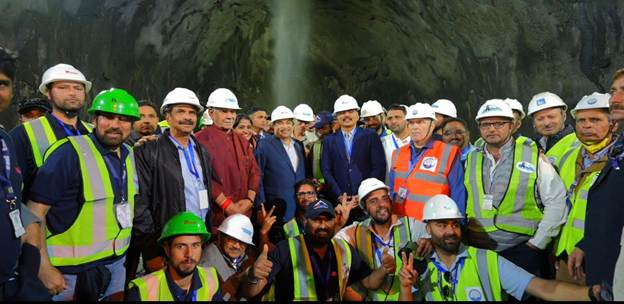
The main tunnel achieved a breakthrough on June 9, 2026, at the eastern portal in Minamarg, Kargil district.
The project also includes eight cut-and-cover sections, four bridges, 40 culverts, snow galleries, catch dams, and avalanche protection structures. The tunnel will have ventilation systems, automatic fire detection, CCTV surveillance, and pedestrian cross-passages.
2. Brahmaputra Underwater Road-cum-Rail Tunnel — Assam
Assam is set to get India’s first underwater road-cum-rail tunnel and the second such tunnel in the world. The tunnel will come up under the Brahmaputra River as part of the 33.7-km Gohpur–Numaligarh corridor.
The tunnel will have two tubes, each with two road lanes. One tube will also include railway infrastructure.
The key details of the Brahmaputra Underwater Road-cum-Rail Tunnel project are:
| Feature | Details |
| Project Name | Brahmaputra Underwater Road-cum-Rail Tunnel |
| Corridor | Gohpur on NH-15 – Numaligarh on NH-715 |
| Total Project Length | 33.77 Km |
| Twin Tube TBM Tunnel Length | 15.79 Km (Railway in one tube) |
| Total Civil Cost | Rs.11,982 cr |
| Total Capital Cost | Rs.18,662 cr |
| Major Roads Connected | National Highways: NH-15 & NH-715 |
Route and connectivity
The road distance between Gohpur and Numaligarh is currently around 240 km, and the journey takes about six hours. The new corridor will provide a more direct route between the two locations.
The project will also connect with railway routes on both sides — the Rangia–Murkongselek section near Gohpur and the Furkating–Mariani loop line near Numaligarh.
The new corridor will improve the road and rail connectivity across Assam and other parts of the Northeast.
3. Mumbai–Ahmedabad Bullet Train underwater tunnel — Maharashtra
India’s first undersea rail tunnel is being built as part of the Mumbai–Ahmedabad Bullet Train project in Maharashtra.
The 7-km undersea section will pass beneath Thane Creek and will be part of a larger 21-km underground tunnel between BKC and Shilphata.
Latest update on construction
In July 2026, the second TBM began excavation from Sawli towards Vikhroli. The first TBM had already started excavation from Vikhroli towards BKC.
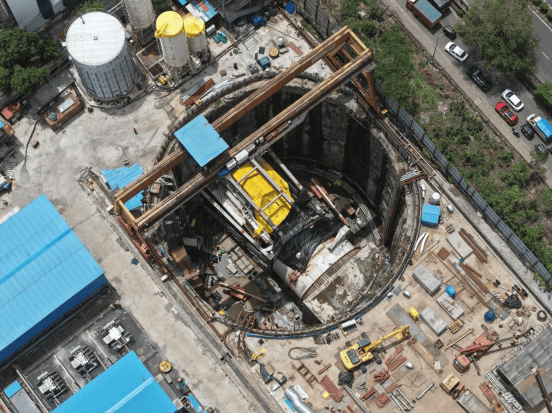
The tunnel will allow the Mumbai–Ahmedabad High-Speed Rail corridor to pass beneath Thane Creek and form a key underground section of the bullet train route.
4. Rishikesh–Karnaprayag Rail Project — Uttarakhand
The Rishikesh–Karnaprayag Rail Project is a 125-km railway line being built through the mountainous terrain of Uttarakhand.
The alignment passes through Dehradun, Tehri Garhwal, Pauri Garhwal, Rudraprayag and Chamoli districts, connecting Rishikesh with destinations including Devprayag and Karnaprayag. A large part of the alignment will pass through tunnels, making it one of the major tunnelling projects in the state.
The key details of the Rishikesh–Karnaprayag Rail project are:
| Feature | Details |
| Project Name | Rishikesh–Karnaprayag Railway Line |
| Location | Uttarakhand |
| Rail Line Length | 125 km |
| Main-Line Tunnels | 16 |
| Main Tunnel Length | 104 km |
| Escape Tunnels | 12 |
| Escape Tunnel Length | 98 km |
The project includes 16 main-line tunnels and 12 escape tunnels. Eight additional access tunnels, known as adits, have also been completed. Together, these adits cover around 5 km and provide additional access points for construction.
Latest update
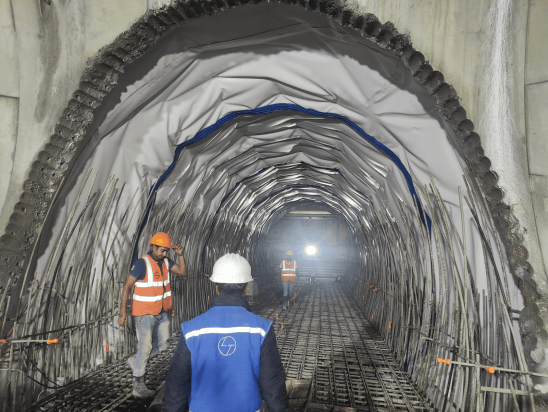
As of July 2026, around 101 km of the 104-km main-line tunnelling work and more than 95 km of the 98-km escape tunnels had been completed, according to the latest government update.
Once completed, the railway line will provide rail connectivity to Uttarakhand’s hill districts and destinations such as Devprayag and Karnaprayag.
5. Bengaluru–Kadapa–Vijayawada Economic Corridor tunnel — Andhra Pradesh
Road travel between Bengaluru and Vijayawada is set to get a more direct route with a 3.68-km tunnel being built on the Bengaluru–Kadapa–Vijayawada Economic Corridor. The tunnel will pass through a hilly and forested stretch in Andhra Pradesh, helping vehicles avoid the existing longer route.
The wider 343-km corridor is being developed as a six-lane, access-controlled greenfield highway connecting Bengaluru with Vijayawada.
| Feature | Details |
| Corridor | Bengaluru–Kadapa–Vijayawada Economic Corridor |
| Highway | NH-544G |
| Location | Andhra Pradesh |
| Tunnel Length | 3.68 km |
| Estimated Cost | ₹1,092.18 crore |
| Expected Completion | Mid-2027 |
Latest update
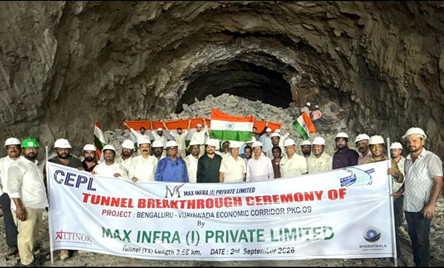
The 3.68-km tunnel achieved excavation breakthrough on September 4, 2026. The tunnel is being constructed under Package-9 of NH-544G, between Porumamilla in YSR Kadapa district and Sitaramapuram in SPSR Nellore district.
6. Dwarka Expressway–Vasant Kunj Tunnel — Delhi
A new underground road link is planned between Dwarka Expressway and Vasant Kunj in Delhi, aimed at providing a more direct route between the two areas.
The project includes a tunnel passing beneath the Southern Ridge and is part of a wider six-lane, access-controlled corridor. The key details of the tunnel are below.
| Features | Details |
| Corridor | Dwarka Expressway–Vasant Kunj |
| Total Corridor Length | 8.1 km |
| Tunnel Length | 3.14 km |
| Project Cost | Rs.6,969 cr |
| Route | Shiv Murti Interchange–Nelson Mandela Marg |
| Road Type | Six-lane, access-controlled |
| Construction Model | Hybrid Annuity Model |
The corridor will connect the Shiv Murti Interchange on Dwarka Expressway with Nelson Mandela Marg in Vasant Kunj. A major portion of the alignment will run underground, including a section beneath the Southern Ridge.
The project is planned to provide a direct road connection between the Dwarka side of Delhi and Vasant Kunj, while reducing the need for vehicles to use longer surface routes.
Project status
The project received Union Cabinet approval in July 2026 and is being developed by the National Highways Authority of India (NHAI). Construction is yet to begin, making it one of the upcoming tunnel projects in the Delhi-NCR region.
7. Shinkun La Tunnel — Himachal Pradesh-Ladakh
Shinkun La Tunnel, which is set to become the world’s highest tunnel upon completion, is being developed to provide all-weather connectivity to Ladakh.
| Feature | Details |
| Tunnel | Shinkun La Tunnel |
| Location | Himachal Pradesh–Ladakh |
| Length | 4.1 km |
| Type | Twin-tube road tunnel |
| Road | Nimu–Padum–Darcha |
| Altitude | Around 15,800 feet |
The tunnel forms part of the wider Nimu–Padum–Darcha road, which provides an alternative road link towards Ladakh.
Why is the tunnel being built?
The Shinkun La Tunnel is being developed by the Border Roads Organisation (BRO). Once completed, it is expected to strengthen year-round road connectivity between the region and Ladakh, while reducing dependence on the high-altitude pass.