


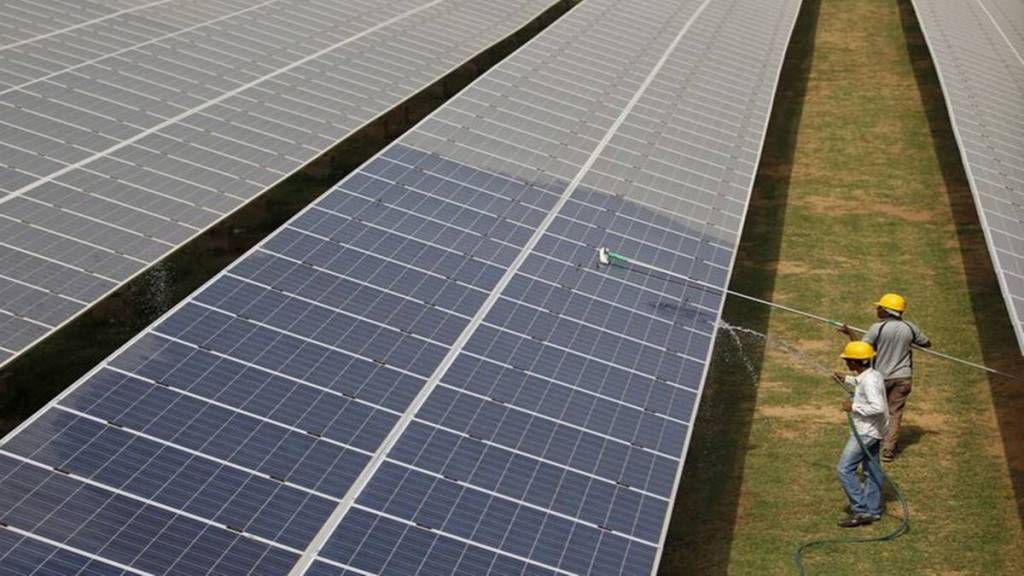

India has announced a Rs 1.86 lakh crore green energy corridor to improve intra-state transmission infrastructure and battery storage.
The country has made significant strides towards its goal of 500 GW in renewable energy by 2030 — even as transmission bottlenecks, thermal stress and battery storage concerns took centre stage. The investment announced on Wednesday is expected to add 51,126 circuit km of transmission lines, 2,28,903 MVA of substation capacity and 50 GWh of battery storage.
“The country’s current power generation capacity exceeds 500 gigawatts, with renewable energy sources already accounting for 52% of this total…the grid must be designed to manage the load associated with these fluctuations. Handling this variability poses a major challenge,” Union Minister Ashwini Vaishnaw said while announcing the Cabinet decision.
He added that the goal of sourcing 500 gigawatts from non-fossil fuel sources now looked “achievable” by 2030. Vaishnaw told reporters that India had already reached a capacity of around 270 gigawatts from non-fossil fuel sources.
“Furthermore, the plan is to achieve a capacity of 786 gigawatts by 2035–36. With these targets in place, it is crucial to ensure adequate transmission and evacuation capabilities for renewable energy,” he added.
Rs 1,86,405 crore investment
The government has laid heavy emphasis on grid-readiness and stability for integrating large shares of renewable energy over the past year — implementing an intra-state Green Energy Corridor scheme in 10 states. A PIB release in mid-March explained that the transmission system for evacuation of 24 GW RE under GEC Phase-I had already been commissioned while the transmission system under GEC-II for evacuation of around 20 GW RE was under implementation.
According to a PIB press release, GEC-III is expected to be set up by FY2032-33 with a total project outlay of Rs.1,86,405 crore. This includes Rs.1,36,378 crore for the development of Intra-State Transmission Systems under Phase-III of the scheme and Rs.50,000 crore for 50 GWh of Battery Energy Storage Systems. It involves total central financial support of Rs.54,082 crore.
Vaishnaw noted that the primary objective of the newly announced project was to develop “harmonised and accelerated renewable energy access” and create a ‘smart’ grid. He explained that this would involve “designing the grid with the inherent variability of renewable energy in mind” — introducing innovations to handle these fluctuations and upgrading the existing grid infrastructure.
“The scheme will help in achieving the target of 900 GW installed Non-Fossil capacity by 2035. The scheme will also contribute to long term energy security of the country and promote ecologically sustainable growth by reducing carbon footprint. It will generate large direct & indirect employment in the power sector, manufacturing, and construction industries,” the official release reiterated.
Massive loss of clean electricity
According to a study by the Centre for Science and Environment, renewable energy has seen a 3.5x increase within six years to exceed 140 GW of installed capacity. But the report warned that the rapid surge had “fundamentally altered the demand–supply balance in the grid”. CSE highlighted deep intra-day variability and operational stress on conventional generation that now presented a significant challenge to the stability of the national power grid.
Union Minister Shripad Naik also told Parliament in late July that the government held back 8,133 GWh of solar power in the April-June quarter owing to transmission constraints. News agency Reuters calculated at the end of July that India had been unable to run 7% of its solar capacity at full output due to infrastructure curbs.
According to energy think tank Ember, transmission constraints have led to a loss of 300 gigawatt-hours of clean electricity between January and March 2026. Naik also told Parliament that curbs in transmission occurred mainly during peak solar generation hours — when power flows can exceed the capacity of available transmission lines.
Transmission bottlenecks and battery storage issues
India has seen a significant “mismatch between the commissioning of clean energy projects and the transmission systems meant to carry their output” as it expands non-fossil energy capacity towards 500 GW. Transmission bottlenecks, thermal stress and limited battery storage have emerged as the key pressure points.
The “variable and intermittent” nature of renewable energy sources has made it difficult for India to integrate a substantial share of such generation into the existing grid. A significant mismatch continues to persist between production sites and the demand locations — with authorities forced to move power across thousands of kilometers of transmission lines to the rest of the country.
Details shared by the Ministry of Statistics and Programme Implementation at the end of March also highlighted a concerning geographical imbalance to the green expansion — with more than 70% of India’s entire renewable energy potential heavily bottlenecked in just six states. The report put the total estimated renewable energy potential at 4,704,043 MW by the end of March 2025. Rajasthan remained in the lead with 23.70% while Maharashtra followed with 14.26% of the estimated renewable energy generation potential. Gujarat was a distant third at 9.10%, with Andhra Pradesh (9.1%) and Karnataka (8.59%) following closely behind. Madhya Pradesh rounded out the list with 8.09% of this quota.
Grid congestion and power loss due to transportation is also compounded by a dearth of battery storage capacity. Solar and wind are intermittent sources of energy that can be affected by phenomena such as daylight timings or weather patterns. Battery storage therefore plays a critical role — smoothing out uncertainties with a reservoir of stored energy supply.