


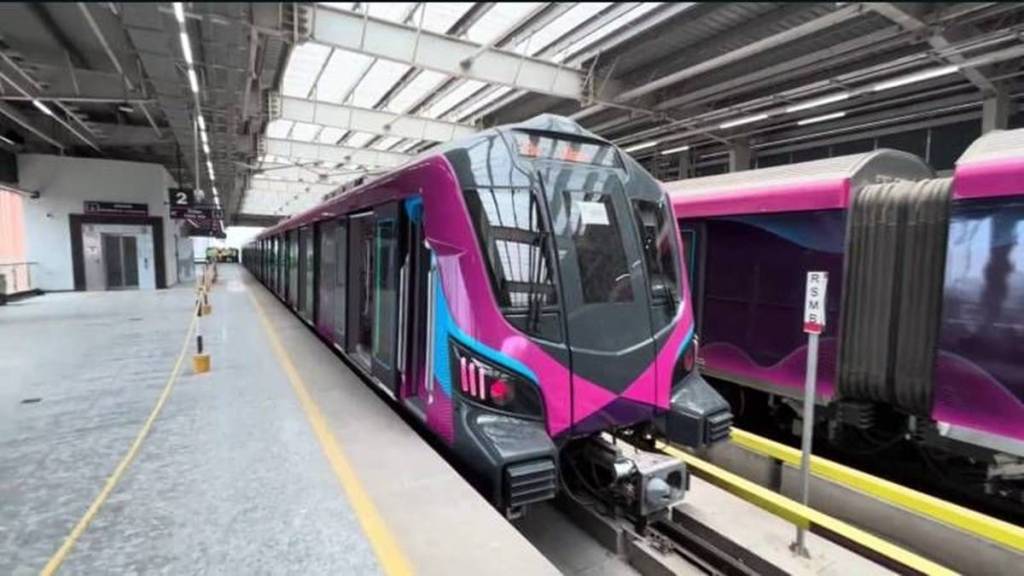

Pune’s metro network is set for a major expansion, with Prime Minister Narendra Modi virtually inaugurating Pune Metro Line 3, also known as the Pink Line, today.
The new corridor will connect the Hinjewadi IT hub with Shivajinagar, providing metro connectivity to one of the city’s busiest employment centres. Alongside the inauguration, the Prime Minister also laid the foundation stone for four new metro corridors under Phase II.
PM Modi said while virtually inaugurating the metro line that he was pleased to see another section of the Pune Metro opening. He recalled laying the foundation stone for the project’s first phase 10 years ago. He added that the new metro service would improve connectivity to Pune’s major IT hub.
Live: PM Shri @narendramodi inaugurates, lays foundation stone of Pune Metro Projects.
https://t.co/UsJ2Eb69qB
— G Kishan Reddy (@kishanreddybjp) November 3, 2026
Together, the projects involve an investment of around Rs 21,800 crore and are expected to extend metro connectivity to several residential, commercial and IT hubs across Pune.
Pune Metro Line 3: 23-km Pink Line route, stations
Built at a cost of over Rs 8,300 crore, Pune Metro Line 3 will run for 23 km, connecting Maan with District Court Metro station.
The corridor will link the Hinjewadi IT hub with Shivajinagar, covering several important residential, commercial and office areas along the way.
The route will include Maan, Maan-MIDC Circle, Maan Bus Depot, Hinjewadi Phase II-Circle II, Hinjewadi Phase II-Circle I, Padmabhushan Chowk, Shree Shiv Chhatrapati Shivaji Maharaj Chowk, Hinjawadi, Hinjawadi Phase I, Wakad Chowk, Shree Shiv Chhatrapati Sports Complex, Mahalunge, Mitcon Balewadi, R K Laxman Museum Balewadi, Balewadi High Street, Balewadi Phata, Baner Gaon, Baner Pashan Link Road, Aundh, Sakal Nagar, Savitribai Phule Pune University, Bhosale Nagar, Agriculture College, Shivajinagar and District Court.
Hinjewadi IT hub to get direct metro connectivity
The new corridor will make daily travel easier for IT professionals and other commuters travelling between Hinjewadi and central Pune. It will also connect with the existing metro network, allowing commuters to access other parts of the city through interchange facilities.
Pune Metro Phase II: Four new corridors to expand network
Apart from inaugurating Line 3, PM Modi also laid the foundation stone for Pune Metro Phase II, estimated to cost around Rs 13,500 crore.
The expansion will include four corridors — Lines 2A, 2B, 4 and 4A — covering a total of more than 44 km. These routes will extend metro connectivity to several residential, commercial and IT hubs across the city.
Under the plan, Lines 2A and 2B will cover a combined length of around 12.75 km. Line 2A will connect Vanaz with Chandani Chowk, while Line 2B will extend the existing east-west metro network from Ramwadi to Vitthalwadi.
Line 4 will run for around 25.52 km, connecting Kharadi with Khadakwasla. Meanwhile, Line 4A will cover 6.12 km between Nal Stop and Manik Baug.
Kharadi, Magarpatta, Hadapsar to get better metro connectivity
The new corridors will bring several important areas under the expanding metro network, including Kharadi, Magarpatta, Hadapsar, Swargate, Manik Baug, Nanded City, Pune Cantonment and Warje.
The extension from Ramwadi to Vitthalwadi is expected to improve metro access to the developing residential, commercial and IT areas of Kharadi and Wagholi. The proposed Kharadi-Khadakwasla corridor will also connect several important parts of the city.
New metro lines to integrate with existing network, bus services
The new routes will also be connected with the existing Pune Metro network and intercity bus services to make travel between different transport systems easier.
Interchange facilities are planned at Swargate, Nal Stop and Kharadi Bypass. These connections are expected to help passengers switch between metro services and access intercity bus transport more conveniently.
Line 3 to have women train operators, solar power
The Pink Line will also introduce measures focused on women’s participation and environmental sustainability. The entire corridor will be operated by women train operators, making it a first-of-its-kind initiative.
In another green initiative, around 30% of the line’s total electricity requirements are expected to be met through solar power. The project is also expected to encourage commuters to use public transport instead of private vehicles, helping reduce road congestion and vehicular emissions.