


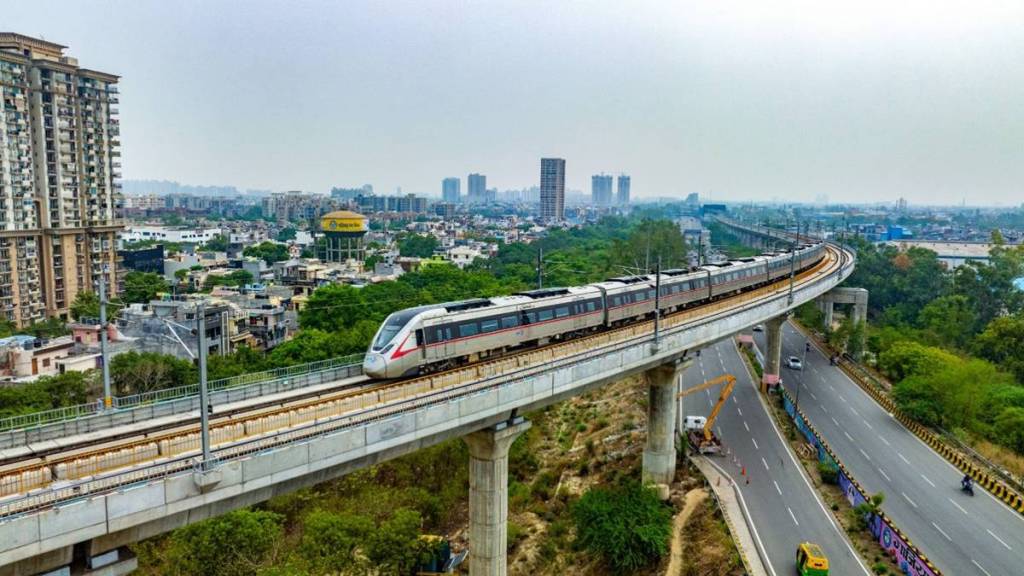

Following the success of India’s first semi-high-speed regional rail corridor connecting Delhi, Ghaziabad, and Meerut, the National Capital Region Transport Corporation (NCRTC) is now preparing to expand the network with two new priority corridors.
These include the Delhi–Panipat–Karnal Namo Bharat corridor and the Delhi–Gurugram–Bawal Namo Bharat corridor, which aim to make regional travel faster, more convenient, and more efficient for thousands of daily commuters.
Shalabh Goel, Managing Director of NCRTC, spoke to Financial Express Digital and revealed that the proposed Delhi–Panipat–Karnal corridor is expected to cut travel time between Delhi and Karnal from nearly 180 minutes to just 90 minutes.
Similarly, the Delhi–Gurugram–Bawal corridor will reduce the travel time between Delhi and Bawal from about 180 minutes to about 67 minutes.
Cabinet nod expected soon for both corridors
According to Goel, the proposed corridors are in the final stages of securing approval from the Centre. Meanwhile, the preparatory work has already begun.
This includes geotechnical investigations, utility mapping, and the shifting or modification of utilities such as extra-high-tension (EHT) power lines and water pipelines.
These early activities are expected to speed up construction once the projects receive the required government approvals. Once approved, the corridors are expected to improve regional connectivity and significantly reduce travel time for passengers across the National Capital Region (NCR).
Economic Impact: Proposed corridors to boost growth across NCR
Explaining the wider economic impact of the projects, Goel added that the proposed Namo Bharat corridors will help distribute economic activity more evenly across the National Capital Region (NCR).
This will reduce pressure on Delhi while creating new growth opportunities in emerging urban centres.
He added that the corridors will also support Transit-Oriented Development (TOD) by enabling planned, mixed-use development around Namo Bharat stations.
This is expected to improve accessibility, encourage economic activity and enhance the overall quality of urban life. Beyond driving long-term regional growth, the development of the corridors is expected to generate substantial direct and indirect employment during both the construction and operational phases.
Delhi–Karnal Corridor to link key cities & hubs
The Delhi–Panipat–Karnal Namo Bharat corridor will strengthen connectivity between several key urban, educational and industrial centres.
The route will connect Education City in Kundli (Sonipat), the Barhi Industrial Area, Panipat city, the IOCL refinery and Karnal, making travel easier for students, workers and daily commuters.
Delhi–Bawal Corridor to connect airport, industrial belt
The proposed Delhi–Gurugram–Bawal Namo Bharat corridor will connect key urban and industrial centres, including Gurugram, Manesar, MBIR and Bawal.
Goel added that the corridor will also provide seamless connectivity to Delhi Airport through the Namo Bharat network, making travel more convenient for commuters while supporting industrial and economic growth across the region.
How will new Namo Bharat Corridors benefit daily commuters?
Reduction in travel time: The new Namo Bharat corridors are expected to significantly cut travel time across the NCR. Journeys that currently take nearly three hours could be completed in around an hour to an hour and a half, making daily commuting faster and more convenient.
-Improved connectivity: The new corridors will improve connectivity between major cities and nearby towns. It will help people move more easily between home, work, and other key destinations. This better connectivity will also support access to education, jobs, and industrial areas.
-Reduced traffic congestion: The new corridors are expected to reduce traffic on roads by offering a faster rail option for commuters. This will help shift a large number of daily commuters from road to rail. With fewer vehicles on the road, travel is likely to become smoother and less stressful, especially during peak hours.
More mobility in NCR
For years, daily travel across the NCR has been shaped by long road journeys and heavy traffic. The expansion of Namo Bharat will change this by creating a faster regional transport network that connects cities beyond Delhi more efficiently.
As new corridors come up, commuters will get a reliable alternative for travelling between residential areas, workplaces and industrial hubs.
With quicker journeys, smoother interchange with other transport systems and better access to key destinations, Namo Bharat will play an important role in shaping the future of mobility in the NCR.
India’s first Namo Bharat corridor
The Delhi–Meerut Namo Bharat Corridor, India’s first semi-high-speed regional rail corridor, spans 82 km and connects Delhi, Ghaziabad and Meerut through a network of 16 stations, offering faster and more efficient regional connectivity across the NCR.
The route covers key locations including Sarai Kale Khan, Jangpura, New Ashok Nagar, Anand Vihar, Sahibabad, Ghaziabad, Guldhar, Duhai, Duhai Depot, Muradnagar, Modi Nagar South, Modi Nagar North, Meerut South, Shatabdi Nagar, Begumpul and Modipuram.
As per official data shared by NCRTC, the Delhi–Meerut corridor has been developed at an estimated cost of Rs 30,274 crore and comprises both elevated and underground sections.