


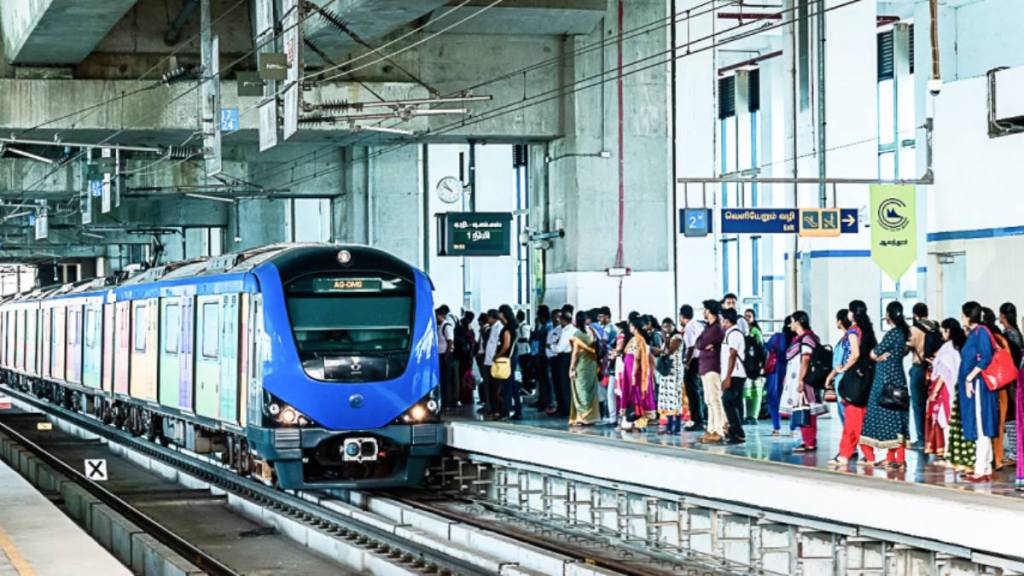

Chennai’s metro network is set for a major expansion as work continues on the second phase of the project across different parts of the city.
The planned network will bring metro services to more residential areas, business districts and suburbs, giving commuters more routes for daily travel.
The expansion covers 118.9 km across three corridors, with both elevated and underground sections. Construction is progressing on different stretches, including tunnelling work that is gradually taking shape beneath some of the city’s busy areas.
Phase-II Corridor-3 gets tunnelling boost
One of the latest signs of progress on Chennai Metro Phase-II comes from Corridor-3, where the Downline Tunnel Boring Machine (TBM) Kaveri has completed its drive to Kilpauk Medical College (KMC) station.
Kaveri broke through at KMC on September 29, 2026, after completing the 685-metre tunnel between Chetpet and KMC. The tunnel, built by Larsen & Toubro under the TU02 contract, took 252 days to complete.
During the drive, the TBM passed beneath five live Southern Railway tracks, the Chetpet Eco Park lake and buildings of Kilpauk Medical College. It also worked close to the existing Phase-I tunnels, maintaining a minimum clearance of 6.1 metres.
Chennai Metro Phase-II: 3 corridors and 128 stations
The Phase-II network will add three new metro corridors, taking services to several parts of Chennai that are currently outside the operational metro network.
Together, the three lines will cover 118.9 km, including 76.3 km of elevated sections and 42.6 km underground.
For commuters, the routes will cover different parts of the city — from Madhavaram in the north to Siruseri and Sholinganallur in the south, while Corridor-4 will connect the Lighthouse area with Poonamallee.
| Corridor | Line / Colour | Route | Length | Total No. of Stations |
| Corridor 3 | Purple Line | Madhavaram Milk Colony to Siruseri SIPCOT | 45 km | 50 |
| Corridor 4 | Yellow Line | Lighthouse to Poonamallee Bypass | 26 km | 30 |
| Corridor 5 | Red Line | Madhavaram Milk Colony to Sholinganallur | 47 km | 48 |
| Total | 118.90 | 128 |
Rs 63,246 crore Phase-II project
Chennai Metro Phase-II has a completion cost of Rs 63,246 crore. The project is being implemented jointly by the Government of India and the Government of Tamil Nadu.
The project has loan assistance from the Japan International Cooperation Agency (JICA), Asian Development Bank (ADB), Asian Infrastructure Investment Bank (AIIB) and New Development Bank (NDB).
Better connectivity, easier travel: Phase-II benefits for commuters
The expanded metro network is expected to make daily travel more convenient by giving commuters better access to mass transit across a wider part of Chennai.
The additional corridors can also help reduce dependence on road-based transport for some trips, particularly for commuters who currently rely on buses, cars or two-wheelers to reach areas without direct metro access.
With more stations and interchange possibilities, commuters will be able to combine different metro routes as part of longer journeys across the city.
The wider network is also expected to make trips to major transport hubs, including railway stations and Chennai International Airport, more accessible.
Chennai Metro Phase-I currently serves 32 stations
While Phase-II is under construction, Chennai Metro’s existing Phase-I network continues to serve commuters across the city.
The operational network currently covers 45 km through two corridors. Corridor-1 runs between Washermenpet and Chennai Airport for 23.085 km, while Corridor-2 connects Chennai Central with St Thomas Mount over 21.961 km.
The existing network has 32 stations, including 13 elevated and 19 underground stations. Around 55% of the Phase-I network is underground.
Alandur and Chennai Central serve as interchange points between the two operational corridors, allowing commuters to switch between the lines.