


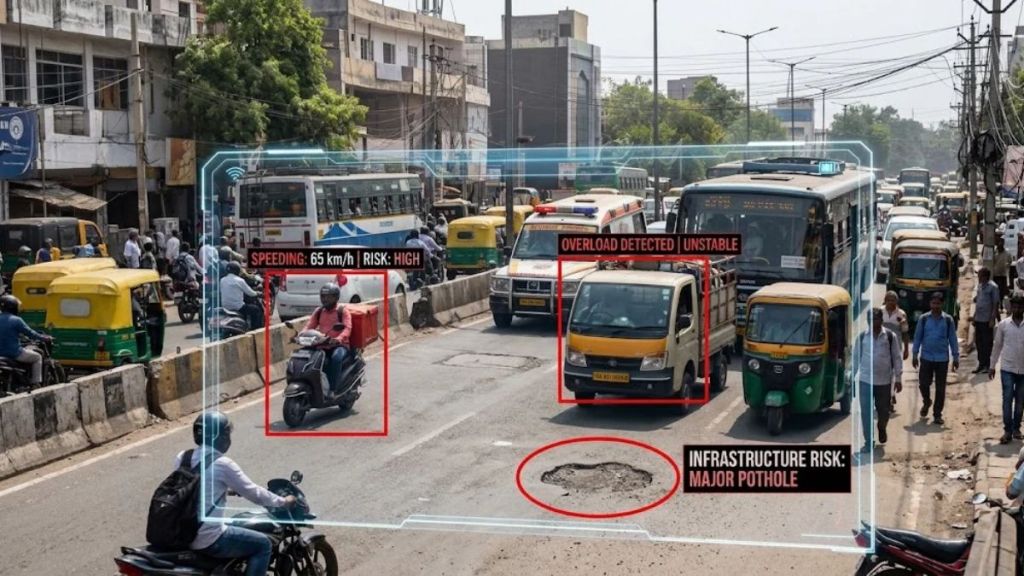

India’s infrastructure expansion has brought renewed attention to how safety is monitored across highways, urban roads, metro networks and tunnels. As transport networks grow more complex, conventional CCTV cameras and manual monitoring have limitations in identifying incidents quickly, particularly when control rooms must track multiple locations at once.
Artificial intelligence (AI) is increasingly being used to analyse camera feeds, identify potential risks and flag incidents such as traffic violations, accidents, congestion and unattended objects. Similar technologies are also being applied to road-condition assessments, helping operators identify defects and track maintenance work.
However, deploying these systems does not automatically translate into safer infrastructure. Their effectiveness depends on the accuracy of alerts, integration with existing systems, the cost of deployment and the ability of authorities and operators to respond to incidents. Adoption also varies across projects, and the technology’s impact depends on how it is used on the ground.
Manoj Kumar, Vice President at Rodic Digital & Advisory, and Kamal Gupta, Managing Director of J. Kumar Infraprojects Ltd, told FinancialExpress.com that AI-based tools were being used for a range of infrastructure-monitoring applications, while pointing to challenges around implementation and emergency response.
AI tools monitor traffic and identify incidents
AI-enabled video analytics can flag events such as wrong-way driving, traffic violations, accidents, crowding, intrusion and unattended objects. The systems analyse camera feeds and can alert monitoring teams when they detect a potential incident. The extent of their use varies across locations and projects.
Kumar said applications include traffic monitoring, accident detection, crowd management, perimeter security, predictive maintenance and emergency response.
“Key use cases include intelligent traffic monitoring, automatic incident and accident detection, crowd and congestion management, perimeter security, predictive maintenance and emergency response,” Kumar said.
He said the technology can reduce the time taken to identify an incident, although the alert must still be assessed and acted upon by the relevant teams.
“The real value lies in compressing the detection-to-action cycle, incidents that may otherwise take several minutes to identify can be flagged almost immediately, allowing response teams to initiate the appropriate protocol much faster,” Kumar said.
Gupta said traffic violation detection, number plate recognition and congestion monitoring were among the applications being used across highways, metros and urban road networks. Other applications, including the detection of overcrowding and unattended objects, are also being developed.
“What’s shifting is scale: systems are being built into infrastructure itself, not added to it later,” Gupta said.
AI-based road monitoring tracks defects
AI is also being used with digital imaging and LiDAR technology to assess road conditions and identify defects. Such systems can help track maintenance requirements and monitor whether identified problems are addressed.
Kumar cited projects in Assam and Mumbai. In Assam, digital road scanning is used for segment-wise assessment, pavement condition index scoring, defect identification and rectification notifications, with contractor response times also being tracked.
In Mumbai, a LiDAR-based solution covers 2,400 km of roads using 360-degree point-cloud data and high-resolution imagery.
Kumar also cited figures from Rodic’s work under the Bihar OPRMC project management unit, which covers more than 10,000 km of roads across 38 districts and 44 divisions. According to the company, the programme has recorded more than 5.19 lakh inspections and identified 2.16 lakh defects, of which 85% were closed within the prescribed response time.
The figures relate to the company’s project work and do not, by themselves, establish how much AI has improved road conditions or reduced accidents.
Cost and integration pose challenges
Deploying these systems across large infrastructure networks requires investment in cameras, computing equipment, connectivity, data storage and command centres. Integrating technology from different vendors can also be difficult, while the reliability of alerts depends on data quality and detection accuracy.
Kumar identified interoperability, privacy, cybersecurity, data governance and the availability of skilled personnel as challenges to wider deployment.
There is also a gap between detecting a potential risk and responding to it. An alert may require verification by an operator before emergency services or maintenance teams are notified. The outcome therefore depends on the procedures and personnel supporting the technology, as well as the system itself.
Gupta said implementation required specialist expertise, coordination between engineering teams and clearly defined emergency protocols.
He cited a car fire in a Dwarka Expressway tunnel earlier this year, saying a High-Pressure Water Mist system detected and suppressed the fire before it escalated. The example relates to an integrated fire-safety system; it does not, on its own, demonstrate the effectiveness of AI surveillance across infrastructure projects.
Safety systems need operational support
Both executives said safety technology needed to be considered during infrastructure planning. Integrating systems at the design stage can help align monitoring equipment with control rooms and emergency procedures, while retrofitting them into existing projects may pose additional challenges.
“Safety infrastructure has to be a design-stage priority, not an afterthought,” Gupta said.
The wider question is whether infrastructure operators can translate alerts into timely action. As AI monitoring is adopted across more projects, its practical impact will depend on detection accuracy, integration with existing systems, protection of data and the ability of response teams to act on the information they receive.