


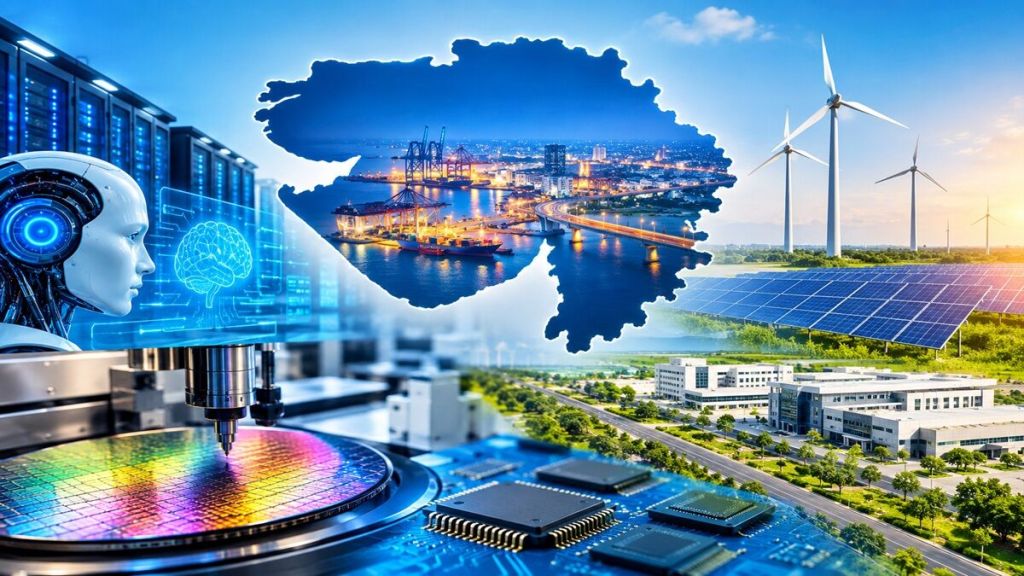

Gujarat is reshaping its economic roadmap, moving beyond traditional manufacturing and heavy industry to place artificial intelligence (AI), semiconductors and green energy at the core of its future growth. Chief Minister Bhupendra Patel also unveiled an ambitious industrial roadmap last month — predicting that the western state would become a $3.5 trillion economy by 2047.
Patel said that “new sectors such as semiconductors, AI, data centres, green hydrogen, renewable energy, aerospace, defence and advanced manufacturing are becoming the pillars of Gujarat’s futuristic development,” as the state gears up for Vibrant Gujarat 2027.
The state’s Viksit Gujarat Industrial Policy 2026 also identifies 21 key sectors and outlines a framework for developing Gujarat into a “global hub for advanced manufacturing, innovation, and sustainable development”.
While speaking at an event in Mumbai ahead of the Vibrant Gujarat summit, CM Patel outlined a clear shift in the state’s industrial strategy. Instead of relying only on textiles, chemicals, petrochemicals and conventional engineering, Gujarat is now actively courting high-tech, capital-intensive sectors that align with global technology and climate trends.
The semiconductor ecosystem being developed in Dholera and Sanand was highlighted as a key component of this shift. These hubs are expected to host fabrication units, assembly and testing facilities, and related supply chains, positioning Gujarat as one of India’s primary chip-making regions.
On clean energy, Chief Minister Patel said renewable power, green hydrogen and green manufacturing would help the state “lead India’s clean and sustainable development journey.” This includes large solar and wind projects, green hydrogen production clusters, and policies to attract low-carbon manufacturing.
Come to Gujarat, Grow in Gujarat, Grow with Gujarat!
Guided by PM @narendramodi Ji’s vision, Gujarat is accelerating towards becoming a $3.5 Trillion economy.
Through targeted regional master plans and an enabling ecosystem, Gujarat continues to turn policies into ground… pic.twitter.com/Gi00jOM2BX
— Bhupendra Patel (@Bhupendrapbjp) September 3, 2026
Viksit Gujarat 2047: A USD 3.5 trillion target
The push into new-age sectors is part of a larger vision- “Viksit Gujarat 2047”—under which the state aims to become a USD 3.5 trillion economy by 2047. To support this, Gujarat has prepared region-wise economic master plans and recently held Vibrant Gujarat Regional Conferences in four regions under the theme “Regional Aspiration, Global Ambition”.
These master plans are designed to match each region’s strengths—ports, industrial clusters, logistics corridors, skill bases—with specific sectoral priorities, so that investment does not concentrate only in a few districts but spreads across the state.
The $3.5 billion target marks an ambitious leap for the state — with Ajay Bhadoo, Additional Secretary, Ministry of Commerce & Industry stating during a recent event that Gujarat presently accounted for approximately $110 billion in exports.
Gujarat needs to expand its economy nearly tenfold to achieve its USD 3.5 trillion target. From an estimated USD 361 billion GSDP in 2027, the state needs to add about USD 3.14 trillion over two decades—requiring around 12% annual growth in dollar terms, driven by high-tech manufacturing, AI, semiconductors, clean energy and services.
Infrastructure as the backbone: From factories to futuristic tech
Gujarat’s existing infrastructure advantages are a key enabler for this transition. CM cited:
- Major ports and expanding port-led industrial zones.
- The Dedicated Freight Corridor and the Delhi-Mumbai Industrial Corridor (DMIC).
- GIFT City as a global financial and tech services hub.
- Strong international connectivity through airports and ports.
- A deep MSME ecosystem and a large skilled workforce.
He also highlighted the Mumbai-Ahmedabad High-Speed Rail Corridor and the DMIC, saying stronger connectivity between Mumbai and Gujarat could create “one of Asia’s most powerful economic corridors.”
Faster movement of people, goods and capital along this axis is expected to attract more investment in advanced manufacturing, logistics, R&D and tech services.
Courting big business and global capital
During the Mumbai visit, Patel met leading industrialists, including Mukesh Ambani and Anand Mahindra, as part of efforts to align corporate investment plans with Gujarat’s new sectoral priorities. These interactions are aimed at securing commitments in areas such as:
- Semiconductor fabrication and packaging.
- AI infrastructure, including data centres and compute facilities.
- Green hydrogen production and export-oriented clean energy projects.
- Aerospace and defence manufacturing under India’s indigenisation push.
“Gujarat wants to be seen not just as a traditional industrial base, but as a destination for next-generation technologies and sustainable industries,” CM said.
Gujarat has already begun converting its technology ambitions into large investment pipelines. In semiconductors, Tata Electronics is developing a Rs 91,000-crore AI-enabled semiconductor fabrication facility at Dholera, while Micron Technology’s assembly, testing, marking and packaging unit at Sanand carries a proposed investment of Rs 13,000 crore; together, these projects are central to the state’s bid to become India’s chip-manufacturing hub.
On digital infrastructure, the Gujarat government says it has received proposals from 14 companies for data-centre projects under its Viksit Gujarat Data Centre Policy 2026–29, with potential first-phase investment of more than Rs 6 lakh crore and a 7.5-GW capacity target.
The policy is aimed at drawing hyperscalers, cloud firms, AI companies and institutional investors through incentives such as power-tariff support, electricity-duty reimbursement and, in Dholera, a 2.5% capital subsidy—positioning the semiconductor city as a combined chip, AI-compute and green data-centre investment destination.
Over past two decades, Vibrant Gujarat Global Summit has transformed the state from a traditional industrial power into a future-ready global gateway.
From semiconductors and AI to Green Hydrogen and GIFT City, Gujarat is powering the future with world-class infrastructure and… pic.twitter.com/uNqhh7taz2
— Bhupendra Patel (@Bhupendrapbjp) September 3, 2026
Why AI, chips and green energy matter for Gujarat?
For Gujarat, the focus on AI, semiconductors and green energy is both economic and strategic:
Semiconductors: With global supply chains diversifying away from single-country dependence, India is pushing to build domestic chip capacity. Gujarat’s early moves in Dholera and Sanand could give it a first-mover advantage in fabrication, testing and design-linked manufacturing. Tata Electronics’ planned 300-mm fab at Dholera is designed for capacity of up to 50,000 wafer starts a month, producing 28-nm to 110-nm analogue and logic chips.
AI and data centres: As AI workloads grow, so does demand for data centres, high-performance computing and digital infrastructure. By linking semiconductor plans with data-centre policies, Gujarat aims to create an end-to-end digital infrastructure ecosystem. Its Data Centre Policy 2026–29 targets 7.5 GW of capacity and about Rs 6 lakh crore in investment, backed by incentives for large hyperscale and AI-ready facilities.
Green energy and hydrogen: The state already leads in renewable capacity. Adding green hydrogen and green manufacturing allows it to tap into emerging export markets, meet global carbon standards and attract companies looking to decarbonise their supply chains. Gujarat has about 69 GW of installed power capacity, including roughly 47 GW from renewable sources, giving energy-intensive projects such as fabs and data centres access to a large clean-power base.