



The United States has launched an investigation into the European Union’s Carbon Border Adjustment Mechanism (CBAM), a move that could create an opportunity for Indian exporters of steel, iron and aluminium to seek similar concessions from the bloc.
The US Trade Representative (USTR) has invited public comments from American small businesses until November 9, reported The Indian Express. The investigation focuses on how the EU calculates emissions from imported goods and applies its carbon border tax.
Indian exporters could face higher costs under CBAM, which took effect in January 2026. However, a provision in the India-EU trade deal could give Indian businesses a route to seek concessions if Washington secures greater flexibility from Brussels.
A senior government official told The Indian Express that India’s forward Most-Favoured-Nation (MFN) clause could help Indian industry obtain concessions that the EU has promised the US. Any benefit, however, would depend on the outcome of the investigation and the terms of any changes agreed between Washington and Brussels.
What is US investigating?
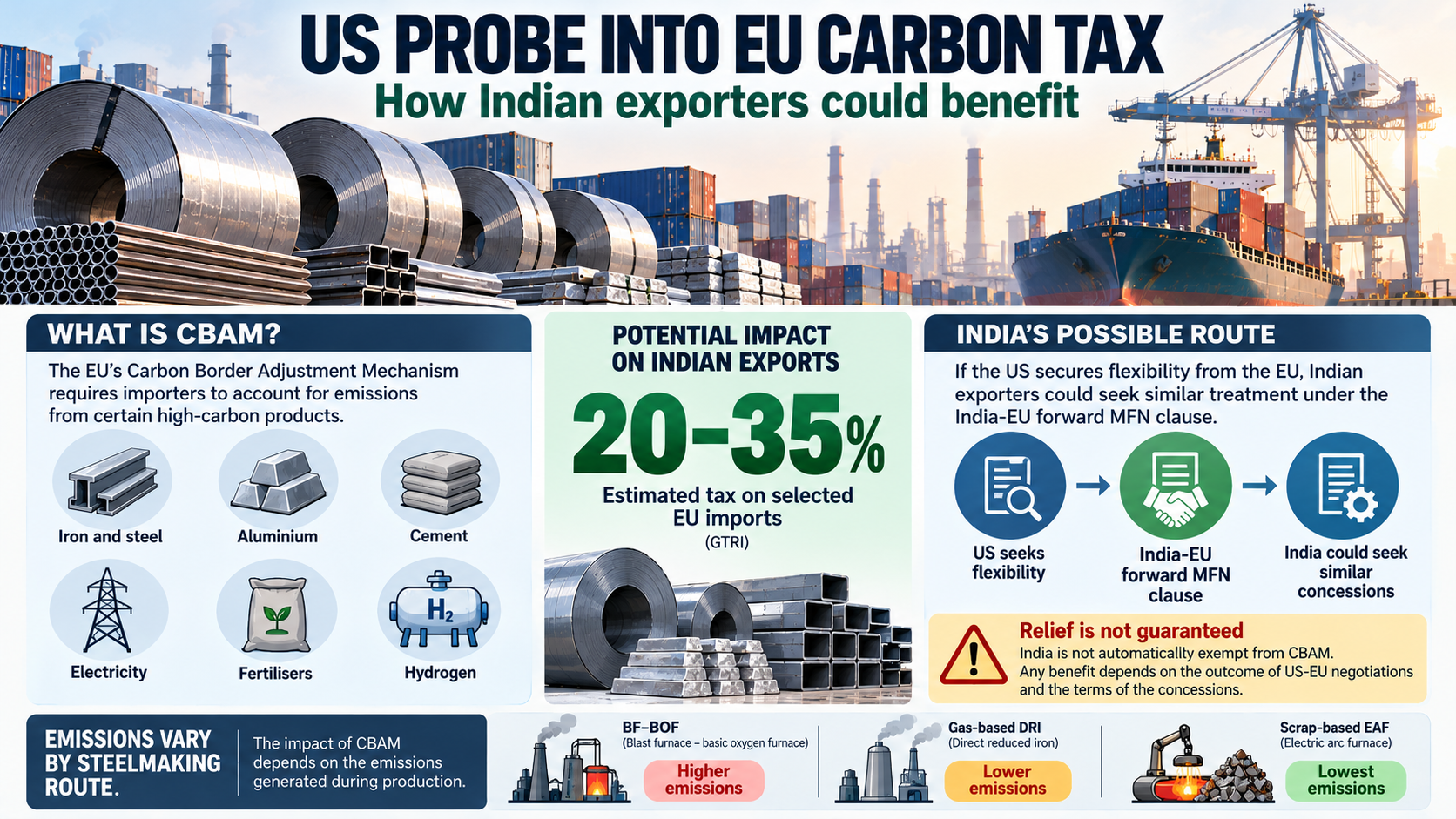
CBAM requires EU importers of covered goods to account for emissions generated during production. It applies to sectors including iron and steel, aluminium, cement, electricity, fertilisers and hydrogen.
The mechanism aims to ensure that imported products face a carbon cost comparable to that borne by European manufacturers, reducing the cost advantage of goods produced under less stringent carbon-pricing systems.
The USTR has raised concerns about how the EU calculates emissions for imported products. It alleges that the bloc uses country- and sector-level production and energy data to estimate emissions when companies do not provide their own figures. It also objects to a mark-up applied to default values and to requirements for third-party verification of company-level emissions data.
These requirements, according to the US concerns reported by The Indian Express, could increase compliance costs for exporters.
The investigation and public consultation are preliminary steps. They do not, by themselves, mean the EU will change CBAM or that the US will impose new trade measures.
The dispute follows an August 2025 US-EU joint statement in which the bloc agreed to consider additional flexibility in CBAM implementation, including in response to concerns about American small and medium-sized businesses.
How could India benefit?
India’s potential advantage lies in the forward MFN clause negotiated as part of its trade deal with the EU. The provision could allow Indian goods to receive comparable treatment if the bloc grants favourable conditions to another country under its CBAM rules.
The clause is significant because CBAM remained outside the India-EU trade deal, leaving Indian exporters exposed to the mechanism’s requirements.
If the US secures concessions that reduce the compliance burden for its businesses, India could seek similar treatment through the MFN provision. However, the clause does not automatically exempt Indian products from CBAM or eliminate any applicable carbon charges. The outcome would depend on the concessions granted, the products covered and the precise terms of the agreement.
The stakes are particularly high for India’s metal industry. The Global Trade Research Initiative (GTRI), a trade-policy think tank, estimates that CBAM could translate into a tax of 20% to 35% on selected imports into the EU and expects Indian exports of iron, steel and aluminium products to face pressure.
Indian industry has also raised concerns about EU restrictions on steel scrap exports, arguing that such measures, alongside CBAM, could act as non-tariff barriers.
Why is CBAM a challenge for Indian steelmakers?
The impact of CBAM varies with the emissions generated during production. Steel made through the blast furnace–basic oxygen furnace (BF-BOF) route generally produces more emissions than gas-based direct reduced iron (DRI). Scrap-based electric arc furnace (EAF) production typically has the lowest emissions among these routes.
Indian steelmakers rely heavily on the blast furnace route, leaving parts of the industry exposed to higher carbon-related costs. The government plans to expand scrap-based and electric arc furnace production under its green steel initiative.
However, access to quality scrap remains a constraint. A May 2025 report by the Indian Council for Research on International Economic Relations (ICRIER), authored by Amrita Goldar, Kumar Abhishek and Sunishtha Yadav, said scrap accounts for only 20% of India’s steelmaking feedstock, with domestic availability at about 25 million metric tonnes annually.
The report warned that climate-linked trade measures such as CBAM were increasing pressure on emissions-intensive industries to decarbonise, while limited access to quality scrap remained a major obstacle.
Indian exporters therefore face two challenges: managing CBAM’s immediate costs and compliance requirements, and shifting towards lower-emission production over time.
The US investigation could offer a near-term opportunity if it leads to concessions that India can seek under its MFN clause. But relief is not guaranteed. The eventual impact will depend on negotiations between Washington and Brussels, the scope of any changes and whether those changes extend to Indian exporters.