


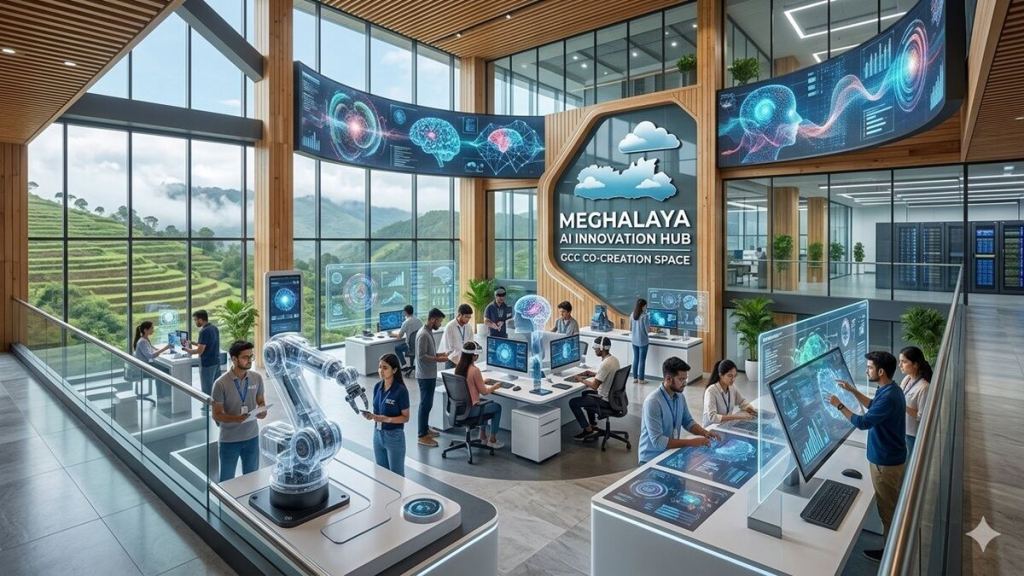

The Meghalaya government is preparing a new information technology policy focused on artificial intelligence (AI) and global capability centres (GCCs), as the state is planning to attract technology companies beyond India’s major urban hubs.
The policy is expected to include customised incentives for investors committing more than Rs 100 crore, while officials acknowledge that infrastructure, scalability and industry readiness will need further development.
Policy to focus on AI and GCCs
Pravin Bakshi, Commissioner and Secretary of Meghalaya’s Information Technology and Communications Department, said the government was working on the second version of its IT and IT-enabled services policy.
“We are now in the process of working on an IT, ITeS policy 2.0. In that, we will try to focus on AI and then we will try to focus on GCC,” Bakshi told news agency PTI on the sidelines of the Nasscom BPM Confluence 2026.
He said the government wanted to make Meghalaya more attractive to technology and business-services companies. Investors committing more than Rs 100 crore could be considered for incentives designed specifically for their projects, in addition to benefits available under existing policies.
“The state government is always very keen to support any investment of more than Rs 100 crore by way of customised incentives,” Bakshi said.
GCC interest still at an early stage
The proposed policy will also seek to attract GCCs—specialised centres established by companies to manage functions such as technology, finance, analytics, customer support and research. Bakshi said Meghalaya had held initial discussions with CodePay, a US-based fintech company, about the possibility of setting up operations in the state. However, he said the process was still at an early stage.
“We have had some initial talks with CodePay, but there is a lot of homework that remains,” he said.
The secretary pointed out that cities such as Bengaluru and Visakhapatnam currently attract a large share of GCC investments because they already have deeper talent pools, stronger business networks and established technology infrastructure.
“There is a reason why these GCCs are landing up in Vizag or in Bangalore. There is still some ground to cover,” Bakshi said.
Opportunity for Shillong and other cities
Bakshi said Meghalaya could benefit in the future as technology and business-process work gradually expands from tier-1 cities to tier-2 and tier-3 locations. He cited Meghalaya’s English-speaking workforce as one of the state’s potential advantages. At the same time, he acknowledged that the state would need to improve its ability to support companies as they expand.
“There is still a lot of work to be done in terms of scalability,” he said.
This means training more skilled workers, improving digital and physical infrastructure, and making it easier for companies to run and expand over time.
Shillong Tech Park-II adds space
The policy plans come soon after the inauguration of Shillong Tech Park-II at Umsawli by Chief Minister Conrad K Sangma. The facility adds 1.8 lakh square feet of ready-to-occupy technology space. Built at a cost of Rs 121 crore, it is the largest single addition of dedicated IT space in Meghalaya so far.
The new facility is intended to provide space for IT, IT-enabled services and technology companies looking to establish operations in Shillong. Companies that have shown interest or signed agreements for space include Shillong-based StaffFlex and Shamrock AI, along with US-based Alorica, according to the state government.
AI Centre to focus on public services
An AI Centre of Excellence is also planned at the technology park. Bakshi said the Union government had sanctioned Rs 18 crore for the centre, which will occupy approximately 10,000 square feet. The centre is expected to become operational in about two months. Its initial work will focus on applying AI in healthcare, education and governance.
The proposed centre could support the development and testing of technology solutions for public services, while also providing training and collaboration opportunities for students, researchers, start-ups and companies.
Semiconductor skill training
Meghalaya is also preparing for opportunities linked to the semiconductor industry in the Northeast. Bakshi said the state’s skill-development body was preparing training modules for young people who could eventually work at Tata Electronics’ semiconductor assembly and test facility in Assam‘s Jagiroad.
The training programme will help local candidates to develop technical skills relevant to semiconductor manufacturing and allied operations. This could also help Meghalaya’s youth get jobs in the growing electronics and semiconductor industry.
The proposed IT policy focuses on AI and Global Capability Centres as key areas of Meghalaya’s technology plans. To attract large companies, the state will need skilled workers, suitable infrastructure, good connectivity, reliable services and enough capacity to support companies as they expand. The policy includes technology infrastructure, investment incentives and workforce training. Its impact will be measured by the investments, jobs and technology projects that are actually set up in Meghalaya.