



Madhya Pradesh is joining hands with the Asian Development Bank (ADB) to develop renewable-energy projects through the public-private partnership (PPP) route, with the initiative expected to attract up to $1 billion in private investment, news agency ANI reported on Monday.
The ADB has entered into an agreement with the Madhya Pradesh government to provide transaction advisory services for the development, structuring and rollout of three clean-energy projects across the state.
The agreement was signed in Bhopal by ADB Country Director for India Mio Oka, in the presence of Madhya Pradesh Chief Minister Mohan Yadav, ANI reported.
ADB reportedly said that the mandate is its first transaction advisory services (TAS) engagement in India. Under the arrangement, the multilateral development bank will act as transaction advisor for projects being developed through the PPP model.
Solar, battery storage project at Shajapur
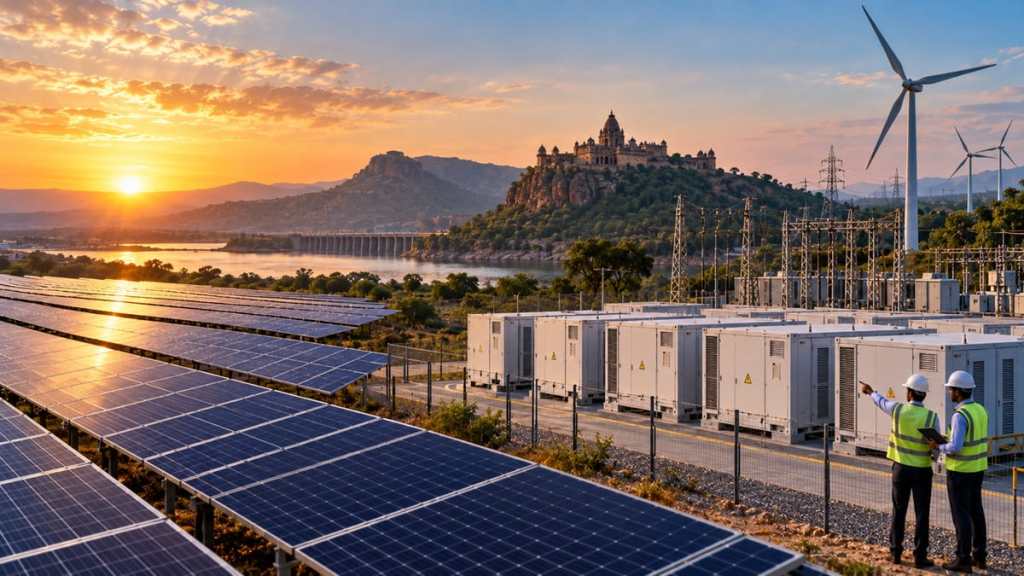
One of the projects in the pipeline is a solar power generation and battery energy storage facility at Shajapur. It is reportedly said that the project is being planned to help meet Madhya Pradesh’s peak electricity requirements while supporting grid stability.
The planned battery storage system will reportedly allow electricity generated from solar power to be supplied during peak-demand periods and during hours when solar generation is unavailable.
The project is also intended to support local distribution networks by improving the reliability of electricity supply and balancing power availability across different periods of the day.
The three projects are developed in line with the Madhya Pradesh Renewable Energy Policy 2025, which targets expansion of renewable-energy generation and energy-storage capacity in the state.
The policy framework aims for renewable resources to meet 50% of Madhya Pradesh’s electricity demand by 2030, according to the information cited by ANI.
ADB to structure bankable PPP projects
Under the agreement, ADB will support Madhya Pradesh in preparing, structuring and taking the projects through the procurement process.
The transaction advisory role is aimed at developing commercially viable and bankable project tenders that can attract private-sector participation.
ADB Country Director for India Mio Oka said public resources alone would not be sufficient to meet India’s growing energy requirements, while private capital would need projects and markets to be structured in a way that makes them investable.
“By helping Madhya Pradesh to structure bankable PPP projects, ADB is helping to crowd in private investment, demonstrate what works, and create scalable models for clean energy infrastructure across the state,” ANI quoted Oka as saying.
The advisory engagement will draw on ADB’s experience in project preparation, transaction structuring and procurement across Asia and the Pacific.
Up to $1 billion private investment
The partnership is expected to help mobilise up to $1 billion in private investment for clean-energy infrastructure in Madhya Pradesh.
The PPP structure allows private capital and expertise to participate in the development of renewable-energy assets, while the transaction advisory process is intended to establish the commercial and contractual framework required for private investment.
For Madhya Pradesh, the arrangement covers more than the development of individual renewable-energy assets. The projects are also being designed around the state’s requirements for electricity supply, peak-demand management and grid stability.
The inclusion of battery storage is particularly relevant to solar-based generation, as electricity production from solar assets varies through the day and falls when solar resources are unavailable.
ADB’s first transaction advisory mandate in India
The Madhya Pradesh engagement marks ADB’s first transaction advisory services mandate in India. The bank has maintained an operational relationship with Madhya Pradesh for more than 25 years, covering several development priorities, including investment in energy infrastructure.
The latest agreement expands that engagement into transaction advisory services for renewable-energy PPP projects.
The arrangement also comes as India seeks to expand private participation in clean-energy infrastructure and develop financing models for projects that require large upfront investments.
From generation to storage and grid stability
The Madhya Pradesh projects combine renewable generation with infrastructure aimed at improving the reliability of electricity supply.
The proposed Shajapur solar and battery storage facility is expected to provide electricity during peak hours and maintain supply when solar generation is not available.
This makes energy storage an integral part of the project structure rather than a standalone addition to renewable generation.