


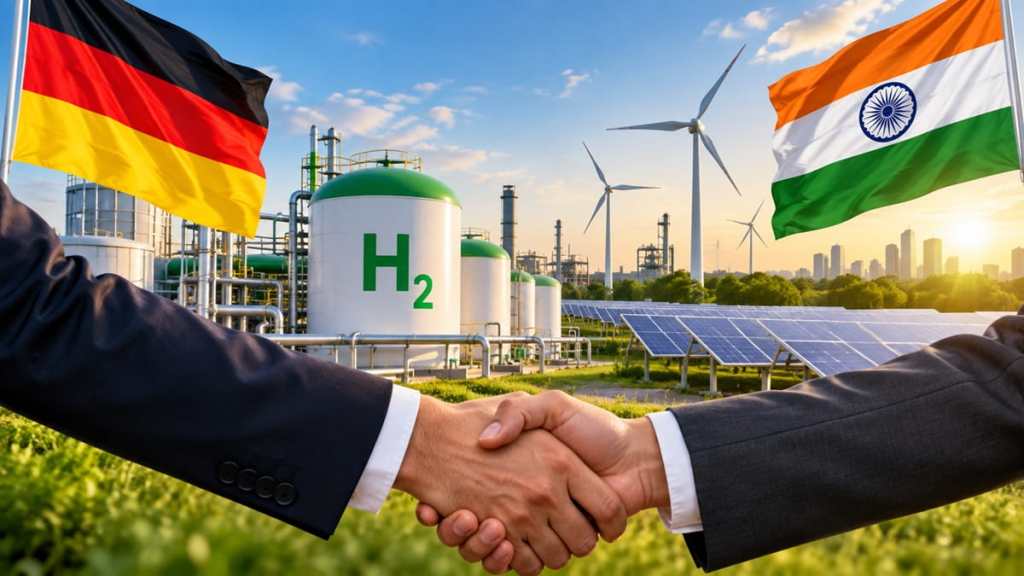

India’s clean-energy expansion is creating demand for technology, equipment and investment across its industrial sector. This is opening up opportunities for cooperation with Germany, which has expertise in renewable energy, energy storage and sustainable manufacturing. The India-EU Free Trade Agreement could support this cooperation by improving market access and creating opportunities for investment and manufacturing partnerships between the two countries.
In January this year, the India-EU FTA negotiations were concluded. The European Commission has since moved the agreement into the formal approval process, with the pact still requiring the necessary EU procedures before it can enter into force. Earlier, it was reported that the agreement could be signed by the end of 2026 and become operational in early 2027.
For Germany, the opportunity is not limited to selling equipment into India. The bigger potential lies in local manufacturing, technology partnerships and the creation of integrated green industrial supply chains.
That direction was also evident after German Environment Minister Carsten Schneider addressed the same following the fourth Indo-German Environment Forum in New Delhi. Schneider said the FTA offered significant potential for environmental technologies and the circular economy and pointed to cooperation ranging from renewable-energy integration to green industrial clusters, The Indian Express reported.
From trade deal to industrial opportunity
According to the Ministry of Commerce & Industry, the India-EU FTA brings together markets representing around two billion people. The commerce ministry said the agreement could create opportunities for manufacturers, service providers, startups and investors in both markets. Belgium’s Prime Minister Bart De Wever also highlighted areas including green hydrogen and infrastructure as potential beneficiaries of the agreement.
The agreement gives German companies a bigger platform from which to access the Indian market while allowing Indian manufacturers to plug into European value chains.
But the more interesting opportunity could be in sectors where India needs both technology and capital, while Germany has established industrial expertise. Green hydrogen fits that description particularly well.
Germany already has a foothold in India’s hydrogen push
One of the clearest examples is the partnership between Bharat Heavy Electricals Ltd (BHEL) and Germany-linked thyssenkrupp nucera India.
According to BHEL’s official statement in July 2026, the company announced a strategic tie-up with thyssenkrupp nucera India for alkaline electrolyser systems. The partnership aimed at phased indigenisation and local manufacturing of alkaline electrolyser systems for green-hydrogen projects in India.
This is a major development as electrolysers are among the critical pieces of infrastructure required to produce green hydrogen.
The BHEL partnership effectively combines German technology and expertise with India’s engineering, manufacturing and project-execution capabilities.
BHEL said the arrangement would strengthen its ability to execute green-hydrogen projects and contribute to the National Green Hydrogen Mission and the government’s Make in India push.
For Germany, such partnerships offer a route into India’s rapidly expanding clean-energy market without necessarily relying only on exports from Europe.
However, for India, localisation can help build a domestic supply chain for equipment that will be needed if the country is to scale green hydrogen.
The government partnership is already backed by money
The hydrogen opportunity is also supported by a much bigger India-Germany clean-energy partnership. During German Chancellor Friedrich Merz’s January 2026 visit to India, the two countries announced €1.24 billion in new funding commitments under the Green and Sustainable Development Partnership.
According to the Prime Minister’s Office, the funding will support priority projects in renewable energy, green hydrogen, PM e-Bus Sewa and climate-resilient urban infrastructure. A battery-storage working group was also launched under the India-Germany Platform for Investments in Renewable Energy Worldwide.
This means the relationship is developing across several layers such as government financing, technology cooperation, manufacturing and potential private-sector investment.
Green industrial clusters could be the next step
The idea of industrial clusters is particularly relevant as India’s green transition will require more than individual hydrogen plants. Green hydrogen production needs renewable electricity, electrolysers, storage, transportation infrastructure and industrial consumers.
The same ecosystem can support green ammonia, green steel, low-carbon chemicals and other energy-intensive industries.
At the fourth Indo-German Environment Forum, India’s Environment Ministry on September 1, 2026 said the two countries were discussing cooperation in renewable energy, energy storage, green hydrogen, energy efficiency, sustainable manufacturing and associated technologies.
The forum also had dedicated sessions on low-carbon industries, resource efficiency and circular economy, and sustainable finance, green skills and investment mobilisation. That makes the industrial-cluster approach potentially important.
Instead of looking at hydrogen as a standalone fuel, India and Germany could look at clusters where renewable power, hydrogen production, manufacturing and industrial demand are located close to one another.
Germany brings industrial technology
This is where Germany’s role becomes particularly interesting. Germany has deep capabilities in areas such as industrial equipment, power systems, energy efficiency, grid integration, storage and environmental technologies.
Schneider said that Germany brings experience in grid integration, storage systems and regulation, while India has ambitious targets for solar energy, green hydrogen and domestic manufacturing.
He argued that joint initiatives covering renewable-energy integration and green industrial clusters could help reduce emissions. The BHEL-thyssenkrupp nucera partnership provides a tangible example of this model moving from policy to industrial cooperation.
Germany’s existing corporate base gives it an advantage
The opportunity also starts from an already sizeable business relationship. More than 2,000 German companies operate in India, according to the German government, while India and Germany have been working to expand cooperation in technology, manufacturing and resilient supply chains.
The Indian government has separately noted German companies’ plans to expand operations, increase manufacturing capacity and establish new facilities in India. At a September 2025 meeting between Commerce Minister Piyush Goyal and German Foreign Minister Johann Wadephul, both sides also committed to strengthening bilateral trade and investment and building more resilient and diversified supply chains.
FTA could change the economics
The pact is designed to reduce tariffs and improve market access between India and the European Union. Earlier this month, it was reported that the European Commission had said the agreement covers almost all bilateral goods trade, while India has secured market access for more than 99% of its exports to the EU by trade value.
For German companies, better access to the Indian market could make it easier to integrate India into their global manufacturing and supply chains.
For Indian companies, access to European markets could make investments in cleaner production technologies more commercially attractive.
Green hydrogen could become a bridge between the two economies
India has an industrial-scale ambition for green hydrogen, while Germany needs clean energy and low-carbon industrial inputs as it attempts to decarbonise its own economy.
India can offer renewable-energy resources, manufacturing capacity and potentially competitive green-hydrogen production. Germany can contribute technology, equipment, financing expertise and access to European industrial markets.
According to the Prime Minister’s Office, the January 2026 India-Germany agreements already included an important example of this emerging trade relationship: an offtake agreement between AM Green and Germany’s Uniper Global Commodities for green ammonia. The PMO included the agreement among the key outcomes of Chancellor Merz’s visit.
That takes the relationship beyond technology cooperation towards an actual cross-border green-commodity supply chain.
The opportunity extends beyond hydrogen
Green hydrogen may be the most visible opportunity, but it is unlikely to be the only one. The Indo-German Environment Forum specifically identified potential cooperation in:
Renewable energy
Energy storage
Energy efficiency
Sustainable manufacturing
Circular economy
Resource efficiency
Green finance
Green skills
Associated environmental technologies
For Indian industry, that could mean opportunities for domestic manufacturers supplying equipment and components to German companies.
For German companies, India could become both a large domestic market and a manufacturing base for cost-competitive clean technologies.
The bigger question: how much investment follows?
The India-EU FTA does not automatically converts into factories or investments. Companies will still make decisions based on land, electricity costs, infrastructure, policy stability, supply chains, skilled labour and the economics of individual projects.
That is why the BHEL-thyssenkrupp nucera arrangement is significant as a business indicator, rather than simply another bilateral MoU.
It gives a hint on what the next phase could look like: German technology being localised through Indian manufacturing capacity to serve a growing domestic market.
The next step would be to see whether similar models emerge in batteries, grid equipment, industrial decarbonisation, recycling, green steel and other clean technologies.