


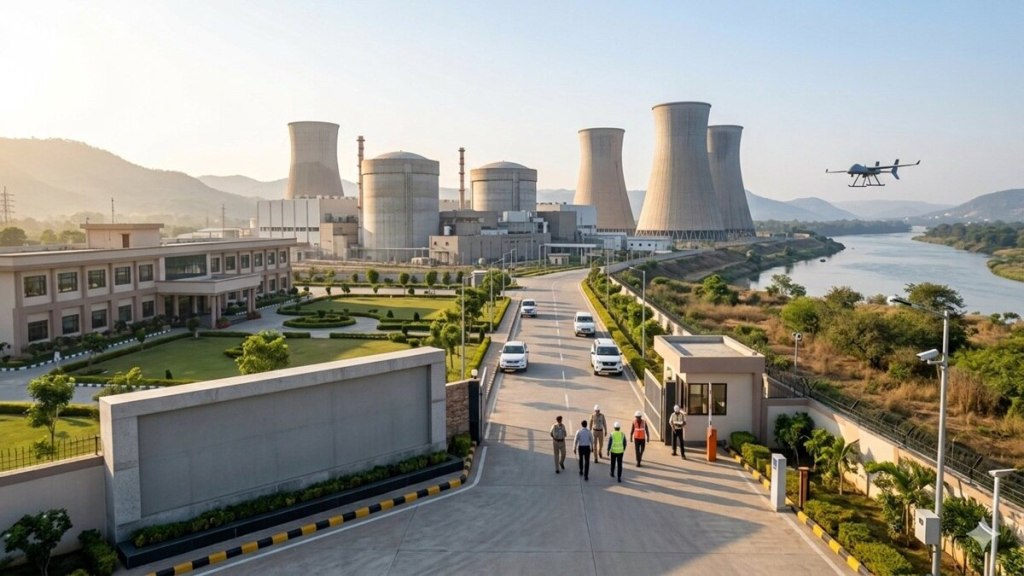

NTPC’s plan to build 30 gigawatts (GW) of nuclear power capacity by 2047 could involve an investment of roughly Rs 4.5–6 lakh crore, based on industry cost estimates cited in a PTI report. The state-owned power producer is preparing to begin feasibility studies in more states, including Uttar Pradesh (UP), as it searches for locations for the proposed projects.
The investment range is an indicative calculation using the reported cost of Rs 15,000–20,000 crore for every GW of nuclear capacity. It is not an expenditure commitment announced by NTPC, and the eventual cost would depend on the projects and technologies selected.
A senior company official told news agency PTI that feasibility studies had been completed in Madhya Pradesh (MP), Bihar and Odisha. The expansion of the site search is part of NTPC’s effort to diversify its generation business and contribute to India’s target of reaching 100 GW of nuclear capacity by 2047.
3 potential sites identified
The completed studies have identified Banka in Bihar, Basai in MP and Nabarangpur in Odisha as potential locations for nuclear power projects, according to the official.
“More states will be explored as the vision is 30 GW nuclear capacity by 2047. Of course, Uttar Pradesh is on our list along with more states. We will conduct feasibility studies soon,” the official told PTI.
Identifying a potential site does not mean construction has been approved. The locations must move through the government’s technical review and approval process before a project can advance. The official said NTPC envisages projects with a typical capacity of 1,400 MW, comprising two units of 700 MW each.
At the industry cost range cited in the report, a project of that size would imply an investment of approximately Rs 21,000–28,000 crore. This, too, is an indicative estimate rather than a project-specific budget disclosed by the company.
From feasibility study to project approval
Site selection is an early step in developing a nuclear power project. According to the process described in the PTI report, the feasibility study is submitted to the Department of Atomic Energy. Its Standing Site Selection Committee examines the proposal and, if it finds the site technically feasible, forwards it to the Atomic Energy Commission for further processing.
That distinction matters for assessing NTPC’s investment pipeline. The company has outlined a long-term capacity ambition, but feasibility studies alone do not establish the final construction cost, financing arrangements or commissioning schedule.
A continuous water supply is among the key requirements considered for a nuclear project. The availability of suitable land is another factor, with requirements varying according to the project’s size. For NTPC, expanding the number of states under consideration provides more potential locations to evaluate against these requirements.
Technology partnerships under discussion
Alongside the site search, NTPC is exploring possible technology collaborations with international nuclear energy companies. The official named US-based Westinghouse, Russia’s Rosatom and France’s EDF as companies with which NTPC is exploring collaboration on large pressurised water reactor projects in India.
The report does not announce a final technology selection or a concluded partnership with any of the three companies. The choice of projects and technology will be important in determining how the broader 30 GW ambition translates into individual investments.
India’s nuclear expansion carries a Rs 15 lakh cr price tag
NTPC’s proposed programme forms part of a much larger national expansion plan. The Central Electricity Authority has estimated that achieving India’s 100 GW nuclear capacity target would require investment of around Rs 15 lakh crore, according to PTI. The estimate involves adding approximately 91 GW to the existing capacity of 8.8 GW cited in the report.
NTPC’s 30 GW ambition is equivalent to 30% of the national capacity target. However, the company’s proposed contribution remains a long-term goal, with individual projects still needing to progress through site assessment, approvals and development.
The national investment estimate also illustrates the financial scale of the transition. Moving from capacity targets to operating plants will require more than identifying suitable locations: each project must develop a clear cost, execution and financing plan.
A diversification move for a large power producer
NTPC’s nuclear plans would extend a generation portfolio that already includes coal, gas and liquid fuel, hydropower and solar energy. The company has more than 91,000 MW of installed capacity and meets roughly one-fourth of India’s electricity demand, according to the PTI report. Nuclear power would add another business segment as it expands beyond its thermal generation base.
For now, NTPC is looking for suitable locations for its nuclear power projects. The estimated cost of Rs 4.5–6 lakh crore is not approved spending. The next steps will depend on site reviews, project approvals and how the company plans to fund and build the plants.