


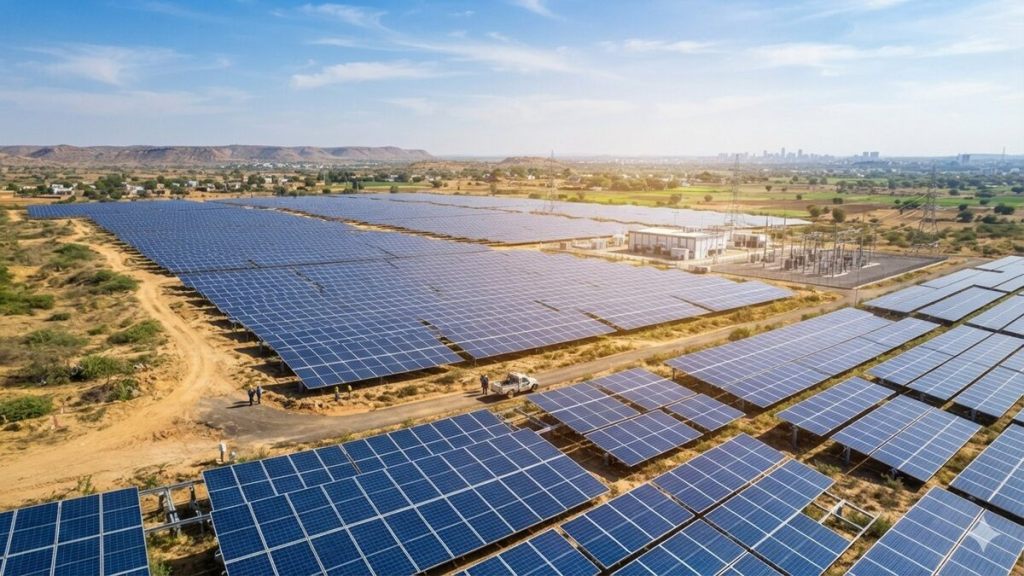

India’s solar power sector has expanded nearly 60-fold in just over a decade, with installed capacity rising from 2.8 GW in 2014 to 168 GW as of August 31, 2026, according to data from the Ministry of New and Renewable Energy (MNRE).
Solar has now become the largest component of India’s renewable energy capacity, supported by utility-scale projects, rooftop installations, solar pumps, domestic manufacturing and a widening policy framework.
As per government data, the next phase of growth is expected to focus on storage-backed floating solar projects, higher domestic manufacturing, and the rapid expansion of rooftop systems.
The Union government’s newly approved Pradhan Mantri Surya Sarovar Yojana (PM-SSY) will add 5,000 MW of floating solar capacity with co-located energy storage, while the Indian Solar Manufacturers Association has estimated that India’s rooftop solar capacity could rise to 132 GW by 2030.
Floating Solar & Storage: How PM-SSY unlocks 5,000 MW capacity
The Union Cabinet has approved PM-SSY with an outlay of Rs 5,070 crore. The scheme will be implemented between financial year 2026-27 and financial year 2030-31, with financial support disbursed until 2032-33.
The programme aims to develop:
- 5,000 MW of floating solar photovoltaic capacity.
- At least 10,000 MWh of co-located energy storage.
- Floating solar projects with a minimum two-hour storage duration.
- Projects on reservoirs and industrial water bodies to reduce dependence on land.
As per MNRE data, the scheme could increase India’s floating solar capacity from around 700 MW to nearly 5,700 MW. It is also expected to reduce nearly 10 million tonnes of carbon dioxide emissions annually and generate around 16,000-17,000 full-time equivalent jobs.
Floating solar is gaining importance because it allows renewable energy projects to use water surfaces instead of competing for increasingly scarce land. The National Institute of Solar Energy has estimated India’s floating solar potential at around 102.18 GW across reservoirs and inland water bodies.
Storage will be equally important. Solar generation is concentrated during daylight hours, while electricity demand often rises in the evening. Battery and other energy storage systems can help shift solar power to peak-demand periods and improve grid stability.
2026 Capacity Additions: India surpasses US with 44.6 GW Surge
MNRE mentioned that India added a record 44.61 GW of solar capacity in 2025-26, nearly double the 23.83 GW added in 2024-25. Total non-fossil fuel capacity reached 283.46 GW, including 274.68 GW from renewable energy sources. Annual non-fossil capacity additions also reached an all-time high of 55.29 GW.
In 2025, India added around 37 GW of solar capacity, becoming the world’s second-largest solar growth market and surpassing the United States in annual additions, said the Ministry of New and Renewable Energy.
The installed solar base includes utility-scale projects, rooftop systems, hybrid projects and off-grid installations. Large solar projects account for around 118.79 GW, while grid-connected rooftop systems contribute approximately 27.88 GW.
Another government data added that major solar clusters are located in Rajasthan, Gujarat, Karnataka, Tamil Nadu, Andhra Pradesh and Maharashtra. Projects such as Bhadla Solar Park in Rajasthan, Pavagada Solar Park in Karnataka and Rewa Ultra Mega Solar Park in Madhya Pradesh have helped establish large-scale solar generation in the country.
Policy architecture behind growth
India’s solar expansion has been supported by a combination of long-term targets, demand mandates, competitive auctions, transmission investments and consumer-focused schemes. The National Solar Mission, launched in 2010, provided the foundation for large-scale solar deployment.
This was followed by the Solar Parks Scheme, Green Energy Corridor Programme, Renewable Purchase Obligations and competitive bidding through electronic reverse auctions.
Renewable Purchase Obligations require distribution companies and other obligated entities to procure a specified share of their electricity from renewable sources, said the Ministry of Power. The RPO trajectory has been notified through 2029-30, with the renewable purchase target for 2026-27 set at 35.95 per cent.
India’s long-term climate commitments have also shaped the sector. Under the Panchamrit goals announced at COP26 by PM Modi, the country aims to achieve 500 GW of non-fossil fuel capacity by 2030 and net-zero emissions by 2070. Mission LiFE complements this effort by encouraging more sustainable patterns of consumption.
Tariff Economics: How Solar costs dropped from Rs 18 to Rs 2.44 per unit
Competitive bidding has played a major role in reducing the cost of solar power. Through e-reverse auctions, developers compete to supply electricity at the lowest tariff. Agencies such as the Solar Energy Corporation of India have helped expand this model and create a transparent mechanism for tariff discovery.
Solar tariffs fell from around Rs 18 per unit in 2010 to a record low of Rs 2.44 per unit at the Bhadla Solar Park auction in 2017. The decline made solar increasingly competitive with conventional sources and accelerated procurement by utilities.
According to the International Renewable Energy Agency (IRENA) report, India is now among the world’s lowest-cost solar markets. In 2025, the levelised cost of electricity from utility-scale solar photovoltaic projects was estimated at around USD 35 per megawatt-hour (MWh), below the global average of USD 44 per MWh.
From past milestones to upcoming projects
India’s solar sector has evolved through several stages:
- The National Solar Mission created the initial policy foundation in 2010.
- Solar parks and competitive auctions enabled large-scale capacity additions.
- Falling tariffs made solar power commercially competitive.
- The Green Energy Corridor improved power evacuation.
- PM-KUSUM expanded solar adoption among farmers.
- PM Surya Ghar brought rooftop solar into the mainstream household market.
- PLI and ALMM policies encouraged domestic module and cell manufacturing.
- PM-SSY is now extending the sector into floating solar backed by energy storage.
The next wave of projects is expected to include 5,000 MW of floating solar under PM-SSY, new storage-linked renewable projects, expansion of solar-cell and module manufacturing, and a rapid increase in residential rooftop installations. The sector is also likely to see deeper integration with battery storage, green hydrogen, electric mobility, data centres and industrial power demand.
Manufacturing moves up the value chain
India’s solar growth is increasingly being matched by a push to build domestic manufacturing capacity. Solar module manufacturing capacity has risen from just 2.3 GW in 2014 to around 172 GW as of March 31, 2026.
The expansion has been supported by the Production Linked Incentive scheme (PLI) for high-efficiency solar photovoltaic modules and the Approved List of Models and Manufacturers, which promotes quality standards and domestic production.
According to a September 2026 Jefferies report, India has emerged as the world’s second-largest solar photovoltaic manufacturing base. Around 35 GW of solar cell capacity is currently operational, while another 100 GW is under construction. The report expects approximately 90 per cent of India’s solar manufacturing value chain to be localised by 2030.
The manufacturing opportunity extends beyond modules. Domestic production is also expected to expand across solar cells, wafers, inverters, glass, backsheets, junction boxes, trackers and other balance-of-system components.
Rooftop Expansion: PM Surya Ghar targets 132 GW horizon
India’s solar transition is no longer limited to large parks and utility-scale plants. Rooftop solar is emerging as an important part of the next growth cycle. The PM Surya Ghar: Muft Bijli Yojana, launched in February 2024 with an outlay of Rs 75,021 crore, aims to support rooftop solar installations for one crore households.
As of August 12, 2026, more than 51.58 lakh households had benefited from rooftop solar installations, while around 19 lakh households were receiving zero electricity bills. The scheme had supported the commissioning of approximately 14.8 GW of rooftop capacity.
The Indian Solar Manufacturers Association also estimates that India’s rooftop solar capacity could rise from around 17 GW currently to 132 GW by 2030. It expects annual demand to reach 9-15 GW during the period, leaving an estimated 115 GW of untapped residential potential.
ISMA Secretary General Amit Manohar said the PM Surya Ghar programme had helped expand rooftop adoption into markets where project economics had earlier been less favourable.
“PM Surya Ghar has played an important role in expanding residential rooftop solar adoption, particularly in markets where project economics remain challenging,” Manohar said. He also called for early clarity on the programme’s next phase.
“As the current programme approaches March 2027, providing early clarity on its next phase, including consideration of PM Surya Ghar 2.0, preferably by December 2026, would help maintain market continuity and provide greater visibility to consumers and industry stakeholders,” Manohar added.
Policy continuity will be important for manufacturers planning new capacity. Companies need visibility on subsidies, procurement rules, financing and demand before committing long-term capital to factories and supply chains.
Solar power reaches farmers
The agriculture sector is another important area of solar deployment. As per PIB release published in August 2026, the PM-KUSUM scheme supports decentralised solar power plants, solar pumps and feeder-level solarisation. Nearly 11.49 lakh off-grid solar pumps have been installed, while more than 15.89 lakh agricultural pumps have been covered through feeder-level solarisation.
The programme has also supported the commissioning of around 1,726 MW of decentralised solar capacity and benefited more than 21.77 lakh farmers. Solar pumps can reduce farmers’ dependence on diesel and help lower irrigation costs. Feeder solarisation can also allow states to supply daytime electricity to agricultural consumers while reducing pressure on distribution companies.
Transmission infrastructure expands
The growth of solar capacity must be matched by adequate transmission and grid-management infrastructure. The government has approved 54 solar parks with a combined sanctioned capacity of 39,188 MW. The Green Energy Corridor Programme is supporting the evacuation of renewable electricity from generation centres to demand hubs.
By February 2026, the programme had enabled the evacuation of 24,567.8 MW of renewable energy. Strengthened transmission networks are expected to facilitate the evacuation of around 44 GW of renewable power.
Grid flexibility, storage, forecasting and balancing will become increasingly important as the share of variable renewable power rises. The new floating solar programme’s storage component is intended to address part of this challenge.
India’s global solar role
India has sought to extend its solar leadership beyond domestic capacity creation. It co-founded the International Solar Alliance with France in 2015 to promote global cooperation on solar energy. The country has also championed the One Sun One World One Grid initiative, which seeks to encourage cross-border renewable energy trade and interconnected electricity networks.
During its G20 Presidency, India helped build consensus around the goal of tripling global renewable energy capacity by 2030. The country’s expanding manufacturing base could further strengthen its global role by enabling exports of modules, cells, components and engineering services.
India’s solar journey has moved from a policy target to a large industrial and infrastructure opportunity. The next challenge will be to maintain the pace while addressing land availability, transmission constraints, financing, recycling, storage costs and policy certainty.
PM-SSY, PM Surya Ghar, PM-KUSUM, new manufacturing capacity and the projected rooftop market are expected to shape the next phase. Together, these initiatives could make solar not only the largest source of India’s renewable capacity but also a major driver of manufacturing, employment, energy security and industrial growth.