


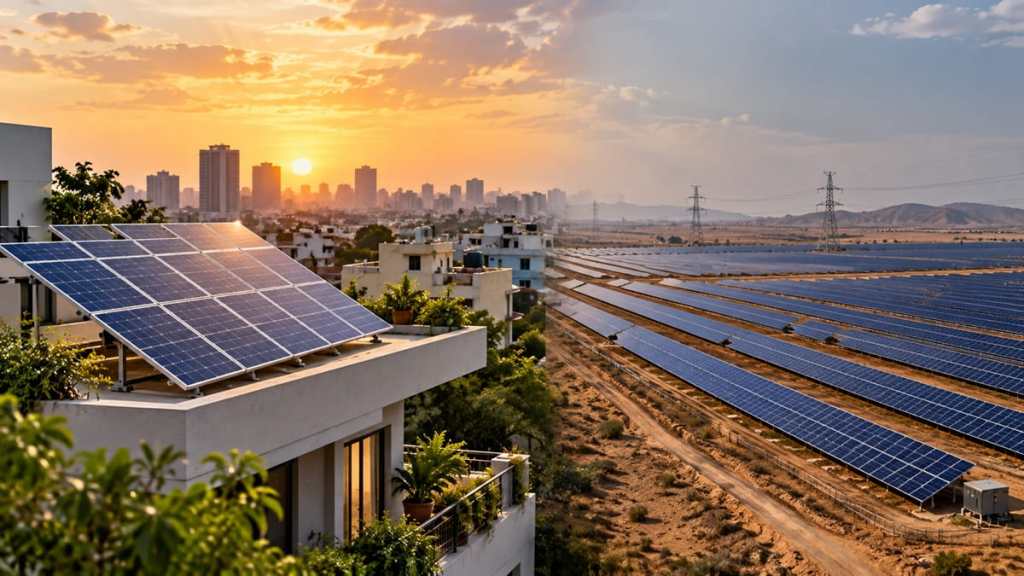

India’s solar boom is entering a new phase. Rooftop and distributed projects are taking a larger share of fresh capacity even as utility-scale solar faces growing scrutiny over grid absorption, curtailment, storage and the pace of new renewable-energy tenders.
According to JM Financial Institutional Securities, the shift marks an early sign of deceleration in utility-scale solar, even though India’s overall renewable-energy addition momentum remains strong.
In its report titled “Early signs of deceleration in utility solar”, the brokerage argues that the composition of India’s solar growth is changing, with rooftop solar increasingly accounting for new additions as regulators and utilities take a closer look at the implications of adding more standalone solar capacity.
The change comes after an extraordinary acceleration in India’s solar build-out. Annual solar capacity additions increased from around 6-7 GW in FY21 to 24 GW in FY25 and 44 GW in FY26, according to JM Financial.
The report revealed that the latest numbers show the expansion has not stopped. What is changing is where the new capacity is coming from.
Rooftop solar is emerging as a new growth engine
In August 2026, India added 3,445 MW of solar capacity, compared with 4,114 MW in August 2025. For FY27 through August, cumulative solar additions stood at 17,779 MW, slightly higher than the 17,484 MW added during the corresponding period of FY26. Those numbers indicate that solar deployment remains robust.
But the split between utility-scale and distributed generation has changed sharply.
Rooftop solar additions reached 1,850 MW in August 2026, almost twice the 973 MW recorded a year earlier.
For FY27 through August, rooftop additions stood at 6,862 MW, compared with 3,832 MW during the same period of FY26.
Ground-mounted projects still account for a substantial share of India’s solar additions. However, their contribution has declined from the levels seen during the earlier phase of the solar boom.
The brokerage also said that several months of FY25, ground-mounted projects represented 70-85% of monthly solar additions. Their share has since moved towards 40-60%, falling to 41% in August 2026. Rooftop and distributed solar, meanwhile, accounted for 54% of additions in August.
The shift is significant as it suggests that India’s solar expansion is becoming less dependent on a handful of large utility-scale projects and increasingly distributed across smaller installations closer to consumers.
The utility-scale solar model is facing a different problem
The pressure on utility-scale solar does not stem from a lack of demand for renewable electricity. It stems from a more fundamental question: Can India’s power system absorb all the renewable electricity being generated?
Predominantly, solar plants produce electricity during daylight hours. As solar penetration increases, the energy generated can exceed local demand or available transmission capacity during certain periods. When that happens, renewable generation can be curtailed.
For developers, this introduces a problem that goes beyond the headline tariff of a solar project.
A project may offer electricity at a competitive price but still create system-level challenges if the grid cannot evacuate or absorb its output when generation peaks.
JM Financial reported that resistance from regulators to approving new solar projects is becoming increasingly visible. The brokerage also points to a change in the renewable-energy tendering pipeline.
A recent regulatory proceeding in Gujarat illustrates the issue.
Gujarat’s 1,250 MW solar case
Recently, the Gujarat Electricity Regulatory Commission (GERC) adjourned a petition filed by Gujarat Urja Vikas Nigam Ltd (GUVNL) seeking adoption of a Rs 2.34 per kWh tariff for 1,250 MW of solar power.
GUVNL argued that the procurement was required to meet its Renewable Purchase Obligations and support India’s target of sourcing 50% of installed electricity capacity from non-fossil sources by 2030. GERC did not immediately approve the proposed tariff. Instead, it raised several questions that GUVNL must address before the petition can proceed.
The questions are important as they go beyond the price of solar power.
The regulator is examining Gujarat’s grid absorption capacity and whether additional standalone solar procurement without storage is prudent when the state is already experiencing renewable-energy curtailment.
The question is gradually moving from how cheaply solar power can be generated to how effectively that power can be integrated into the electricity system.
Why the grid is becoming the next bottleneck
India’s first major phase of renewable-energy expansion focused on increasing generation capacity and reducing the cost of electricity. Large solar parks offered economies of scale. Competitive auctions pushed tariffs lower, while falling equipment costs helped developers build projects at increasingly competitive prices. But high renewable penetration introduces another layer of complexity.
Solar energy generation is variable and concentrated in specific hours. Electricity demand does not necessarily follow the same pattern. This creates periods of surplus generation as well as periods when renewable output falls sharply. The resulting challenge is one of timing.
A megawatt generated at noon cannot automatically meet electricity demand at 8 pm. That is why storage is becoming increasingly important to renewable-energy procurement.
From standalone solar to hybrid and dispatchable power
JM Financial points to a clear change in the technology mix of renewable-energy tenders. While solar dominated earlier auctions, newer tenders increasingly include:
Solar-wind hybrid projects
Battery energy storage systems (BESS)
Firm and dispatchable renewable energy (FDRE)
Round-the-clock (RTC) renewable power
Pumped-hydro storage
Hybrid projects can combine the generation profiles of wind and solar. Batteries can store excess electricity and release it later. Pumped hydro can provide longer-duration storage. FDRE and RTC projects are designed around more predictable supply requirements.
This makes the next phase of renewable investment fundamentally different from the earlier solar build-out.
Renewable-energy tendering is slowing
The changing procurement environment is also visible in India’s tender pipeline. Renewable-energy capacity additions rose from 18.5 GW in FY24 to 28.7 GW in FY25 and 51 GW in FY26, according to JM Financial.
That expansion was supported by strong tender activity. Renewable-energy tender issuance stood at around 52 GW in FY24 and 56 GW in FY25. The pace subsequently weakened.
Tender issuance fell to around 30 GW in FY26 and declined further to 9.3 GW in the first quarter of FY27. The slowdown does not necessarily mean India is retreating from its renewable-energy ambitions. Instead, it could signal a more selective procurement cycle.
As renewable energy penetration rises, developers and utilities have to consider transmission availability, grid connectivity, curtailment risk, storage requirements and the economics of delivering power beyond daylight hours.
The result could be fewer straightforward standalone solar tenders and a greater proportion of hybrid and storage-linked projects.
India is not running out of solar demand
It is important not to confuse a slowdown in utility-scale project momentum with a slowdown in India’s overall solar market. The country added nearly 17.8 GW of solar capacity in the first five months of FY27, according to JM Financial. That follows the record 44 GW added during FY26 and 24 GW during FY25.
In other words, India’s solar market continues to expand at an exceptionally high rate. What is changing is the composition of that expansion.
Rooftop and distributed generation are becoming more important, while utility-scale projects face more scrutiny over their ability to integrate with the grid.
Why rooftop solar matters to the next phase
The rise of rooftop solar represents a significant change in India’s renewable-energy architecture. Large utility-scale plants concentrate generation in areas with high solar resources and depend on transmission networks to move electricity to consumption centres. Rooftop systems distribute generation closer to the point of consumption.
This can reduce dependence on long-distance transmission for part of the electricity requirement and potentially ease some grid pressures associated with centralised generation. But rooftop solar also creates a different set of challenges.
Instead of a small number of large projects, deployment involves thousands or potentially millions of individual installations. Financing, customer acquisition, installation quality, inverter availability, maintenance and distribution-company processes all become important.
Consequently, the business model shifts from large project development towards a more decentralised installation ecosystem.
Utility solar is not going away
The rise of rooftop solar should not be interpreted as the end of India’s utility-scale solar market. Large projects remain essential for adding renewable capacity at scale. A national electricity system cannot rely solely on rooftop installations to meet rapidly rising power demand.
Utility-scale solar also offers economies of scale and can be paired with dedicated transmission and storage infrastructure. The more likely outcome is therefore a two-track solar market.
Large projects will continue supplying bulk renewable electricity, while rooftop and distributed systems expand closer to consumers. At the same time, hybrid projects and storage could increasingly connect these two models by making renewable generation more predictable and dispatchable.
Wind energy adds another piece to the puzzle
Wind capacity additions remain more volatile than solar. India added 383 MW of wind capacity in August 2026, compared with 541 MW a year earlier. FY27-to-date additions stood at 2,426 MW, against 2,643 MW during the corresponding period of FY26, the brokerage reported.
Monthly additions have varied sharply, ranging from around 100-200 MW during weaker periods to 600-1,000 MW during stronger months. March 2026 reportedly witnessed close to 1 GW of additions, while June and July recorded around 600-700 MW each.
JM Financial attributes this volatility partly to the more execution-intensive nature of wind projects, including turbine availability, land, transmission connectivity and project execution. However, wind could become increasingly important as part of hybrid renewable projects.
Solar and wind often have different energy generation profiles. Combining the two can provide a more balanced supply pattern than relying exclusively on either technology.
What does this mean for renewable-energy companies?
The changing market structure could have significant consequences for companies across the renewable-energy value chain. The first phase of India’s solar boom benefited large developers, module manufacturers, EPC companies and transmission-infrastructure providers. The next phase could create opportunities across a wider set of technologies.
Battery storage could become more important as utilities seek to shift solar generation into evening hours. Pumped hydro could gain importance as India requires longer-duration storage.
Hybrid projects could become more attractive as utilities seek to smooth renewable generation.
Transmission infrastructure will remain critical as renewable projects are increasingly located away from major consumption centres.
Rooftop solar could see stronger demand as distributed generation becomes a larger component of capacity additions.
For utility-scale developers, project competitiveness may increasingly depend on factors beyond tariff-including location, transmission access, storage capability and the ability to deliver electricity according to the grid’s requirements.
The economics of India’s next gigawatt will be different
This is perhaps the most important takeaway from the latest data. India’s first solar boom was largely a race to add capacity. The next phase will be a race to add usable renewable capacity. That distinction changes the economics of the industry.
A solar project that generates large amounts of cheap electricity during periods of low demand may be less valuable to the system than a slightly more expensive project that combines generation with storage and can supply power during peak demand.
Similarly, a project located close to available transmission infrastructure may have an advantage over an otherwise cheaper project facing evacuation constraints.
This could gradually shift the competitive landscape from a pure lowest-tariff model towards a model based on reliability, location, flexibility and system integration.
Is India’s solar boom slowing?
The data suggests a more nuanced answer. India’s solar capacity growth remains strong. Utility-scale solar, however, is showing early signs of a more difficult operating environment.
Rooftop and distributed solar accounted for 54% of monthly solar additions in August, while ground-mounted projects accounted for 41%.
At the same time, renewable-energy tender issuance has slowed significantly, and regulators are increasingly examining whether additional standalone solar capacity can be absorbed by the grid.
The result is not a retreat from renewable energy. It is a transition from the first phase of India’s solar expansion to its next stage. The first phase was about building more and the next will be about integrating better.
That means more storage, stronger transmission networks, greater use of hybrid generation and increasing deployment of rooftop and distributed systems.