


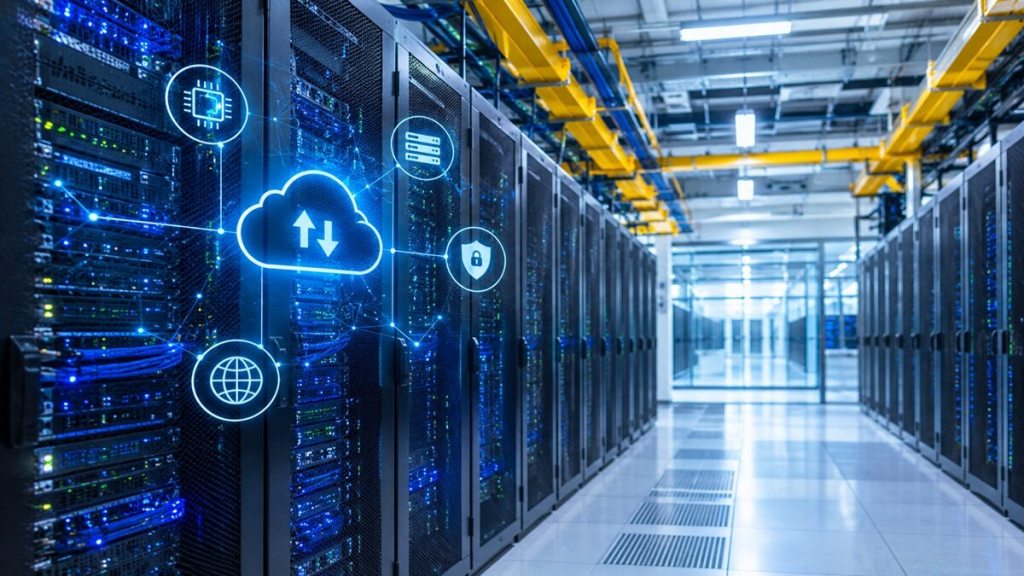

India’s data center industry is exploding—not just because of cloud computing or e-commerce, but increasingly due to artificial intelligence (AI) workloads and strict data localisation laws that require sensitive information to be stored and processed within the country, according to a Jefferies report.
Colocation capacity has already surged fivefold over the past five years to reach around 2 gigawatts (GW), and analysts now project another 5x jump—to nearly 10 GW by 2031.
This expansion unlocks a $45 billion investment opportunity across power, cooling, construction, and network infrastructure, while data center operators stand to earn roughly $9 billion in revenue, cementing India’s status as one of the world’s fastest-growing digital infrastructure markets.
From backend servers to strategic national assets
Data centers are no longer just server rooms—they are the physical backbone of the AI-driven digital economy. They house the computing hardware that powers everything from Unified Payments Interface (UPI) transactions and Aadhaar verification to generative AI models and real-time logistics platforms. As enterprises shift from owning captive facilities to leasing space in professional colocation centers, demand has skyrocketed.
“Data centers serve as the physical infrastructure housing IT hardware required for enterprises’ computing and data storage requirements,” notes a recent industry analysis. “Rising digitalisation of enterprise information and workflows has multiplied the compute/server requirements…which in turn has spurred the demand for leased data centers.”
With AI applications requiring massive parallel processing and low-latency access to data, pressure on data center capacity has intensified—especially as utilisation rates hover near saturation at 95–97%.
AI and data localisation: The twin engines of growth
While cloud adoption and government digitisation (like DigiLocker and GSTN) laid the foundation, two new forces are now supercharging demand:
- AI workloads: Training and running large language models, computer vision systems, and predictive analytics require enormous computational power—often delivered through hyperscale data centers.
- Data localisation mandates: India’s Digital Personal Data Protection (DPDP) Act and sector-specific regulations (in banking, health, and telecom) require critical data to reside on Indian soil, forcing global tech giants to build local infrastructure.
“Regulations such as the DPDP Act and data localisation requirements are encouraging companies to store and process data within India,” the report states. Combined with a 20-year tax holiday for cloud providers, these policies are drawing hyperscalers like AWS, Microsoft Azure, and Google Cloud into aggressive expansion mode.
India’s cost and stability edge makes it a regional hub
India isn’t just growing—it’s outcompeting regional rivals. Key advantages include:
- Lower costs: Power and capital expenditure are 25–40% cheaper than in Singapore, Dubai, or even parts of Southeast Asia.
- Policy certainty: A stable government and long-term incentives reduce investment risk.
- Geopolitical safety: Unlike some neighbors, India faces minimal disruption from regional conflicts or supply chain shocks.
- Connectivity: Mumbai and Chennai host major submarine cable landing stations, ensuring low-latency global access.
“India is trying to position itself as a regional data center hub given that power costs and capex requirements in India are 25–40% lower on an average,” the analysis highlights.
5x in 5 years: The next digital leap
Today, hyperscalers drive 60% of demand, with the Banking, Financial Services, and Insurance (BFSI) sector contributing another 15%. But as AI startups, fintech firms, and health-tech platforms scale up, enterprise demand is accelerating.
Analysts expect colocation capacity to grow from 2 GW today to 10 GW by 2031—a compound annual growth rate that would make India one of the top three data center markets globally. While Mumbai and Chennai remain dominant, new investments from AdaniConneX, Bharti Airtel and TCS are paving the way for tier-2 hubs in Hyderabad, Pune, and Noida.
A $45 billion infrastructure bonanza
This isn’t just a win for data center operators like STT GDC, Yotta, or Sify—it’s a windfall for the entire industrial ecosystem. The $45 billion capex wave will benefit:
- Construction and real estate developers building hyperscale campuses
- Power T&D companies like Hitachi Energy, Siemens Energy and GE Vernova India
- Cooling specialists providing advanced HVAC and liquid cooling solutions
- Network infrastructure firms laying fiber and upgrading backbone connectivity
- Backup power manufacturers, especially Cummins India (gensets) and Kirloskar Oil Engines
“Power infrastructure is the largest capex component, making T&D and backup power suppliers key beneficiaries,” the report underscores. Electricity alone accounts for nearly 30% of total costs, with cooling and automation each adding another 15%.
Who’s building and who’s benefitting?
Major players are already moving fast: AdaniConneX, a joint venture with EdgeConneX, is developing multi-gigawatt data center campuses across India; Bharti Airtel is expanding its Nxtra data center network to support 5G and edge AI applications; and TCS is investing in green, AI-ready facilities to serve global clients while complying with data sovereignty regulations.
Meanwhile, power equipment makers are getting more orders. Cummins India dominates the genset market, while Kirloskar Oil Engines recently secured a high-profile data center contract—signalling rising competition and opportunity.
The road ahead: Power, land and sustainability
As data centers grow larger and more energy-intensive, three factors will separate leaders from laggards:
- Access to reliable, affordable power—ideally from renewable sources to meet ESG goals.
- Land availability near connectivity hubs without regulatory or environmental hurdles.
- Adoption of next-generation cooling, such as immersion or liquid cooling, to handle AI server heat loads efficiently.
Sustainability is no longer optional. With AI racks consuming 2–3x more power than traditional servers, operators are increasingly partnering with solar developers and exploring green hydrogen for backup power.
India’s data center sector is expanding rapidly, driven by growing AI workloads, data localisation rules, and lower operating costs. The country is moving beyond just using digital services to building the physical infrastructure needed to store and process data.
If current plans are implemented as expected, the estimated $45 billion investment in data centers over the next five years could meet domestic demand and also attract clients from South Asia, the Middle East, and parts of Africa. For investors, policymakers, and technology companies, the data indicates that significant capacity addition is already underway, not just projected.