


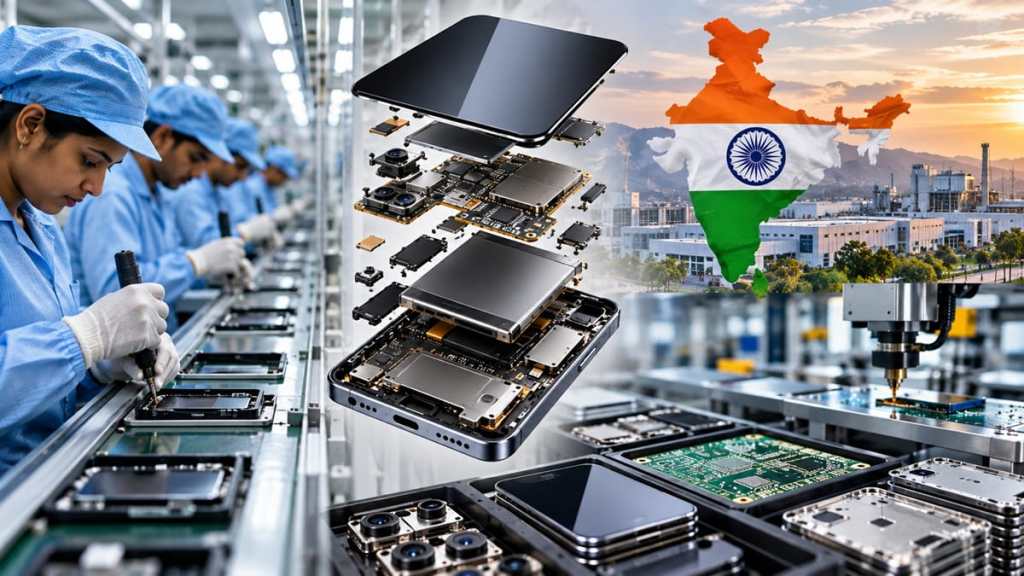

India has emerged as a major mobile-phone assembly hub, but the next phase of its electronics manufacturing push will depend on how many of the components inside those phones can be made locally, brokerage firm Jefferies reported. The government’s Electronics Components Manufacturing Scheme (ECMS) aims to close that gap.
According to Jefferies, India assembles around 99% of the mobile phones sold domestically. Yet, domestic value addition remains below 20%. The brokerage expects the ECMS to potentially raise the share of the mobile phone Bill of Materials (BoM) covered by locally manufactured components to around 50% by FY32.
This shift would mark a big change in India’s electronics manufacturing model: moving from assembling imported or semi-knocked-down components to manufacturing a larger share of the hardware that goes into each device.
Jefferies reported that the government increased the ECMS outlay to Rs 40,000 crore, 75% higher than its original allocation of Rs 22,919 crore. The scheme will operate for six years from FY26 to FY32, with an optional one-year gestation period.
According to Jefferies, as many as 106 projects received approvals under the scheme, with committed capital expenditure of about Rs 69,548 crore. Government estimates cited by the brokerage reveal that these investments could generate around Rs 5.34 lakh crore in component production over the scheme’s six-year tenure.
India already makes 99% of its phones. But, value addition is still low
India’s mobile success has largely been an assembly story. Electronics production in India has more than doubled in five years, rising from around Rs 5.5 lakh crore in FY21 to Rs 12.1 lakh crore in FY26, according to Jefferies. Mobile phones accounted for about 48% of total electronics production in FY26.
However, the increase in production has not shifted into a similar rise in domestic value capture.
A massive share of the high-value components used in smartphones continues to be imported. Citing a NITI Aayog report, the brokerage reported that India’s success in localising assembly has not been matched by comparable localisation in components such as camera modules, display modules and mechanical enclosures.
The economics of component manufacturing are also more challenging.
Typically, manufacturing components requires higher upfront capital expenditure, longer gestation periods and lower asset turns than assembly. Access to technology and technology transfer have also remained constraints, the brokerage reported.
ECMS is designed to address these gaps by incentivising companies to establish manufacturing capacity across key component categories.
ECMS targets 50% domestic value addition in mobile BoM by FY32
The first mobile manufacturing production-linked incentive (PLI) scheme in India had targeted roughly 25% value addition when it was launched in 2021. Jefferies reported that the outcome fell short of initial expectations, leaving the country’s mobile manufacturing ecosystem heavily tilted towards assembly.
ECMS raises the ambition, targeting approximately 50% backward integration in mobile manufacturing. Jefferies estimates that domestic value addition could rise from below 20% of the mobile BoM currently to around 50% by FY32.
The figure does not mean that half of every smartphone manufactured in India will necessarily consist of components made domestically. Rather, it shows the potential share of the mobile BoM that could be covered by component manufacturing capacity created under ECMS.
The policy objective is not simply to manufacture more phones in India, but to capture a larger share of the value embedded in those phones.
Why the first PLI scheme fell short of 25% value addition
The original mobile manufacturing PLI scheme was intended to push manufacturers beyond assembly and towards greater domestic value addition.
However, Jefferies reported that the outcome fell short of the initial expectations of around 25% value addition. The result was an electronics manufacturing ecosystem in which India built scale in final assembly without developing comparable depth across the component supply chain.
That gap is important because components account for the bulk of the value of an electronic device.
The challenge is also structural. Component manufacturing typically requires greater capital investment, longer gestation periods and specialised technology compared with assembly. Technology transfer and access to manufacturing know-how have remained additional constraints.
ECMS is therefore aimed at addressing a part of the supply-chain gap that the earlier PLI-led assembly push did not fully resolve.
PCBs: The biggest missing piece in India’s mobile value chain
Printed circuit boards (PCBs) are among the most important areas targeted under ECMS. Jefferies has identified high-density interconnect (HDI) and multi-layer PCBs as major opportunities and estimates India’s domestic PCB total addressable market at around $7 billion. Currently, about 85-90% of the requirement is met through imports, according to the brokerage.
Technology partnerships could help Indian companies bridge some of the capability gap.
For instance, Syrma SGS is entering multi-layer and HDI PCB manufacturing through a partnership with South Korea’s Shinhyup. Kaynes Technology has also received ECMS approvals covering multi-layer and HDI PCBs, copper-clad laminate and camera modules.
For India’s electronics ecosystem, the development of a domestic PCB industry could be significant as PCBs sit at the core of almost every modern electronic device.
Building that capability would allow India to capture value further upstream instead of limiting its role to final assembly.
Cameras and displays: High-value categories now seeing investments
Camera modules are another major component category where localisation is gaining traction. Jefferies has identified camera modules among the areas receiving ECMS approvals. Dixon Technologies has partnered with HKC to establish display-module manufacturing and has also entered the camera-module segment through its stake in QTech India.
Similarly, Syrma is expanding into camera modules alongside its PCB ambitions.
The government has also approved display-module projects under ECMS. In March, the Ministry of Electronics and Information Technology (MeitY) said approvals had been granted to Dixon Display Technologies and Wangda Technologies for display-module manufacturing.
Jefferies has estimated that display modules account for around 8-9% of smartphone BoM, while camera modules contribute another 7-8%. Precision components account for roughly 8-9%.
Therefore, localising these categories could have a meaningful impact on overall domestic value addition.
ECMS approvals surge: 106 projects and Rs 69,548 crore committed
The scale of projects approved under ECMS shows that companies are making larger investments in component manufacturing. The brokerage reported that cumulative committed capex under ECMS had reached around Rs 1.15 lakh crore, based on government data cited in its report, nearly twice the initial targeted investment of Rs 59,400 crore. The government expects this investment to generate component production worth around Rs 10.35 lakh crore over six years.
By August 2026, 106 ECMS projects had been approved, up from seven in the first tranche. The latest tranche alone added 31 projects.
The government’s August announcement also said the 106 approved projects involved Rs 69,548 crore of investment. Around 38 plants were already manufacturing, while another 16 were at advanced construction or machinery-installation stages.
This shows that the component manufacturing push is beginning to move from approvals towards actual capacity creation.
From assembly hub to component ecosystem: What needs to fall into place
The push for localisation is not limited to PCBs, displays and cameras. The brokerage firm points to investments by Foxconn, Samvardhana Motherson and Tata Electronics in mobile and IT-hardware enclosure manufacturing.
ATL India, part of the TDK Group, is building a lithium-ion battery plant involving around Rs 2,900 crore of capital expenditure. Wipro Engineering has received approval for a roughly Rs 1,400 crore copper-laminates manufacturing facility.
These investments are important because component manufacturing requires an ecosystem of suppliers, materials, machinery and specialised processes.
For instance, the production of domestic PCBs needs access to materials such as copper-clad laminates. Camera and display modules require specialised components and manufacturing processes, while batteries depend on materials and cell technology.
If India wants to move beyond assembly, the supply chain will therefore need to develop at multiple levels that is from raw materials and intermediate components to sophisticated modules and final products.
The scale of projects approved under ECMS suggests that this process is beginning, but the ability to convert investment commitments into commercially viable, high-volume production will be critical.
Beyond smartphones: ECMS could support a wider electronics base
ECMS is also designed with a wider electronics ecosystem in mind. The scheme covers components and sub-assemblies that can serve sectors including IT hardware, telecom, consumer electronics, automotive, medical and industrial electronics.
That creates the possibility that investments initially driven by smartphone demand could eventually support a broader domestic electronics manufacturing base.
For companies, the opportunity is consequently shifting from winning assembly contracts to building capabilities in technologically complex components where capital requirements, qualification processes and technology access create higher barriers to entry.
This could also create a wider supplier ecosystem around component manufacturing, including businesses involved in materials, precision engineering, testing, machinery and specialised manufacturing.