


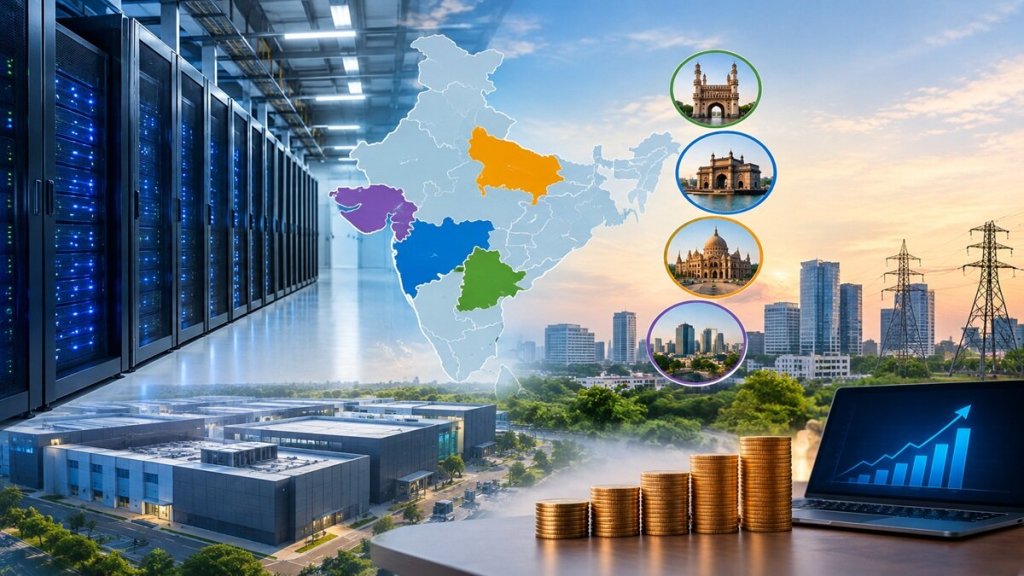

As India prepares for a sharp expansion in data center capacity, states are competing to offer companies a more attractive place to build. Cheaper power, support for land and construction costs and quicker approvals are central to that contest. A new policy ranking by S&P Global puts Telangana, Maharashtra and Uttar Pradesh at the front of the race.
The report ‘India Forward: Reimagining Growth’ places the three states at the top of its Data Center Policy Attractiveness India (DCPAI) index, with Gujarat also in the leading group. All four score around 50 out of 100. The ranking offers a view of how state incentives stack up as India seeks to attract the investment needed to expand its data centre capacity over the coming years.
How was the ranking done?
S&P Global Energy evaluated 19 state policies across 11 states that have been notified since 2016.
These policies cover:
- Information Technology (IT)
- IT-enabled services (ITeS)
- Data centres
- Global Capability Centres (GCCs)
The assessment used four core incentive categories:
- Electricity incentives – tariffs, surcharges, renewable power access, banking and wheeling provisions.
- Land and capital support – subsidies on land, stamp duty, capital expenditure support, interest subvention.
- Operational and technical support – single-window clearances, infrastructure readiness, technical facilitation.
- Regulatory and Ease of Doing Business (EoDB) – deemed approvals, time-bound clearances, legal safeguards such as Essential Services Maintenance Act (ESMA) coverage.
Each state received a composite score out of 100 based on these parameters.
Top cluster: Telangana, Maharashtra, UP and Gujarat
The top-performing states are:
Telangana emerges as the key state for data centre investment in S&P Global’s DCPAI index due to a combination of competitive power tariffs, strong regulatory incentives and clear policy frameworks. These measures help lower both upfront capital costs and ongoing operating expenses for data centre developers, giving the state an edge in attracting hyperscalers and large cloud providers.
Maharashtra offers a balanced, broad-based policy package that covers power, infrastructure, capital support and regulatory ease. Its incentives span the entire project lifecycle, making it a stable and predictable destination for data centre investments, particularly for operators looking for a mix of market access, connectivity and policy support.
Uttar Pradesh has put in place an extensive, multi-category incentive framework that mirrors the leaders in terms of breadth. Its policies provide substantial support across electricity, land and capital, operational facilitation and ease-of-doing-business measures, positioning the state as a competitive option for large-scale data centre projects, especially in the National Capital Region influence zone.
Gujarat stands out for offering the most lucrative electricity-related incentives and ease-of-doing-business measures specifically tailored to hyperscalers. Its focus on low-cost power, streamlined clearances and industrial-friendly regulations makes it particularly attractive for very large, power-intensive data centre campuses aimed at serving national and global workloads.
S&P Global noted that Telangana’s edge comes from a combination of competitive power tariffs, clear regulatory frameworks and targeted incentives that reduce both upfront and operating costs for data centre developers.
Second tier: Odisha, Haryana, Andhra Pradesh, Karnataka
A second cluster of states scored between 42 and 45:
Odisha’s data centre policy focuses on broad-based incentives that cover the entire project life cycle, from land acquisition and approvals to operational support. This end-to-end approach aims to reduce friction for investors and make the state competitive despite not leading in any single incentive category.
Haryana similarly offers a comprehensive package spanning land, capital, operational and regulatory support, targeting the full life cycle of data centre projects. Its strategy is to present a balanced, predictable policy environment that can attract mid-sized and enterprise data centres alongside larger players.
Andhra Pradesh leads the second cluster in land and capital support, providing significant subsidies and concessions on land costs and capital expenditure. These incentives are designed to lower the upfront investment burden for data centre developers and improve the state’s attractiveness for new capacity.
Karnataka stands out for its ease-of-doing-business (EoDB) measures, including regulatory safeguards such as coverage under the Essential Services Maintenance Act (ESMA) to protect critical data centre operations from disruptions. This focus on operational continuity and streamlined clearances complements its existing IT ecosystem.
These states are trying to catch up with the leaders by offering comprehensive packages rather than focusing on a single incentive type.
Third cluster: Rajasthan, Tamil Nadu, West Bengal
The third group, with scores between 30 and 40, includes:
Rajasthan falls in the third cluster of S&P Global’s data centre policy ranking, with moderate scores across incentive categories. Its policies offer a basic framework for IT and data centre investments but lack the depth of power and capital incentives seen in top-ranked states.
Tamil Nadu performs strongly on capital expenditure support, including incentives for captive renewable energy infrastructure that help data centres meet sustainability goals. However, weaker electricity-sector incentives, such as tariffs and surcharge relief, limit its overall attractiveness in the DCPAI index.
West Bengal also sits in the 30–40 score band, with relatively stronger support in some operational and capital areas but lower scores on electricity incentives. This imbalance constrains its competitiveness for power-intensive data centre projects despite other policy strengths.
Why states are competing so hard
S&P Global attributes this policy race to “competitive federalism”, with states using fiscal incentives, streamlined clearances and reliable clean power to attract data centres as a distinct, critical infrastructure asset class.
“As the global security and trade landscapes shift once again, India’s geopolitical strategy is likely to need recalibration,” the report said. “It will remain grounded in the principle of strategic autonomy, with an adjustment toward asymmetric hedging rather than broad-based multi-alignment.”
The report adds that India needs “actionable ways to maximise diplomatic leverage, secure access to new markets and resources, and create domestic conditions to manage global competition,” with data centres seen as strategic infrastructure in this context.
Massive capacity expansion expected by 2031–32
The policy push comes as the data centre sector prepares for rapid growth:
- Current capacity: About 1.5 GW (including enterprise, collocated and dedicated facilities).
- Committed capacity: Around 5 GW already committed over the next decade.
- Announced/planned capacity: An additional 6–7 GW in early stages of planning.
- Projected capacity by 2031–32: Around 26.3 GW, according to official parliamentary projections cited in the S&P Global report.
It shows that India’s data centre capacity could grow more than 17 times from current levels within roughly seven years.
Power demand from data centres set to surge
Given the energy-intensive nature of data centres – which require power not just for servers but also for cooling, backup systems and other operational loads – electricity demand from this sector is expected to rise sharply.
S&P Global estimates that total electricity demand from Indian data centres will grow at a compound annual growth rate (CAGR) of 18 per cent between 2025 and 2035.
This projection is a key reason why electricity incentives – including access to cheap and reliable power, renewable energy options, and wheeling and banking facilities – carry significant weight in the DCPAI index.
For data centre companies, Telangana, Maharashtra, UP and Gujarat currently offer strong policy support, particularly for projects that need large amounts of power and faster clearances. Andhra Pradesh, Karnataka, Odisha and Haryana also offer incentives related to land, investment and ease of doing business.
Tamil Nadu, Rajasthan and West Bengal may attract projects where capital support or existing industrial ecosystems are important, although power-related incentives are relatively weaker. For state governments, key areas for improvement include electricity costs, renewable power access and regulatory clarity. These state policies, along with central measures, will influence where data centres are built and how quickly India expands capacity.