


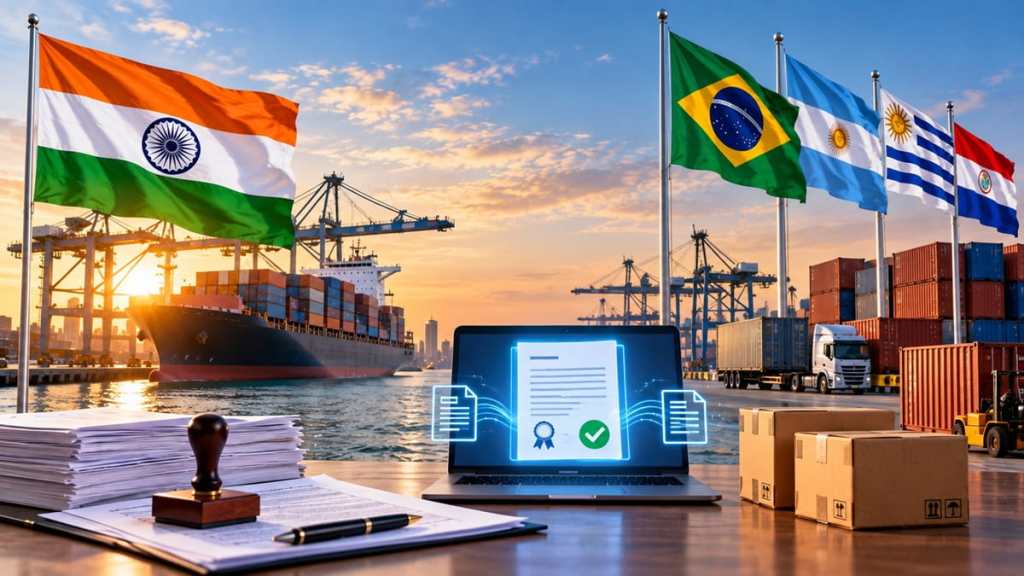

India and the MERCOSUR bloc have taken a step towards reducing paperwork in bilateral trade, signing a protocol that will allow electronic Certificates of Origin (e-CoOs) to be accepted with the same legal validity as their paper counterparts.
This development could lower administrative costs and shorten the time required for exporters to obtain and verify documents needed to claim preferential tariff benefits under the existing India-MERCOSUR Preferential Trade Agreement (PTA). However, the actual savings for businesses will depend on when the protocol becomes operational and how widely exporters adopt the digital process.
What has India agreed with MERCOSUR?
On September 14, India and MERCOSUR signed the First Additional Protocol to the India-MERCOSUR PTA to facilitate the acceptance of electronic Certificates of Origin.
A Certificate of Origin is a trade document that establishes the country where goods originate. It becomes important under a preferential trade agreement as import authorities use it to determine whether a shipment qualifies for lower or preferential tariffs.
Under the new protocol, an electronically issued and signed Certificate of Origin will have the same legal validity and value as a paper certificate.
The documents will have to be issued and electronically signed by authorised entities and officials in accordance with the domestic laws of the respective parties.
The objective is to make India-MERCOSUR trade documentation more paperless and reduce the administrative friction associated with preferential trade.
Why does the e-CoO matter?
For exporters, the cost of doing business overseas extends beyond freight, duties and logistics. Documentation, compliance requirements, verification procedures and the time required to process certificates can also add to the cost and complexity of each shipment.
The government expects electronic Certificates of Origin to reduce transaction costs and processing time associated with their issuance and verification.
Therefore, the immediate benefit is not a new tariff concession. Instead, it is the possibility of making it easier and cheaper for exporters to use tariff preferences that already exist.
That distinction is important as the new protocol does not itself expand the tariff concessions available under the India-MERCOSUR agreement.
In 2004, the PTA was signed and came into effect in June 2009. Under the existing arrangement, India provides preferential tariff concessions on 450 tariff lines, while MERCOSUR provides concessions on 452 tariff lines.
India was already digitising Certificates of Origin
The agreement with MERCOSUR comes as India is simultaneously upgrading its domestic Certificate of Origin system.
On September 7, the Directorate General of Foreign Trade (DGFT) introduced an Open API facility for Certificates of Origin through the Trade Connect e-Platform. The system allows exporters to connect their enterprise resource planning, accounting or other business software directly with DGFT’s CoO system.
Instead of manually entering the same information again on the government platform, businesses can electronically transfer application data from their own systems.
DGFT has said the facility can eliminate repetitive data entry, reduce errors and speed up the application process. It covers both preferential and non-preferential Certificates of Origin and includes the India-MERCOSUR PTA.
This creates a link between the two developments: India is digitising the process of generating and processing Certificates of Origin domestically, while the new protocol provides the legal framework for their electronic acceptance by MERCOSUR partners.
Which exporters could benefit?
The impact is unlikely to come from an immediate surge in exports simply because certificates are going digital.
Instead, potential gains could emerge through lower administrative costs, fewer manual processes and faster verification.
That could be particularly relevant for exporters making frequent shipments or operating on relatively tight margins. Smaller businesses and MSMEs could also benefit if the digital process reduces the resources needed to manage overseas documentation and compliance.
The development also comes against the backdrop of a bigger government push to increase the use of India’s existing trade agreements.
Earlier this month, Commerce and Industry Minister Piyush Goyal called for a nationwide drive to improve the utilisation of free trade agreements and ensure that their benefits reach MSMEs, traders and businesses.
In this context, reducing procedural hurdles could make preferential trade arrangements more accessible to a wider group of exporters.
How large is the India-MERCOSUR trade opportunity?
In 2025, India’s trade with MERCOSUR stood at around $20.84 billion in 2025, according to government figures. Brazil accounts for the largest share of the relationship.
In 2025-26, India-Brazil bilateral trade reached $15.07 billion with the two countries targeting $30 billion by 2030. Pharmaceuticals, chemicals, engineering goods, machinery and agriculture have been identified as areas with scope for further trade.
The size of the existing trade relationship gives bigger relevance to efforts aimed at reducing the administrative cost of cross-border commerce.
If exporters can obtain and have Certificates of Origin verified more quickly, the digital system could make it easier to claim preferential treatment under the existing PTA.
India-MERCOSUR is also looking at a bigger trade agreement
The e-CoO protocol is only one part of the latest India-MERCOSUR trade push. On September 14, the two sides also announced the launch of negotiations to expand the existing Preferential Trade Agreement.
India and MERCOSUR are working on the Terms of Reference that will determine the scope and structure of the proposed expansion. The two developments address different parts of the trade equation.
The electronic Certificate of Origin protocol deals with how businesses access the benefits available under the existing preferential framework. Meanwhile, the planned PTA expansion could determine how much additional market access that framework eventually provides.
When will exporters actually benefit?
The benefits will not be immediate. The First Additional Protocol has been signed, but it will enter into force only after India and the MERCOSUR parties complete their respective internal procedures and notify each other.
Until then, exporters cannot treat the digital certificate framework as an operational change.
Once implemented, the key test will be whether businesses actually experience shorter processing times, fewer manual interventions and lower compliance costs.
That will determine whether the move remains primarily a trade-document digitisation exercise or becomes a meaningful reduction in the cost and complexity of accessing the South American market.
For India, the bigger objective is clear: as trade agreements expand, making them easier for businesses, particularly smaller exporters, to use could be as important as negotiating the tariff concessions themselves.