


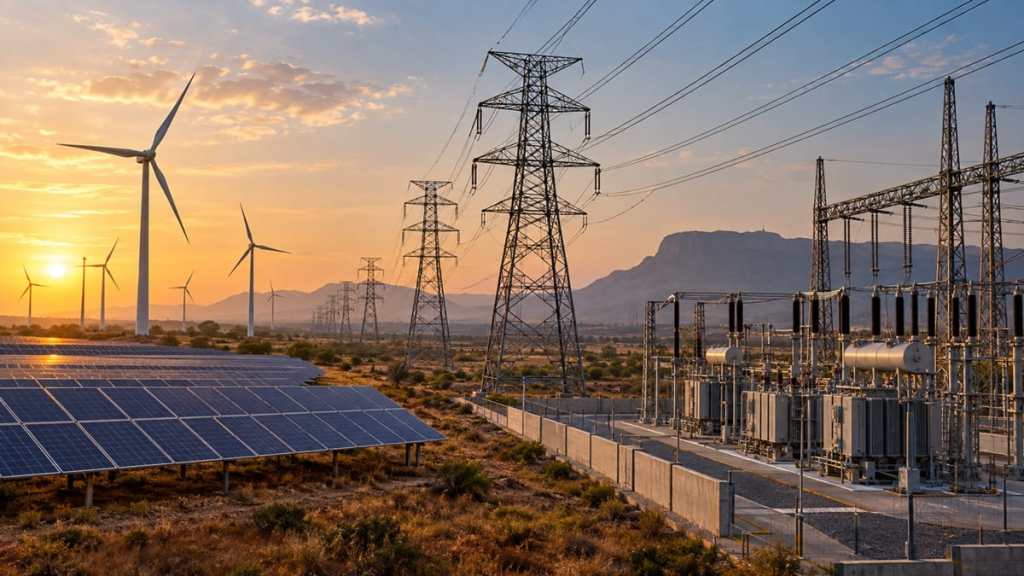

Gujarat is building a major high-voltage transmission network to evacuate electricity from some of its largest renewable-energy zones, with a Rs 5,300-crore project set to provide a key link between generation hubs in the state and demand centres in South Gujarat and neighbouring Maharashtra.
The project, formally known as the “Common Transmission System for evacuation of power from Lakadia (Phase-II: 7.5 GW), Jam Khambhaliya (Phase-II: 5.5 GW) and Jamnagar (Phase-I: 1 GW) – Part-B”, is being implemented through tariff-based competitive bidding.
The three renewable-energy zones together represent 14 GW of planned generation capacity. The transmission system is designed to evacuate this power towards load centres in South Gujarat and Maharashtra, according to official project documents.
The project reveals the infrastructure required alongside India’s rapid expansion of renewable-energy generation: building generation capacity is only one part of the process, with high-voltage transmission networks required to move electricity from resource-rich areas to centres of demand.
Rs 5,300 crore transmission investment
The Part-B project has an estimated cost of around Rs 5,300 crore, including GST.
Ceigall India, which emerged as the successful bidder, received the Letter of Intent (LoI) on September 3. The company has disclosed an annual transmission charge of Rs 608.67 crore.
The project has a 36-month construction period and a 35-year operational period.
The project cost and annual transmission charge represent different parts of the commercial structure and should not be treated as two components of the construction cost.
The project is being developed under India’s tariff-based competitive bidding (TBCB) framework. Under this model, the selected transmission service provider is responsible for developing and operating the transmission assets under a long-term transmission service arrangement.
The 14 GW renewable-energy network
The transmission infrastructure is being developed around three renewable-energy zones.
Lakadia Phase-II accounts for 7.5 GW of planned renewable generation capacity, making it the largest of the three components.
Jam Khambhaliya Phase-II represents another 5.5 GW, while Jamnagar Phase-I accounts for 1 GW.
Together, the three zones represent 14 GW of planned renewable-energy capacity.
The transmission system is intended to disperse electricity generated in these zones towards load centres in South Gujarat and Maharashtra.
This requires a high-capacity network capable of carrying large volumes of electricity over long distances, connecting renewable-energy generation areas with the wider western-region power grid.
765 kV substation at Nashik
A major component of the project is a new 765/400 kV transmission substation at Nashik in Maharashtra.
The project provides for three 1,500 MVA transformers at the 765/400 kV level, along with associated transformer bays, line bays, reactors and other high-voltage equipment.
The Nashik substation will form an important transmission node for power being evacuated from Gujarat’s renewable-energy zones towards the western-region grid.
The 765 kV network is designed for high-capacity, long-distance transmission, allowing large quantities of electricity to be transferred between generation and demand centres.
Around 320 km of transmission lines
The project also involves the construction of significant transmission-line infrastructure.
One of the main links is a 765 kV double-circuit transmission line between South Olpad in Gujarat and the new Nashik substation, with the detailed tender documents specifying approximately 240 km for this section.
The project also includes a 400 kV double-circuit transmission line between Nashik and Pimpalgaon, covering approximately 80 km.
Together, these two sections account for roughly 320 km of transmission lines.
The system will also include communication infrastructure, including optical-fibre systems, as well as protection, control and other equipment required to operate the interstate high-voltage network.
Why transmission is critical to renewable energy
Renewable-energy projects are often located in areas with strong solar and wind resources rather than close to major electricity-consuming centres.
Gujarat is developing large renewable-energy zones, particularly across areas where generation capacity can be concentrated. The electricity generated at these locations then needs to be moved to areas where demand is higher.
The network linked to Lakadia, Jam Khambhaliya and Jamnagar is designed to connect the planned renewable generation with the wider grid and enable power to be transmitted towards demand centres in Gujarat and Maharashtra.
Without adequate evacuation infrastructure, generation capacity can face restrictions in delivering its output to the grid.
Rs 5,300 crore covers Part-B, not the entire 14 GW network
The Rs 5,300 crore figure applies specifically to Part-B of the larger transmission architecture.
The transmission system required to evacuate power from the three renewable-energy zones is being developed through multiple components.
Part-B includes the transmission infrastructure centred around the Nashik connection, including the South Olpad-Nashik and Nashik-Pimpalgaon transmission links, along with the associated substation infrastructure.
Other elements of the wider transmission system are being developed separately.
Therefore, the Rs 5,300 crore project should be viewed as one major component of the wider network being developed to evacuate the planned 14 GW of renewable power, rather than the total cost of connecting all 14 GW to the grid.
Demand for transformers, conductors and grid equipment
The project also creates demand across India’s power-transmission equipment and infrastructure supply chain.
The construction of a 765/400 kV substation and hundreds of kilometres of high-voltage transmission lines requires equipment such as power transformers, switchgear, reactors, conductors, towers, cables, protection systems and communication equipment.
The project also involves engineering, procurement and construction activity, followed by long-term operations and maintenance requirements.
As renewable generation expands, transmission infrastructure is consequently emerging as a parallel investment segment alongside solar and wind generation.
The TBCB model
The project is being implemented through tariff-based competitive bidding, with REC Power Transmission Company Ltd (RECPDCL) acting as the bid process coordinator.
Under the model, the successful transmission service provider is responsible for financing, developing, owning and operating the transmission assets.
This differs from a conventional government-funded EPC project, where a contractor typically constructs an asset for the project owner and hands it over after completion.
In this case, the selected developer has a long-term operational role. The transmission service arrangement provides for a 35-year operational period, while the disclosed annual transmission charge is Rs 608.67 crore.
Building the grid alongside renewable capacity
The Gujarat project is part of the transmission infrastructure being developed to support the country’s expanding renewable-energy capacity.
As generation increasingly comes from large renewable-energy zones, grid infrastructure needs to connect those zones with demand centres across state and regional boundaries.
That requires investment in high-voltage transmission lines, substations, transformers, grid-control systems, protection equipment, communication networks and other associated infrastructure.