


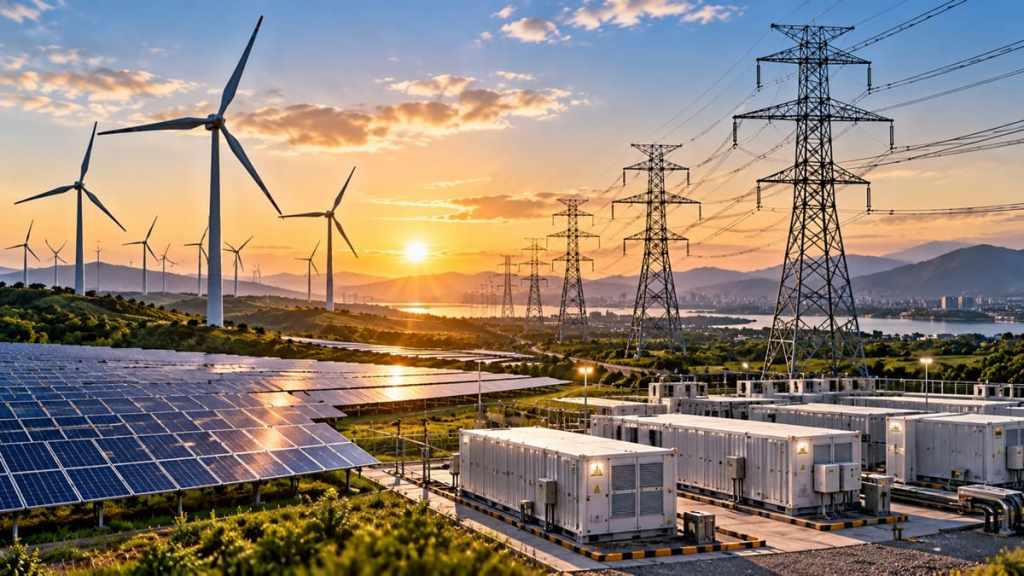

India’s renewable energy expansion is running into a problem beyond adding solar panels and wind turbines: getting that electricity to where it is needed. The Centre’s approval of the Green Energy Corridor Phase-III (GEC-III) seeks to address that bottleneck by expanding intra-state transmission infrastructure and adding large-scale battery storage capacity.
According to a Motilal Oswal Financial Services report, the scheme has a total project outlay of Rs 1.86 lakh crore, comprising Rs 1.36 lakh crore for intra-state transmission infrastructure and Rs 50,000 crore for 50 GWh of battery energy storage systems (BESS). The scheme is designed to facilitate evacuation of up to 135 GW of renewable energy capacity by FY33.
For the renewable energy industry, the significance of GEC-III goes beyond the headline investment figure. It could create a large pipeline of transmission projects, provide greater visibility for battery deployment and reduce one of the infrastructure constraints that has been delaying renewable projects. Here are the three key aspects to watch.
Rs 1.36 lakh crore transmission investment could create a major project pipeline
The biggest component of GEC-III is the Rs 1.36 lakh crore investment in intra-state transmission infrastructure. This is important as renewable generation is not evenly distributed across India. States such as Gujarat, Rajasthan, Karnataka and Andhra Pradesh have seen increasing concentrations of solar and wind capacity.
While inter-state transmission capacity has been expanding, the Motilal Oswal report points to bottlenecks within states themselves. GEC-III is intended to strengthen this layer of the network through high-voltage transmission lines, substations and pooling stations.
In simple terms, the challenge is no longer just generating renewable electricity. The grid also needs enough capacity to collect that power from renewable-rich areas and move it into the wider electricity network.
The scheme also creates different opportunities depending on the type of transmission project. Greenfield transmission projects will be awarded through tariff-based competitive bidding (TBCB), with transmission service providers responsible for building, operating and maintaining the assets. Brownfield upgrades and network-strengthening projects, meanwhile, will be executed on a cost-plus basis.
For transmission companies, this means GEC-III could provide visibility over a substantial multi-year capex pipeline.
Motilal Oswal estimates that the scheme could generate an additional annual bidding opportunity of Rs 20,000-24,000 crore for transmission utilities such as Power Grid and Adani Energy Solutions.
The key question will be how quickly these projects move from approval to bidding and execution.
The opportunity is sizeable, but the economic impact will ultimately depend on project awards, construction timelines and commissioning.
Why the 50 GWh battery component matters
The other major component of GEC-III is the proposed 50 GWh of battery energy storage systems, backed by an allocation of Rs 50,000 crore. Battery storage becomes important as the share of solar and wind power rises.
For instance, solar generation is concentrated during daylight hours, while electricity demand can remain high during the evening. Battery storage can help bridge this mismatch by storing electricity and making it available when the grid needs it.
The brokerage report identifies three broad functions for the BESS component:
Improving grid flexibility
Reducing transmission congestion
Shifting renewable electricity to periods of peak demand
A stronger transmission network helps move renewable electricity, while storage provides the grid with greater flexibility over when that electricity can be used. The 50 GWh deployment also creates visibility for battery-related equipment and manufacturing.
The brokerage firm expects the scale of deployment to reinforce the long-term opportunity for domestic battery manufacturing. The report also points to the possibility of greater policy focus on areas such as customs duties and domestic-content requirements as battery demand increases.
What to watch
The important issue will be how the proposed storage capacity is actually contracted and deployed. The headline 50 GWh represents substantial storage capacity, but the eventual opportunity for battery manufacturers and equipment suppliers will depend on procurement structures, project awards and execution.
Better transmission could unlock delayed renewable projects
The other aspect is less visible than the Rs 1.86 lakh crore investment figure but could be important for renewable developers. A renewable energy project can be technically ready to generate electricity but still face delays if adequate transmission infrastructure is not available to evacuate that power.
This is particularly relevant as renewable generation becomes increasingly concentrated in resource-rich states.
The Motilal Oswal report says improved transmission connectivity should benefit renewable developers facing project delays caused by evacuation constraints. It also says transmission-related execution risks have contributed to lower developer participation in some utility-scale bids.
GEC-III therefore addresses two sides of the renewable-energy equation.
Generation capacity needs to be built, but the grid needs to be ready at the same time. Without adequate evacuation infrastructure, additional solar and wind capacity can create congestion and increase the risk of projects being delayed or underutilised.
That makes transmission investment an important supporting layer for India’s broader renewable-energy expansion.
From renewable capacity to grid capacity
GEC-III comes as India’s renewable energy base expands rapidly. The Motilal Oswal report notes that GEC-I and GEC-II were designed to support about 44 GW of renewable energy evacuation, of which around 26 GW had been integrated as of early 2026. At the same time, India’s renewable energy capacity had reached about 263 GW, with the country targeting more than 500 GW by 2030.
The issue is not simply whether India can add more solar and wind generation. It is whether the generation, transmission and storage systems can expand together. GEC-III attempts to address that through a combination of intra-state transmission investment and battery storage.
What does the Rs 1.86 lakh crore opportunity mean for companies?
The impact will extend across several parts of the electricity ecosystem. For transmission utilities, the largest immediate opportunity comes from the Rs 1.36 lakh crore transmission component and the resulting project-bidding pipeline.
For battery manufacturers and equipment suppliers, the 50 GWh storage component provides longer-term visibility for deployment.
For renewable energy developers, the benefit is less about direct project awards and more about reducing transmission constraints that can delay projects or make utility-scale projects less attractive.
Motilal Oswal identifies Power Grid, Adani Energy Solutions and Torrent Power among the transmission utilities that could benefit, while Acme Solar and JSW Energy are identified among renewable developers and Premier Energies among battery-focused equipment manufacturers.
The three things to watch
- Transmission bidding: How quickly the Rs 1.36 lakh crore infrastructure pipeline translates into tenders and project awards will determine the near-term opportunity for transmission companies.
- Battery deployment: The 50 GWh BESS component could become a significant demand driver for the storage ecosystem, but procurement and execution will determine how quickly that opportunity materialises.
- Renewable project execution: Better evacuation infrastructure could reduce delays and transmission-related risks for renewable developers, particularly in states where solar and wind capacity is concentrated.