


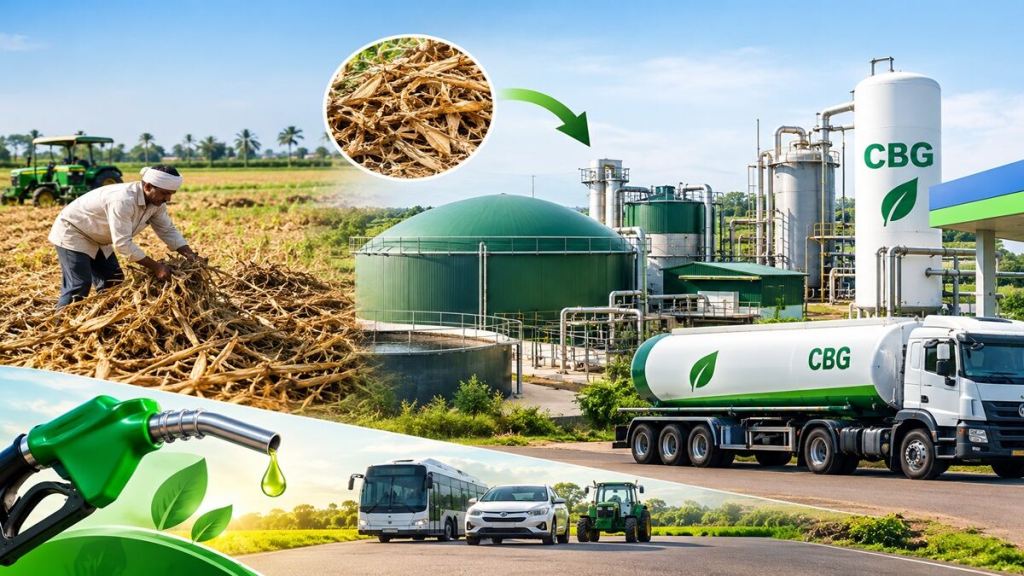

Reliance Industries has announced a Rs 1 lakh crore investment in Andhra Pradesh to build a network of compressed biogas (CBG) plants across the state. According to Reliance executive director Anant Ambani, this move could create over 3 lakh jobs and generate nearly Rs 60,000 crore in revenue for the state over the coming decades.
Ambani shared the proposal at a foundation-stone ceremony in Madanapalle on Friday (October 2). At the event, the state also launched two large agriculture-focused initiatives- the Rayalaseema Horticulture Hub and the Indian School of Agriculture (ISA).
రాయలసీమ చరిత్రలో ఈ రోజు ఒక సువర్ణ అధ్యాయం. కరవు సీమను సిరుల సీమగా మార్చే రూ.లక్ష కోట్ల గ్లోబల్ హార్టికల్చర్ హబ్ కు శ్రీకారం చుట్టాం. రైతుల భవిష్యత్కు అండగా నిలిచే ఇండియన్ స్కూల్ ఆఫ్ అగ్రికల్చర్ ఏర్పాటుకు శంకుస్థాపన చేశాం.
ఈ రెండు కార్యక్రమాలను గాంధీ జయంతి రోజున చేయడం ఎంతో… pic.twitter.com/C4nuzgjF77
— N Chandrababu Naidu (@ncbn) October 2, 2026
Compressed biogas: Turning farm waste into fuel
Compressed biogas is a renewable fuel made by processing organic waste—such as crop residue, animal dung, food waste and other biomass—into methane-rich gas that can replace conventional natural gas in transport, industry and commercial use. By converting waste into energy and nutrient-rich bio-manure, CBG projects aim to reduce landfill and field burning, cut greenhouse gas emissions, and create new income streams for rural households.
Anant Ambani said, “Reliance Industries is grateful to the Government of Andhra Pradesh for the opportunity to invest Rs 1 lakh crore in the state to set up compressed biogas plants.”
A broader clean-energy and manufacturing push
Beyond CBG, Ambani said Reliance is investing in clean-energy projects in Rayalaseema and exploring opportunities in advanced manufacturing in the state. He cited government data indicating that Andhra Pradesh has approved 388 mega projects since June 2024, with total investment commitments above Rs 14 lakh crore and potential employment of almost 11 lakh people; about a third of that investment is expected to flow into the Rayalaseema region.
Reliance also said it would continue supporting the Indian School of Agriculture through “strategic investment, digital capabilities, technical expertise and industry partnerships”. “Today, we are not just laying foundation stones. We are laying the foundations for rural enterprise, stronger villages, a more sustainable India, and most importantly, for improving the lives of our farmers,” Ambani said.
"Pashu seva bhi prabhu seva hai"
At the Indian School of Agriculture foundation stone laying ceremony in Madanapalle, Shri Anant Ambani, Executive Director, Reliance Industries Limited, shares a belief close to his heart — "Pashu seva bhi prabhu seva hai." Serving animals is… pic.twitter.com/EqLmNo4BjO
— Reliance Industries Limited (@RIL_Updates) October 2, 2026
Rayalaseema Horticulture Hub: A Rs 40,000–1 lakh crore farm push
The Rayalaseema Horticulture Hub, announced alongside the ISA, is designed to promote technology-driven horticulture in a historically drought-prone region. Reports describe it as part of a larger plan with an overall investment of around Rs 1 lakh crore, including roughly Rs 40,000 crore from the Centre (under schemes such as Purvodaya) and about Rs 60,000 crore expected from private investors and the state.
Indian School of Agriculture: AI, drones and farm CEOs
The Indian School of Agriculture in Madanapalle is envisioned as a training and innovation hub that blends modern technology with traditional farming knowledge. Ambani said the school would use tools such as artificial intelligence, drone-based crop monitoring, precision irrigation, robotics and price intelligence to help farmers improve yields and incomes.
“Here in this School, Artificial Intelligence (AI) will meet the Traditional Intelligence of Bharat’s hard-working Kisans,” he said.
Virtual classrooms and a farmer platform
Reliance’s telecom arm, Jio, is expected to work with the ISA to deliver training to millions of farmers in Indian languages through virtual classrooms in villages. The idea is to train rural youth as digitally enabled extension workers who can support local farmers with technology and market information.
Ambani also pointed to Jio Krishi, a platform developed by Jio with products and services aimed at farmers, and noted Reliance’s bio-energy R&D centre in Jamnagar. He said the group would explore cooperation between the ISA and Vantara’s proposed university for wildlife and veterinary sciences, to broaden career options in agriculture and allied fields.
Andhra Pradesh is building the future of horticulture.
Madanapalle marks a defining milestone with the foundation stone for the Global Horticulture Hub and the Indian School of Agriculture, in the presence of Hon’ble Union Finance Minister Smt. Nirmala Sitharaman Garu and… pic.twitter.com/eDVsmaUJWZ
— Andhra Pradesh Economic Development Board (@AP_EDB) October 2, 2026
The Rs 1 lakh crore CBG investment plan is expected to create more than 3 lakh jobs, especially in rural areas, and generate nearly Rs 60,000 crore in state revenue over several decades. It could also give farmers new markets for crop residue and organic waste, while producing cleaner fuel and bio-manure. Along with the proposed horticulture hub and ISA, the plan aims to link agriculture with clean energy and technology.