


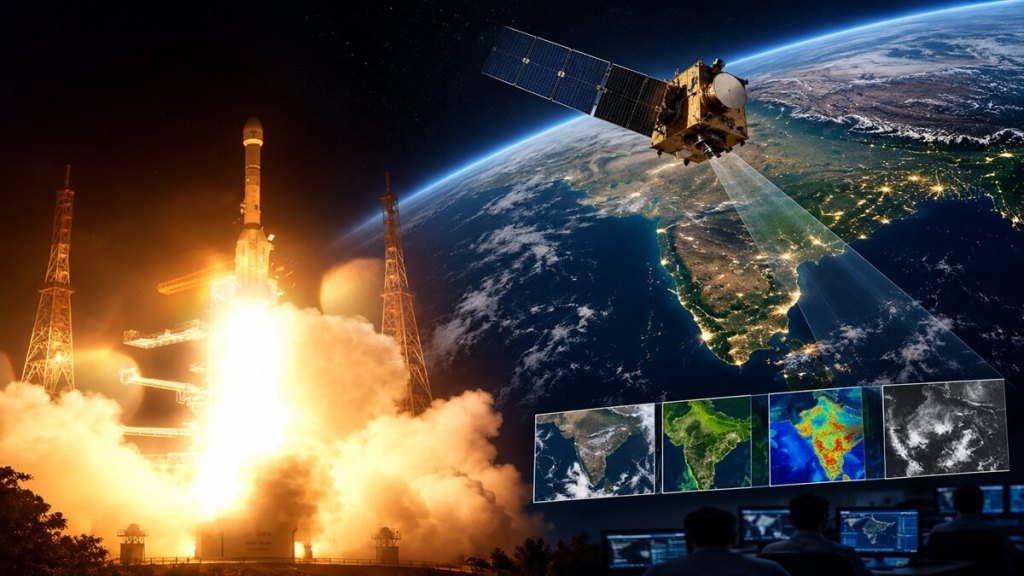

India now has its first dedicated imaging satellite watching the country from a geosynchronous orbit, a position that lets it stay fixed over the same region instead of circling the globe like most Earth-observation satellites.
On Friday (September 4), the Indian Space Research Organisation (ISRO) successfully placed the EOS-05 spacecraft in its intended orbit using the GSLV-F17 rocket, launched from the Satish Dhawan Space Centre in Sriharikota. The mission marks another step forward for India’s remote-sensing and disaster-monitoring capabilities.
The GSLV-F17 lifted off from the Second Launch Pad carrying EOS-05 to a Sub-Geosynchronous Transfer Orbit (Sub-GTO). It was the 19th flight of India’s Geosynchronous Satellite Launch Vehicle and the second consecutive successful GSLV mission, following the GSLV-F16 launch of the NASA-ISRO NISAR satellite in July 2025.
Mission Success!
GSLV-F17 has successfully accomplished its mission, placing EOS-05 into the intended orbit.
Sharing a few memorable moments from the lift-off.
For more information:https://t.co/VneB2jgZoY#GSLVF17 #EOS05 #ISRO pic.twitter.com/kv0zB6V5Vi
— ISRO (@isro) September 3, 2026
ISRO chairman V Narayanan announced the success soon after injection, saying the vehicle had “successfully and precisely injected the Advanced Earth Observation Satellite 05, the geo-imaging satellite, in the intended and required orbit”. He added, “We have injected the heaviest satellite, 2,367 kg, using this launch vehicle. The health of the satellite is perfectly alright.”
Once fully operational, EOS-05 will become India’s first imaging satellite designed to work from a geosynchronous orbit, providing a very different kind of coverage compared to traditional low-Earth orbit (LEO) satellites.
What makes EOS-05 different?
Most Earth-observation satellites orbit much lower, whizzing around the planet and passing over any given location for only a few seconds at a time. EOS-05, by contrast, is placed in a geosynchronous orbit where it moves in sync with Earth’s rotation, effectively staying “locked” over the Indian region like a camera mounted on a very tall pole.
This orbital position enables three key capabilities:
- Fixed over Bharat: Unlike conventional imaging satellites that circle the globe, EOS-05 remains positioned to continuously view the Indian landmass and surrounding regions.
- Near-continuous eyes in the sky: The satellite is designed to image select areas as frequently as every 5 minutes and cover the entire Indian landmass roughly every 30 minutes, at around 42-metre resolution — a revisit rate India has not had before from an imaging satellite.
- Game changer for disaster response: Such high-frequency, high-detail coverage is expected to be invaluable during fast-unfolding events like cyclones, floods, cloudbursts and large fires, helping authorities track developments in near real time and improve warnings, evacuations and relief planning.
EOS-05 turns India’s Earth-observation architecture from a series of periodic snapshots into something closer to a live, wide-angle feed for critical regions.
Advanced sensors: Visible, infrared, multi-spectral and hyperspectral imaging
EOS-05 is described by the government as a “state-of-the-art” Earth observation satellite. It carries advanced imaging payloads that work across multiple bands:
- Visible spectrum imaging
- Infrared imaging
- Multi-spectral imaging
- Hyperspectral imaging
These sensors allow the satellite to capture detailed information on land use, vegetation health, soil moisture, water bodies, urban growth and atmospheric conditions. When combined with its high revisit rate, this data can support more frequent crop assessments, better drought and flood monitoring, and improved tracking of environmental changes.
Minister of State (MoS) in the Department of Space, Jitendra Singh, highlighted this on X, “EOS-05 is a state-of-the-art Earth Observation satellite and India’s first imaging satellite from Geosynchronous Orbit, enabling advanced imaging across visible, infrared, multi-spectral and hyperspectral bands. With the visionary leadership of PM Shri @narendramodi Ji, India’s space capabilities continue to scale new heights, strengthening our position as a global space power.”
Another giant leap for India in Space!
Kudos to Team @isro on the successful launch of GSLV-F17/EOS-05.
EOS-05 is a state-of-the-art Earth Observation satellite and India’s first imaging satellite from Geosynchronous Orbit, enabling advanced imaging across visible, infrared,… pic.twitter.com/1HHJrWM7ze
— Dr Jitendra Singh (@DrJitendraSingh) September 3, 2026
GSLV-F17: Proving India’s heavy-lift capability for geo-orbit missions
The GSLV-F17 rocket that carried EOS-05 is a key part of India’s strategy to launch heavier spacecraft into geosynchronous orbits. The vehicle’s payload fairing uses a 4-metre-diameter ogive composite configuration, designed to accommodate larger satellites.
By successfully injecting a 2,367 kg satellite into a Sub-GTO, ISRO has again demonstrated the reliability of the GSLV platform for geo-orbit missions. This is particularly important as India plans more complex Earth-observation, communication and possibly future navigation or space-science missions that require placement in or around geosynchronous orbit.
The mission also underlines the growing role of Indian industry and academia in ISRO’s programmes. Narayanan credited “the hard work of the entire ISRO team along with our industrial partners and academia” for the success, calling it “a great achievement in our country’s space programme”.
Strategic and civilian uses: From weather and agriculture to security
From its geosynchronous vantage point, EOS-05 is expected to serve both civilian and strategic needs.
Key application areas include:
- Weather and climate monitoring: More frequent imaging of cloud systems, storm development and large-scale weather patterns over the Indian Ocean and subcontinent.
- Agriculture and land resources: Regular updates on crop conditions, irrigation status, land-use changes and drought or flood impacts.
- Disaster management: Near-continuous monitoring of cyclones, floods, landslides and large fires to support early warning and damage assessment.
- Strategic surveillance: Persistent imaging of border regions, critical infrastructure and areas of security interest, complementing other reconnaissance assets.
By providing repeated observations of large areas, EOS-05 adds a new layer to India’s existing constellation of remote-sensing satellites, which mostly operate in lower orbits and offer higher spatial resolution but less frequent revisits.
Public interest and a busy year ahead for ISRO
The launch attracted significant public attention, with students, teachers and space enthusiasts gathering at viewing galleries in Sriharikota despite rain. Many stayed in the launch-viewing area to watch the GSLV-F17 lift off, reflecting the growing popular engagement with India’s space missions.
Following the success of GSLV-F17, ISRO has indicated an ambitious schedule for the rest of the financial year. Narayanan told reporters that the space agency is targeting another six launches in the current financial year, spanning a mix of Earth-observation, communication and possibly technology-demonstration missions.
PM Modi hails mission as sign of India’s rising space capabilities
Prime Minister Narendra Modi called the successful launch an “outstanding achievement” and a proud moment for the nation. In a post on X, he said, “Yet another outstanding achievement by ISRO and a proud moment for our nation. The successful launch of GSLV-F17 carrying EOS-05, India’s first-ever imaging satellite from Geosynchronous orbit is a reflection of the excellence, innovation and growing capabilities that define India’s space sector.”
PM Modi also emphasised the expanding partnership between ISRO and Indian industry and mentioned that, “The growing partnership between ISRO and Indian industry is adding new strength and scale to our space programme and expanding India’s capabilities across the entire space ecosystem.”
Yet another outstanding achievement by ISRO and a proud moment for our nation.
The successful launch of GSLV-F17 carrying EOS-05, India’s first-ever imaging satellite from Geosynchronous orbit is a reflection of the excellence, innovation and growing capabilities that define… https://t.co/fXzwnSmwAF
— Narendra Modi (@narendramodi) September 4, 2026
Why EOS-05 matters for India’s space and security future
With EOS-05, India joins a small group of countries operating dedicated imaging satellites from geosynchronous orbit, a capability that combines wide-area coverage with high temporal resolution. For a country prone to monsoon-driven disasters, with long borders and fast-growing infrastructure, the ability to “watch over Bharat” almost continuously is a strategic upgrade.
The mission also reinforces India’s position as a serious player in space-based Earth observation, complementing earlier successes such as the Cartosat series, RISAT radars and the recent NISAR mission with NASA.