


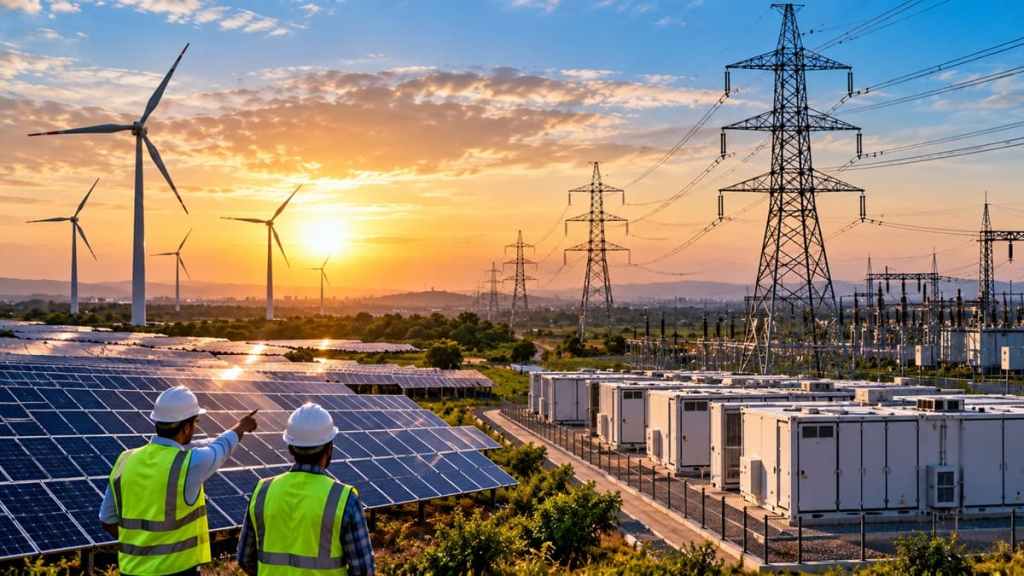

India’s new transmission and battery storage programme aims to unlock 135 GW of renewable power, but slow infrastructure execution could leave grid bottlenecks unresolved even as the country races towards its 2030 clean-energy target.
India’s renewable energy expansion is running into a problem that cannot be solved simply by installing more solar panels or wind turbines: the electricity generated must also be carried through the grid and delivered when consumers need it.
That is the challenge at the heart of the Centre’s Rs 1.86 lakh crore PM-DHARA scheme. Approved by the Union Cabinet in September 2026, the programme is designed to strengthen state-level transmission networks and deploy battery storage to help integrate larger volumes of renewable power. It targets the evacuation of up to 135 gigawatts (GW) of renewable energy and the deployment of 50 gigawatt-hours (GWh) of battery energy storage systems.
But the investment announcement does not mean the grid constraints will disappear immediately.
In its October 12 report, Indian Renewables: Dhara’s Benefits Will Come With a Gap, S&P Global Ratings talks about the time lag between the scheme’s intended benefits and the infrastructure needed to deliver them. Full implementation is expected only by FY2032-33, while India’s renewable capacity is set to expand much sooner.
This creates a difficult transition period for the power sector. If generation capacity grows faster than transmission and storage infrastructure, projects could face connectivity delays, electricity could be curtailed and the country could struggle to extract the full benefit of its renewable investments.
The issue is no longer just how quickly India can add clean-energy capacity. It is whether the power system can absorb that capacity reliably, economically and at scale.
What is PM-DHARA, and where will the Rs 1.86 lakh crore go?
The PM-DHARA programme – PM-Developing Harmonised and Accelerated Renewable-energy Access – addresses two linked weaknesses in India’s renewable power infrastructure: inadequate transmission within states and insufficient storage to manage fluctuations in renewable generation.
Of the total outlay, Rs 1.36 lakh crore has been earmarked for strengthening intra-state transmission infrastructure, while Rs 50,000 crore is allocated to support 50 GWh of battery energy storage capacity. The programme is intended to help evacuate renewable electricity from generation sites and improve the grid’s ability to manage variations in supply.
The distinction between the two investments is important.
Transmission infrastructure moves electricity from where it is generated to where it is consumed. This includes lines, substations and associated equipment that connect renewable energy projects to the wider electricity network. Battery storage, meanwhile, can absorb surplus electricity when generation is high and release it later when demand rises or renewable output falls.
Neither can fully substitute for the other. Batteries cannot resolve every transmission bottleneck, while additional transmission capacity alone cannot address all the operational challenges created by variable solar and wind generation.
PM-DHARA is intended to tackle both sides of the problem, but the time required to build these assets will determine when the benefits become visible.
Why India’s renewable grid is struggling to keep pace
India has set a target of reaching 500 GW of non-fossil fuel-based installed electricity capacity by 2030. Achieving that ambition requires not only new generation facilities but also coordinated investments in transmission networks, storage and grid management.
The difficulty is that renewable generation projects and transmission infrastructure operate on different timelines. Solar and wind projects can be developed relatively quickly, but transmission corridors require route planning, land access, clearances, equipment procurement and construction. Delays at any of these stages can leave generation capacity waiting for a reliable connection to the grid.
The resulting mismatch is particularly relevant in renewable-rich states such as Rajasthan and Gujarat, where large concentrations of solar and wind capacity require adequate evacuation infrastructure.
An analysis by energy think tank Ember found that India curtailed 300 GWh of renewable electricity because of transmission constraints in the first quarter of 2026, accounting for nearly two-thirds of total renewable energy curtailment during the period. Ember also identified delays in transmission projects and connectivity constraints as risks to the country’s 2030 ambitions.
Curtailment means that electricity which could have been generated is not supplied to the grid, often because the network cannot accommodate it or because system operators need to maintain grid stability.
For renewable developers, this creates uncertainty over how much of their potential output can be delivered. For the power system, it means that adding generation capacity does not automatically translate into an equivalent increase in usable electricity.
This is why transmission infrastructure has become a central issue for the next phase of India’s energy transition.
The implementation gap: Why the benefits may take until FY2032-33
The key concern raised by S&P Global Ratings is the gap between the scheme’s announcement and its full implementation.
Although the Rs 1.86 lakh crore programme establishes a substantial investment pipeline, transmission assets cannot be delivered immediately. Projects need to move from planning and approvals to procurement, construction, testing and commissioning. The pace of implementation will also depend on coordination between central agencies, state governments and transmission utilities.
The programme’s full implementation timeline, extending to FY2032-33, means the sector could face several years in which renewable generation additions continue while parts of the grid remain constrained.
That timing matters because India’s clean-energy ambitions are concentrated around the end of this decade. Infrastructure that becomes operational only in the early 2030s cannot fully address bottlenecks affecting projects seeking connectivity or commissioning in the intervening years.
Ember’s findings underline the execution risk. Its analysis found that India had delivered only about 80% of its annual transmission targets over the preceding five years, while around one in four inter-state transmission schemes faced delays of at least a year. Right-of-way disputes, land issues, environmental clearances and supply constraints for specialised equipment were among the obstacles identified.
These challenges are not automatically resolved by allocating more money. Funding can support construction, but projects must still secure clearances, acquire land, obtain equipment and complete physical works.
The practical test for PM-DHARA will therefore be whether the programme accelerates the delivery of functioning transmission and storage assets, rather than merely expanding the list of sanctioned projects.
Why battery storage is critical – but not an instant solution
The Rs 50,000 crore allocation for 50 GWh of battery energy storage systems addresses another weakness in a power system with a rising share of solar and wind generation.
Solar output is concentrated during daylight hours, while electricity demand can remain high after sunset. Wind generation also varies with weather conditions and season. Storage can help bridge some of these gaps by charging when electricity is available and discharging when the system needs additional supply.
Battery projects can generally be commissioned faster than large transmission projects, making them a potentially useful source of flexibility during the grid expansion period. The earlier analysis associated with the S&P report indicates that battery storage projects may take around six to 18 months to commission, compared with three to four years for transmission projects, although actual timelines depend on project conditions.
However, storage should not be treated as a replacement for the grid. A battery connected to a constrained network cannot necessarily resolve the underlying problem of moving electricity from a generation centre to a distant demand centre. Storage also needs appropriate connections, charging arrangements and operating incentives to deliver its intended benefits.
The effectiveness of PM-DHARA will consequently depend on whether storage deployment is coordinated with transmission upgrades and the locations where flexibility is most needed.
What the delays mean for renewable energy developers
For developers, transmission availability is increasingly a factor in project planning alongside land, financing, equipment and power purchase agreements.
A renewable project may be technically ready to generate electricity but unable to begin commercial operations until its grid connection is available. Delays can push back commissioning schedules, affect expected cash flows and complicate financing assumptions.
Even after a project becomes operational, congestion and curtailment can reduce the amount of electricity it is able to deliver. This makes the timing and location of transmission investments important for developers deciding where to build new capacity.
PM-DHARA could improve the outlook by expanding intra-state networks and supporting storage. But until the infrastructure is commissioned, developers may continue to face uncertainty in areas where renewable generation is expanding faster than evacuation capacity.
The scheme’s ability to unlock 135 GW of renewable energy should therefore be understood as an infrastructure objective, rather than an immediate increase in electricity delivered to consumers.
Can PM-DHARA help India meet its 2030 target?
The scheme addresses a genuine constraint on India’s clean-energy expansion, but its contribution to the 2030 target will depend on how much of the planned infrastructure becomes operational before the deadline.
The gap between the target year and the scheme’s full implementation timeline does not mean the programme will have no near-term benefits. Individual transmission upgrades and storage projects can begin delivering value as they are commissioned. The challenge is whether these additions will come online quickly enough, and in the right locations, to keep pace with renewable generation.
That requires careful sequencing: transmission capacity must be available where projects are being built, storage must be deployed where it can help balance supply and demand, and grid operators must have the flexibility to manage a changing generation mix.
India’s broader power transition is increasingly moving from a focus on installed capacity towards the ability to integrate and deliver clean electricity reliably. S&P Global’s wider analysis of the sector also identifies transmission delays, curtailment risk and limited storage as constraints that could prevent the country from fully absorbing renewable capacity.
PM-DHARA provides a large financial framework for addressing those weaknesses. But its success will be measured not by the size of its outlay alone, but by the speed at which lines, substations and batteries become operational.