


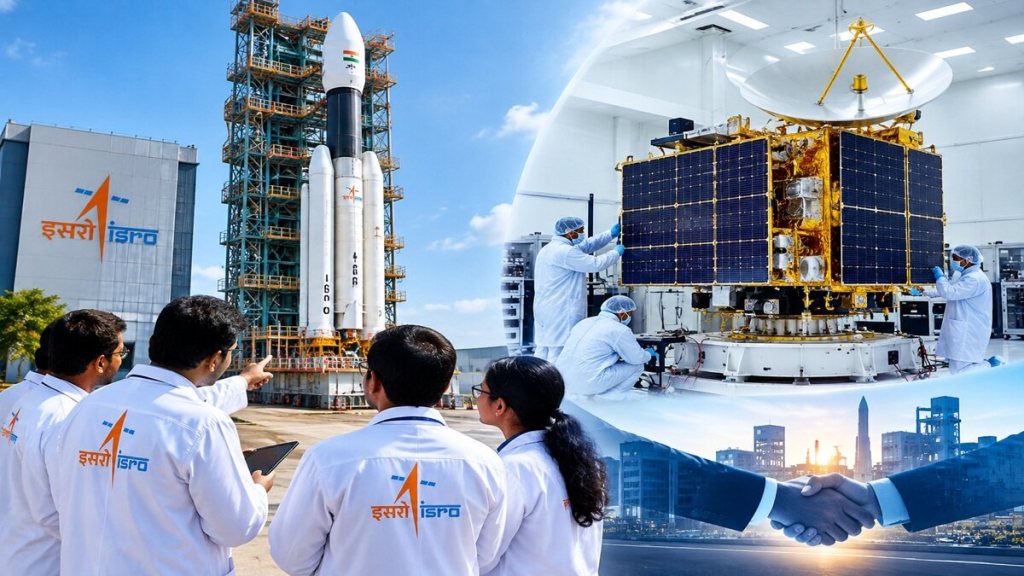

Around nine employee associations across the Indian Space Research Organisation (ISRO) centres have sought a written assurance from Chairman V Narayanan regarding the agency’s future role, recruitment and job security as India shifts routine rocket and satellite production towards private industry, according to an report from The Indian Express.
The representation follows recent remarks by IN-SPACe Chairman Pawan Goenka that ISRO would eventually stop manufacturing launch vehicles, allowing the national space agency to focus on research, advanced technologies and strategic scientific missions.
Employees raise alarm
In a joint representation dated September 4 (Friday), the associations said public comments about transferring ISRO’s manufacturing and operational activities to private firms and public-sector undertakings had created uncertainty among employees.
The signatories include:
- ISRO Staff Association
- SHAR Employees Association
- ISAC Employees Association
- ISRO Staff Association-LPSC
- ISRO Staff Association-BBU
- NRSA Employees Union
- Space Employees Association-BBU
- ISRO Staff Association-IPRC
- SAC Employees Welfare Association
Their central question is whether the statements made by Goenka represent an approved government policy, or merely an outlook presented by IN-SPACe, the space-sector regulator and promoter created under the Department of Space to facilitate private participation.
“We submit this representation in a constructive and democratic spirit. Our loyalty to ISRO and to the national space programme is not in question,” the associations said in the letter. “Precisely because of that loyalty, we consider it our duty to seek clarity before uncertainty hardens into irreversible policy.”
What sparked the letter
The concerns follow remarks made by Goenka at the Business Today India@100 Economy Summit on August 21. He said mature launch-vehicle manufacturing and routine satellite production would increasingly be shifted to industry, while ISRO would concentrate on frontier research and complex missions.
“Eventually, ISRO will not make any launch vehicles and will not manufacture any launch vehicles. That will all be done by the private sector or PSU,” Goenka said.
He also indicated that ISRO would move away from “day in, day out” satellite production, retaining work related to specialised scientific, strategic and technology-development missions before transferring mature technologies to industry.
The shift is already under way in the Small Satellite Launch Vehicle programme. NewSpace India Ltd, ISRO, IN-SPACe and Hindustan Aeronautics Ltd signed an agreement in September 2025 to transfer SSLV technology to HAL. Reports have indicated that the production of the PSLV and LVM3 could also eventually be moved to industry.
Concerns over jobs, capability
The Indian Express report also added that the employee bodies said launch-vehicle design, realisation, integration, testing and launch operations are not simply manufacturing contracts. They described these functions as ISRO’s core scientific and strategic capability, developed through decades of public investment.
They fear that a progressive withdrawal from rocket and satellite realisation could reduce in-house work, affect sanctioned posts and restrict promotion opportunities. They also said employees at development and production facilities could be left with reduced responsibilities even as similar work is undertaken by private contractors.
The representation flagged the possibility of slower hiring for Group A, B and C posts, particularly when ISRO is already dealing with vacancies and attrition. It asked the chairman to clarify the likely recruitment pipeline over the next five to 10 years, as well as safeguards against adverse cadre restructuring or the erosion of career prospects for existing staff.
The associations also raised concerns about strategic autonomy, quality control and safety. They argued that ISRO must retain sufficient independent capability to undertake launches and manufacture systems for sensitive national-security and scientific missions, rather than becoming fully dependent on external suppliers.
Not against private participation
The employees said they were not opposed to greater participation by Indian industry or the commercialisation of space technology through NewSpace India Ltd, or NSIL. Their concern, they said, is the lack of a formal policy document defining the boundary between supporting private industry and transferring ISRO’s own permanent capabilities.
The letter obtained by The Indian Express report referred to reports that the transfer process could extend from SSLV to PSLV and LVM3, that satellite manufacturing may increasingly shift out of ISRO, and that new infrastructure—such as the planned Space Launch Complex at Kulasekarapattinam—could be operated by private entities.
ISRO has transferred many technologies to industry over time, while the SSLV transfer to HAL represents a more comprehensive handover of an operational launch-vehicle system. For the associations, the unresolved issue is the extent to which ISRO will remain a hands-on operational agency after these transfers.
What the staff want
The associations have asked Narayanan to issue a time-bound written clarification covering:
- Whether Goenka’s remarks reflect a decision approved by the Government of India, the Department of Space, or the Space Commission.
- ISRO’s future mandated role in PSLV, LVM3, SSLV and successor launch vehicles.
- The treatment of public-sector undertakings in future transfer plans.
- The likely impact on sanctioned workforce strength, vacancies, recruitment and promotions.
- Safeguards for serving employees and the public-service nature of ISRO jobs.
- The institutional framework for transferring publicly developed technologies and facilities, including the respective roles of NSIL and IN-SPACe.
- Whether service associations will be consulted before any irreversible structural decision.
They have also asked the chairman to confirm that no irreversible transfer of core rocket realisation or launch functions will take place without briefing employee representatives.
The debate comes at a time for India’s space programme when ISRO is pursuing complex missions including Gaganyaan, the Bharatiya Antariksh Station and future lunar exploration, while the government seeks a substantially larger role for Indian companies in launch services, satellites, downstream data and space applications.