


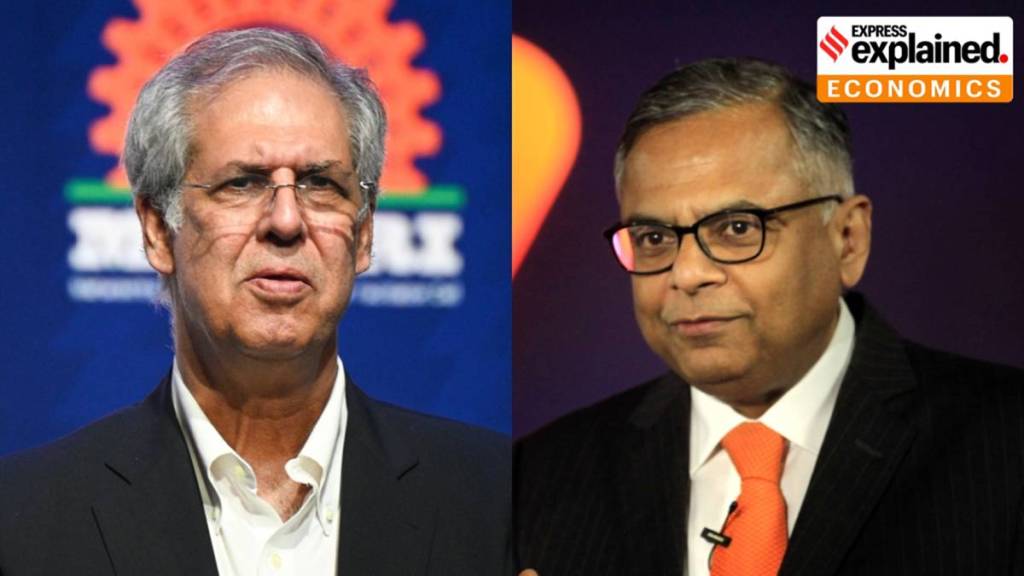

The boardroom slugfest within Tata Sons, the holding company of the 158-year-old Tata Group, has thrown open a question that could unsettle some of India’s most powerful business families: Who really controls a company when ownership and the board no longer see eye to eye?
Tata Trusts, the family-run philanthropic arm chaired by Noel Tata, owns roughly two-thirds of Tata Sons, helmed by chairman Natarajan Chandrasekaran.
Their tussle at one of India’s most iconic business houses — over the larger direction of the company — has promoters watching nervously. It challenges an old corporate tenet: families and trusts provide ownership, capital and long-term vision; professional managers and boards run the business.
But what happens when directors with no meaningful stake can challenge, or even seek to displace, those who own it? The Tata Trusts-board confrontation exposes a deeper faultline in Indian capitalism. If this becomes the new governance template, every promoter family may have to rethink who ultimately holds the power.
The message in the tussle
The Tata dispute has a larger message for Indian business families. “It is not really about independent directors suddenly taking control of promoter driven companies. The bigger issue is that promoters are gradually being reminded that ownership and management are two different things in law,” said Sonam Chandwani, Managing Partner, KS Legal & Associates.
Chandwani said a promoter may have significant voting power, but once directors are appointed, they cannot simply be treated as the promoter’s employees on the Board. “Directors are expected to exercise their own judgement and act in the interest of the company,” she said.
The issue that most promoter families will now be watching closely is whether ownership can remain with the family while effective control gradually shifts to the board.
Parag Srivastava, Partner at Bombay Law Chambers, said the ongoing discussion around Tata Sons director Venu Srinivasan’s request to the Maharashtra Charity Commissioner for an enquiry into the governance of Sir Dorabji Tata Trusts has raised broader questions around promoter trusts, nominee directors and board responsibilities.
“A trust, as a shareholder, has the same rights as any other shareholder. It can, through the trustee, vote at general meetings, appoint and remove directors, and use any special rights in the articles of association. In Tata Sons’ case, the articles give the Trusts the right to nominate directors and require their nominees’ affirmative vote on certain matters,” Srivastava said.
However, under Section 179 of the Companies Act, 2013, managing the business is the responsibility of the board and not the shareholders.
When boardroom independence begins
The Tata Sons dispute matters because it strikes at the heart of India’s corporate power structure.
Tata Trusts hold 66% of Tata Sons, yet the sprawling empire is run by professional managers and boards. India’s old promoter model rested on families owning, chairing and controlling their businesses. That model is changing. Professional CEOs, independent directors and institutional investors are gaining power. That is essential for global-scale companies, but it also creates a potential faultline between the ownership and the board. So who really calls the shots?
Srivastava said a trust may communicate its views or expectations to its nominee. “However, it cannot issue binding instructions, as under Section 166 of the Companies Act, 2013, every director, including a nominee director, owes a fiduciary duty to the company, including its shareholders, employees and other stakeholders. They are required to exercise their independent judgment. Therefore, a trust cannot issue binding instructions requiring a nominee director to vote in a specific manner or abstain from voting if doing so would conflict with the director’s fiduciary duty,” he said.
In the event of a conflict between the nominator’s mandate and the company’s interest, the director’s duty to the company legally prevails. “I think this (Tata episode) will make many family-owned businesses rethink how much control they actually have over the Board,” Chandwani said.
In traditional Indian businesses, there has often been an informal understanding that the family owns the business, the family chooses the leadership and the Board broadly supports that vision. That model becomes vulnerable when the relationship between the promoter group, shareholders and directors breaks down, she said.
Promoter’s interests and board’s judgment
What is worrying the promoters is the regulatory requirement of the board composition. The Companies Act requires every listed public company to have at least one-third of its directors as independent directors. SEBI’s Listing Obligations and Disclosure Requirements go further for listed companies. Regulation 17 requires an appropriate mix of executive and non-executive directors, with at least 50 per cent of the board comprising non-executive directors.
Where the chairperson is a non-executive director, at least one-third of the board must be independent. Where there is no regular non-executive chairperson, at least half must be independent. If the non-executive chairperson is a promoter or is related to a promoter or specified management-level persons, at least half the board must comprise independent directors. “If a non-executive director joins hands with all independent directors in a company and turns against the promoter, things can go wrong. They can take control of the company even if the promoter group has a majority stake,” said a former Tata group official.
Independent directors are not meant to become an alternative class of owners. Their role is to protect the company and its shareholders, particularly minority shareholders, from conflicts, abuse and poor governance. “The million-dollar question is whether Directors are protecting the interests of Tata Trusts, the owners. They had gone against the owners in the last board meet,” said a legal expert.
“The roles of a company director and a trust’s trustee are governed by entirely separate legal frameworks. In their capacity solely as a nominee director on a company’s board, an individual does not have the right or power to seek the removal of a trustee from the nominating trust. Appointment and removal of trustees are governed by the trust deed and, for public trusts in Maharashtra, by the Maharashtra Public Trusts Act,” Srivastava said.
Concerns for owners
The Tata episode shows that independent directors can become a nightmare for the majority shareholder. The architecture of India’s listed-company governance increasingly puts independent directors at the heart of decision-making. Take the Audit Committee. Under SEBI’s LODR framework, at least two-thirds of its members must be independent directors. The Nomination and Remuneration Committee must also have at least two-thirds independent directors and must be chaired by an independent director. This gives independent directors influence over some of the most sensitive decisions in a company — financial reporting, auditors, related-party matters, senior management appointments, remuneration and succession.
The regulator does not want a company to be governed simply according to the wishes of its largest shareholder. “But there is a potential danger if the pendulum swings too far. If promoters believe that their ownership gives them absolute power, governance suffers. If independent directors believe that their independence gives them absolute power, governance suffers equally,” said one legal expert.
There should be defined boundaries between ownership, management and governance. That is why the Tata Sons episode is being watched so closely by promoter families.
If the director also qualifies as a “person having an interest” in the trust, such as by being a trustee, they can request the Charity Commissioner to inquire into the trust’s administration, and the Commissioner has the power to suspend or remove trustees, Srivastava said.
“What the Tata episode does highlight is the danger of confusing shareholder authority with Board authority. A promoter can exercise shareholder rights, but cannot necessarily dictate every decision of the Board. Equally, independent directors cannot use their position to override legitimate shareholder rights or become a competing power centre,” Chandwani said.
“So legally, I would not describe the Tata situation as a warning that independent directors are becoming more powerful than promoters. It is a warning that promoter power has boundaries, and those boundaries become very visible when relationships collapse,” Chandwani said.
Independent directors, new power centre?
This is the question promoter families will not ask publicly, but they will certainly ask privately. Suppose a promoter owns a controlling stake and the family believes a particular strategic decision is against its long-term interests. If the board — including independent directors — reaches the opposite conclusion, who wins? It cannot simply be the promoter.
True, a company is not the personal property of its largest shareholder once it is incorporated and especially once it is listed. But the answer also cannot simply be the independent directors. Directors derive their authority from the company’s legal and constitutional framework. They are fiduciaries, not owners. The Articles of Association, shareholder rights, the Companies Act, SEBI regulations and applicable contractual arrangements all matter, experts say.
Promoters should know exactly what decisions belong to shareholders, what belongs to the board, what belongs to management and what requires special approval. Boards should know the limits of their authority. “But I would not say independent directors can simply take over a company. They cannot. Their role is fundamentally supervisory and fiduciary. They do not acquire the economic ownership of the company merely because they are independent directors. The promoter still retains whatever voting and shareholder rights the law and the Articles give them,” Chandwani said.
Defining board boundaries
The promoter must accept that the board is not a rubber stamp and the board must accept that the promoter is not an irrelevant shareholder. And independent directors must understand that their job is to mediate between competing interests in the interests of the company — not to become one of the competing interests.
This is why Tata Sons has become such an important case study. The immediate dispute may be about Tata Sons, its board, its ownership structure, regulatory requirements and strategic direction. But the implications are much broader.
Every large promoter group should now be asking whether its Articles of Association are sufficiently clear. Whether independent directors have become sufficiently strong to challenge management — but not so powerful that they are perceived as an alternative controlling constituency.
For India’s promoter families, the message should be unmistakable: the era when ownership automatically translated into unquestioned boardroom authority may be ending. But that does not mean the era of promoter control is ending. The promoter families that survive the next phase of Indian capitalism will be those that understand the difference.
They will retain control not by dominating every boardroom, but by building institutions strong enough to withstand disagreements. And that is perhaps the biggest irony of the Tata Sons battle. “The biggest lesson, in my view, is that family businesses cannot depend entirely on trust and personal relationships anymore,” Chandwani said.
“When everyone is aligned, informal arrangements work beautifully. When there is a dispute, the same informal arrangement can become the weakest part of the governance structure,” she said. For family-controlled companies, good governance is therefore not about reducing promoter control. It is about clearly defining where promoter influence ends, where the Board’s independent judgement begins, and what happens when the two no longer agree.