


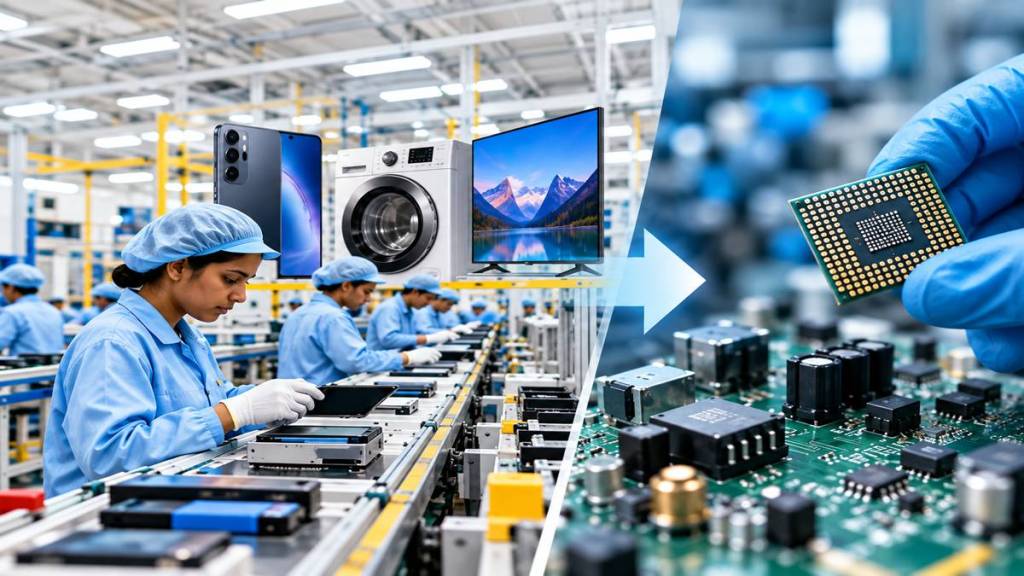

Much like his father before him, Sunil Vachani started out making television sets. Three decades ago, his operations were modest but Vachani soon decided he wanted to more. With Dixon Technologies he forayed into contract manufacturing assembling smart phones, washing machines and television sets for Motorola, Xiaomi, HP and Samsung. Last year, Dixon’s top line hit Rs 48,872 crore with 90% of the revenues coming in from smart phones. Now Vachani’s aiming for bigger things, he’s looking to manufacture components.
He believes achieving global competitiveness is nearly impossible if the country perpetually imports components. The camera modules and display modules businesses, Vachani estimates, would result in value addition of 35% in mobile phones.
Moving up the value chain
It’s not just Dixon. A host of home-grown players— Syrma, Kaynes, Amber, Uno Minda, Motherson—are all leveraging their experience in electronics to bet on backward integration. They’re being backed by the government which is offering support to the tune of Rs 40,000 crore via the electronic component manufacturing scheme (ECMS). The addressable market for printed circuit boards (PCB) alone is $5 billion; today 90% of PCBs are imported.
Ramesh Kunhikannan, who co-founded Kaynes Technology nearly four decades back, has expanded his electronics operations over the years focussing on the high-value segments –industrial, automotive, aerospace. The company, which reported Rs 3,626 crore of revenue in FY26, is now diversifying into multilayer PCBs and semiconductor packaging, attempting to build capabilities in components and sub-assemblies.
Syrma SGS intends to work on a multilayer PCB project, with an investment of Rs 765 crore. Plans are in the offing to set up an annual capacity of 2.5 mn sm for single and multi-layer PCBs and also 1mn sqm capacity for high –density PCBs. It will cater for customers across automotive, industrial and consumer segments. Chairman JS Gujral believes that the foray into components, via the PCB project, would help broad-base the product portfolio as also the manufacturing platform making the firm more resilient. Syrma’s business is already spread across multiple end -markets, giving it a customer base beyond smart phones. The company is also using partnerships, such as its joint venture with Italy’s Elemaster, to expand its manufacturing and global supply-chain reach.
Amber too is evolving from a consumer durables company to a core EMS company; it has used the inorganic route to scale up the electronics business acquiring Power One MicroSystems, Unitronics and Shogini Technoarts. With the Shogini acquisition, Amber is now the second-largest PCB manufacturer in India with revenues of Rs720 crore in FY25.
Scaling up component manufacturing
The company has won an approval under the ECMS for an investment of about Rs 1,000 crore for multi-layer PCBs; the unit, the management expects, should start production in late 2026. The company also has the go-ahead for its joint venture Korea Circuits, for making PCBS, at a proposed investment of Rs 3,200 crore.
Optiemus has moved beyond handset manufacturing into components, including cover glass through its partnership with market leader Corning; it is also making screen protectors. It has also expanded its partnership with Nothing’s CMF, to bring manufacturing, ownership and R&D under a single Indian entity. Executive chairman Ashok Gupta is sharpening its focus on electronics manufacturing as also working to build a portfolio of consumer brands. Gupta believes the company can leverage the manufacturing platforms and distribution strengths for the consumer products piece. The company is setting up a screen protector unit with an annual capacity of 15-20 million.
Meanwhile, Tata Electronics, which is known for manufacturing precision components, also makes smart phones for Apple having acquired Wistron Infocomm and a 60% stake in Pegatron. Much like other players, Tata Electronics is also moving up the value chain and has announced a partnership with Qualcomm Technologies to make automotive modules. CEO and MD Randhir Thakur has said the company is funding its electronics expansion from its internal accruals.