


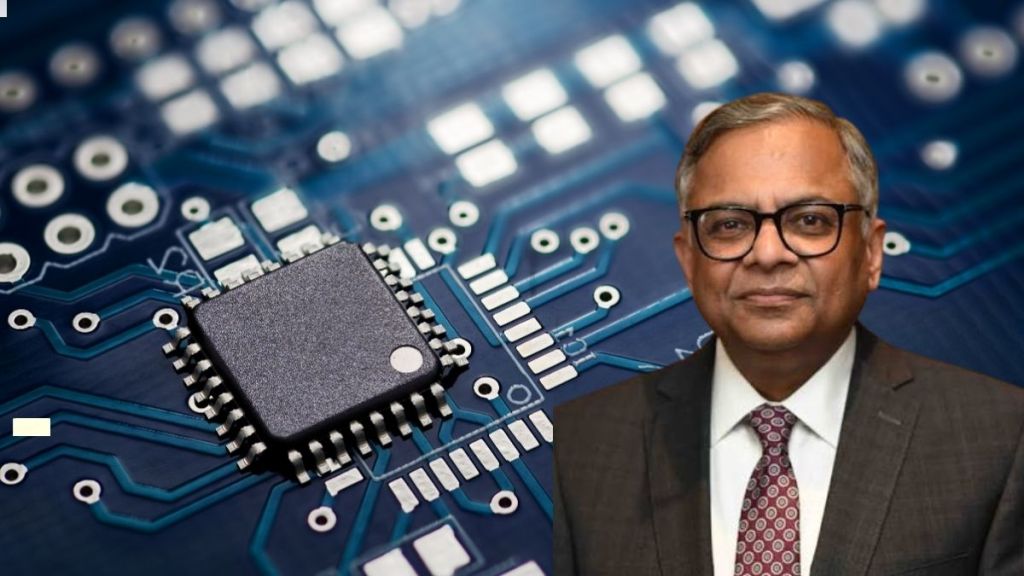

Tata Sons Chairman N Chandrasekaran on Tuesday said the group’s investments in semiconductors should be judged by their strategic importance to India rather than the financial returns they generate over the next two to three years, as the country is seeking to build domestic chip manufacturing capabilities and become part of global supply chains.
“Whether we will get it right and meet the numbers in two years or three years, it’s not the point. The point is that chips are going to be fundamentally required for domestic consumption,” Chandrasekaran said at the 2026 Bloomberg New Economy Forum. He, however, cautioned against investing in advanced manufacturing technologies without assessing market demand and commercial viability.
“You cannot be reckless and say that I am going to be putting a 2 nanometre chip (plant). It’s just not going to work. So, we need to also see where the demand is,” he said, underlining the need to balance long-term strategic objectives with financial sustainability. He added that investments must generate sustainable employment over the long term.
Chandrasekaran said India was well placed to develop its semiconductor manufacturing capabilities, given its talent pool, large domestic market and potential to participate in global supply chains.
However, building the ecosystem would require partnerships with global players to access technologies, as well as careful planning to meet the sector’s energy requirements. “We are in a beautiful spot in India, because we have the talent, we have the domestic market, we can play a part in every global supply chain,” he said.
Tata Electronics, a group company, is setting up a semiconductor fabrication plant at Dholera in Gujarat in partnership with Taiwan’s Powerchip Semiconductor Manufacturing Corporation, with an investment of around Rs 91,000 crore. The proposed facility will manufacture chips for applications spanning automobiles, mobile devices, consumer electronics, artificial intelligence and industrial segments. The group is also developing a semiconductor assembly and test facility in Assam with an investment of around Rs 27,000 crore.
The investments form part of the Tata group’s broader push into advanced manufacturing, electronics and battery technologies. Chandrasekaran said the strategy drew from the group’s history of investing in sectors it believed would be critical to the country’s future industrial development, even when the returns were not immediate.
He cited founder Jamsetji Tata’s vision for steel and hydroelectric power, with the group’s steel plant coming up in 1907 and its hydroelectric power business following in 1911. The same philosophy, he said, informs the group’s current investments in semiconductors and other emerging sectors. “If you design it on the belief that it’s needed for India, it’s needed for mankind, and for the process, it will get right,” he said.
Chandrasekaran said that advanced manufacturing would remain important even as conventional manufacturing faced pressures. While acknowledging that execution timelines and the pace of scaling up remained uncertain, he stressed that businesses needed to invest in capabilities that would be essential in the long run without losing sight of commercial viability.