


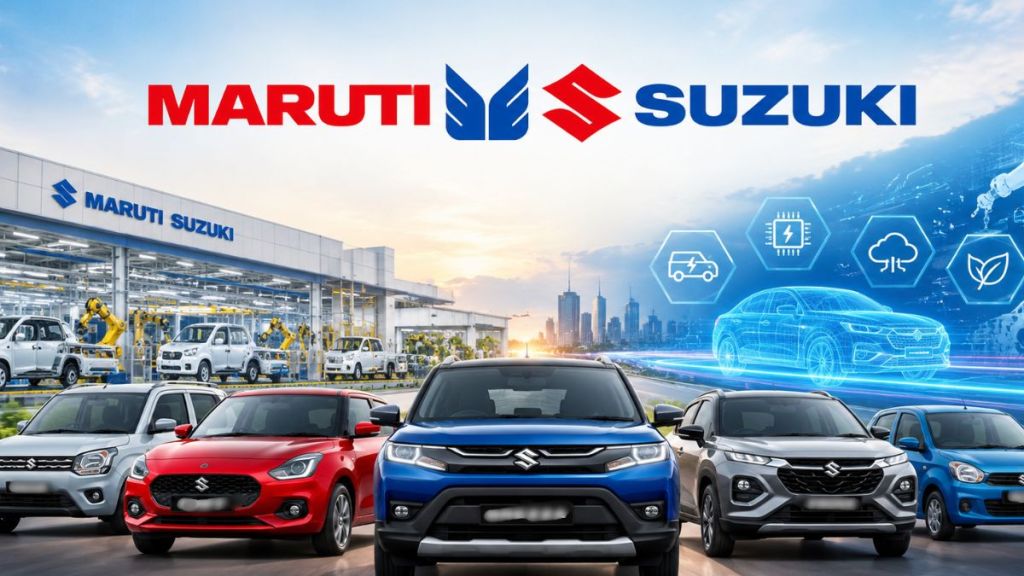

Suzuki Motor Corporation is looking to expand its manufacturing footprint in India, targeting annual production capacity of about 4 million vehicles from fiscal year 2030 onwards. In its, Suzuki’s Technology Strategy Briefing 2026, the company also outlined a multi-pathway technology strategy covering electric vehicles, hybrids, CNG, compressed biogas (CBG) and highly efficient internal combustion engines.
India to become a key global production hub
Suzuki currently has production facilities at Gurgaon, Manesar, Hansalpur and Kharkhoda. “India will be further strengthened as a manufacturing and export hub for delivering products to customers around the world, with the aim of achieving an annual production capacity of approximately 4 million units in fiscal 2030 and beyond,” Suzuki shared.
The company also plans to develop technologies in Japan and share them with Maruti Suzuki, which will then optimize products for individual markets.
“Technology is shared. Products are regionally optimized,” Suzuki said, outlining its approach to global technology development.
Suzuki targets 50% manufacturing efficiency
Suzuki also set a target to improve development efficiency by 30% from the FY20 level and manufacturing efficiency by 50 per cent by FY30.
“For 2030, Suzuki will cut new vehicle development lead time by half while achieving a 30% improvement in development efficiency and a 50% improvement in manufacturing efficiency,” Suzuki Motor Corporation President Toshihiro Suzuki said.
Suzuki takes multi-pathway approach to India
Suzuki is not planning to rely only on electric vehicles for its transition to cleaner mobility. The company said it will use different powertrain technologies depending on the energy mix, infrastructure and customer requirements in each market.
Its strategy includes battery electric vehicles (BEVs), hybrid electric vehicles (HEVs), internal combustion engines, CNG and carbon-neutral fuels.
Suzuki said countries differ significantly in terms of renewable energy availability, charging infrastructure, fuel availability and energy security. It therefore plans to tailor its products to regional requirements rather than use a single technology across all markets.
The company also highlighted “local production for local consumption” as an important part of this strategy, saying it can reduce transportation-related energy use, costs and supply risks.
The company is also working on motors that do not use heavy rare earths. Suzuki said this could help reduce geopolitical risks and improve future recyclability.
CNG and CBG remain important for India
Suzuki said CNG and CBG will continue to play an important role in India’s transition towards cleaner mobility.
The company said CNG vehicles account for about 40% of sales in India. According to Suzuki, a CNG vehicle driven 10,000 km a year emits about 155 kg less CO2 than a petrol vehicle and can reduce fuel costs by about 40%.
Suzuki is also developing CBG, or compressed biogas, which can be produced from sources such as cow dung. The company said CBG can use existing CNG vehicles, engines and infrastructure.
Suzuki has started operating three biogas plants in India over the past year in cooperation with the National Dairy Development Board and dairy cooperatives.
The company said Japan and India agreed in July to launch the Japan-India CBG Initiative, which aims to introduce 1,000 biogas plants across India.
Suzuki wants to halve new model development time
Suzuki has set targets to speed up vehicle development and manufacturing.
By 2030, the company aims to halve the new model development period compared with FY2020. It also plans to improve development efficiency by 30% and production efficiency by 50%.
Suzuki said it will use parallel development, digital tools and greater modularisation to achieve these targets.
The company plans to bring planning, design, production, quality and procurement teams into the development process earlier instead of completing one stage before moving to the next.
Suzuki’s 10-year strategy: More efficient engines, hybrids and EVs in focus
The company said its focus is on minimising energy use while maximising the value that customers actually need.
The strategy covers EVs, hybrids, CNG, CBG and more efficient engines rather than focusing on a single powertrain.
For India, this means expanding local manufacturing, strengthening CNG and CBG technology, developing more efficient engines and hybrids, and preparing for greater EV adoption.
Suzuki said its aim is to deliver products suited to the requirements of individual markets while keeping vehicles smaller, lighter and more efficient.