


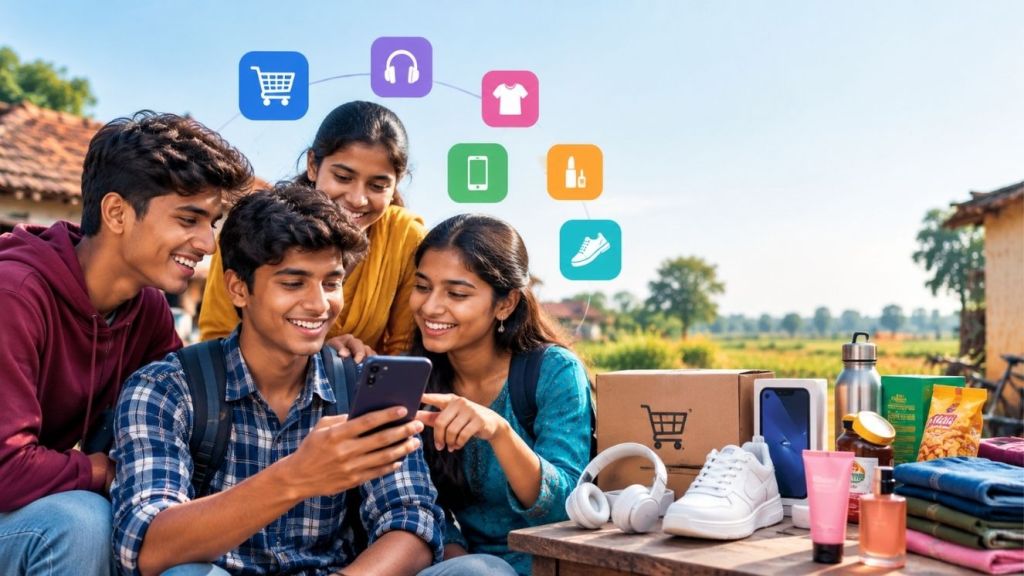

Rural India’s consumption market is becoming more diverse, with younger consumers expanding their product baskets and women emerging as a fast-growing online-shopping segment, even as influencers and artificial intelligence (AI) reshape how households discover and evaluate brands, according to a new report by WPP Media and Kantar.
Rural consumers aged 18–29, classified as Gen Z, now buy across an average of 19.1 product categories a month, up from 17 in February 2025, the Rural Barometer Report 2026 said.
The Rural Barometer study tracks consumer sentiment, spending priorities, and communication behaviour across rural India. The 2026 edition draws on a quantitative study of rural mobile phone users across 12 state groupings, conducted in June 2026 and compared with February 2025.
According to the study, Gen Z accounts for 33% of rural mobile users. Its expanding basket is particularly visible in discretionary and wellness categories. Purchases across convenience-food categories rose 27% to 5.9, while the health and wellness basket grew 36%, compared with 21% among rural consumers overall. Personal grooming purchases among Gen Z increased 9%, even as the category remained flat across rural India.
“Rural India is not a single, uniform market, and the data increasingly reflects that reality,” said Abhishek Singh, senior vice-president and head of rural, social and health, Media Solutions, WPP Media India. “We are seeing younger consumers accelerate digital discovery, women expand their role in household purchasing, and creators and AI influence how products enter the consideration set,” he said.
The digital shift is significant. Gen Z spends an average of 115 minutes online daily, against 93 minutes for rural consumers overall. Nearly 39.4% of this age group shopped online, compared with 29.6% across rural India.
AI adoption is also extending beyond experimentation. More than half of rural consumers, or 52.6%, use at least one AI-enabled feature, rising to 60.4% among Gen Z. Common applications include using product images to shop online, image filters and voice-to-text tools, the study says.
For marketers, the implications extend beyond younger consumers. Rural women now buy across 18.4 product categories a month, ahead of men at 18.1. Their online-shopping participation rose from 20% to 29%, nearly matching the 30.1% recorded among men. Women who follow influencers are also more likely to purchase after viewing content, with 14.4% reporting a purchase against 11.1% of male followers.
Influencers are becoming an important part of the purchase journey: 32.3% of rural adults follow online creators, rising to 40.9% among Gen Z. While 77.3% of followers trust creator recommendations, most actions involve further research or consultation rather than immediate purchases.
“Rural consumption is becoming broader and driven by an aspirational and digitally influenced generation,” said Puneet Avasthi, director, specialist business, South Asia, Kantar India. Households continue to balance everyday essentials with “small indulgences and bigger-ticket aspirations”, he said.
“For marketers, growth will come through understanding the underlying factors and trade-offs creating this headroom for category adoption and digital behaviour,” he added.